

On this page
Perched on top of each kidney, the adrenal glands are essential for survival. While they appear as a single anatomical structure—first forming at 28 to 30 days post-conception (NBK537260)—they actually consist of two different tissues that merged during embryonic development. Understanding the difference between the adrenal cortex vs adrenal medulla hormones is a classic requirement for Class 11 biology, but it is also the key to understanding how your body handles both immediate threats and long-term endurance.
What is the adrenal cortex?
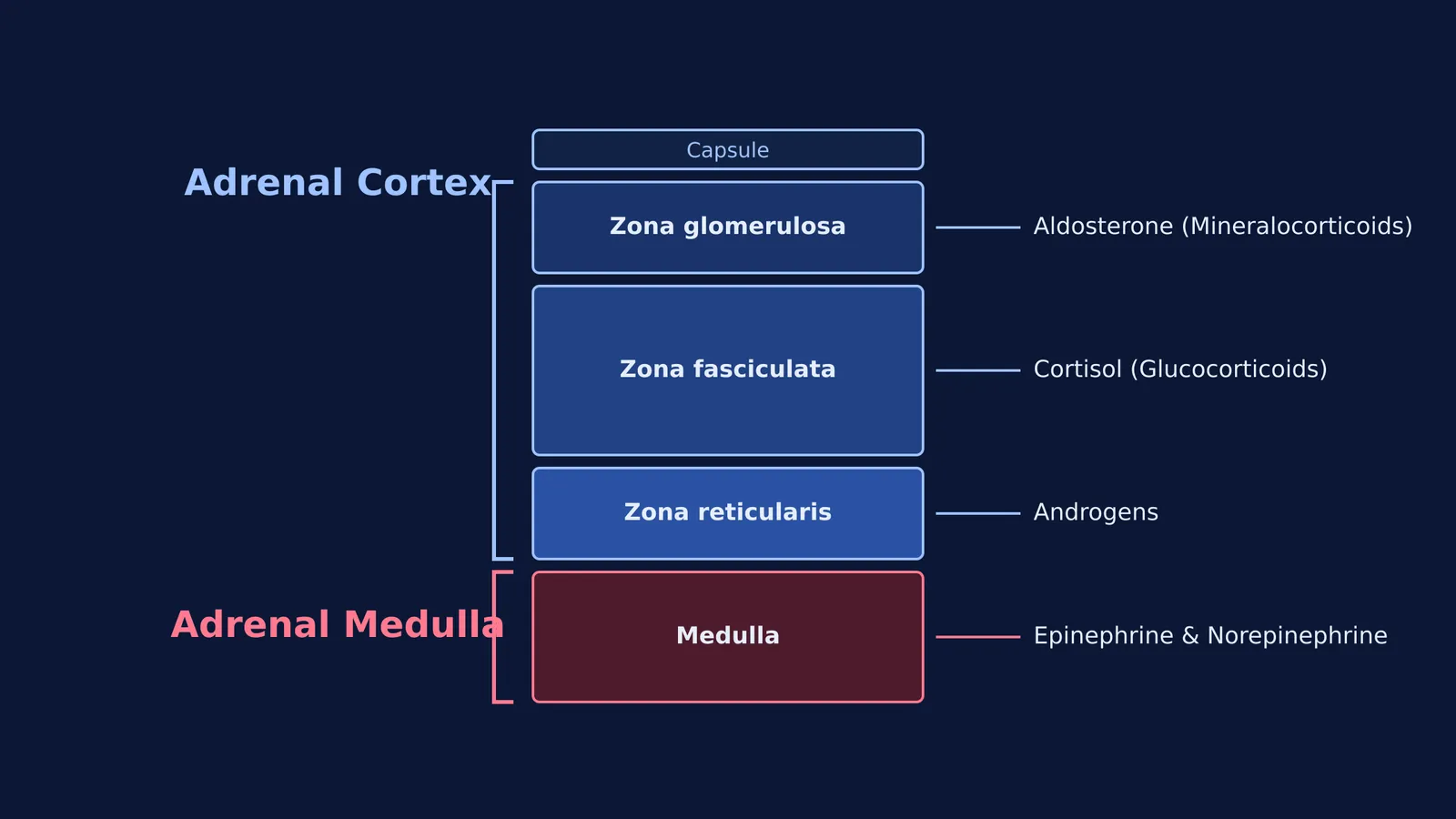
The outer layer, or the adrenal cortex, is the larger of the two tissues, making up the bulk of the gland's weight. It develops from mesodermal tissue and is divided into three distinct microscopic layers: the zona glomerulosa on the outside, the zona fasciculata in the middle, and the zona reticularis on the inside.
The cortex secretes steroid hormones collectively called corticoids, which are synthesised from cholesterol. Its primary jobs are managing long-term stress, metabolism, and electrolyte balance. These hormones fall into three major groups based on the layer that produces them:
Mineralocorticoids: The primary mineralocorticoid is aldosterone, secreted by the outermost layer, the zona glomerulosa. Aldosterone plays a crucial role in maintaining your blood pressure by directing the kidneys to reabsorb sodium and water while excreting potassium. This increases blood volume and, consequently, blood pressure.
Glucocorticoids: The main glucocorticoid is cortisol, produced in the thick middle layer, the zona fasciculata. Cortisol regulates carbohydrate metabolism by stimulating the breakdown of proteins and fats to raise blood glucose levels, ensuring the brain has a steady supply of fuel during prolonged stress. It also suppresses the immune system and reduces inflammation.
Androgenic corticoids: The innermost layer, the zona reticularis, secretes small amounts of sex hormones, primarily weak androgens. These contribute to the growth of axial, pubic, and facial hair during puberty in both males and females.
Because these are steroid hormones, they are lipid-soluble and act by entering cells and binding to intracellular receptors to alter gene expression. The production of glucocorticoids and androgens in the cortex is regulated hormonally by adrenocorticotropic hormone (ACTH) released from the anterior pituitary gland.
What does the adrenal medulla do?
Hidden inside the cortex lies the adrenal medulla. Unlike the cortex, the medulla forms from neural crest cells during embryonic development. This makes it essentially a modified sympathetic ganglion of the autonomic nervous system.
The medulla secretes amine hormones called catecholamines—primarily epinephrine (adrenaline) and norepinephrine (noradrenaline)—directly into the bloodstream.
The Emergency Response: When you face an immediate threat, these hormones trigger the classic fight-or-flight response.
The Effects: They rapidly prepare the body for physical exertion. They increase alertness, dilate your pupils to let in more light, raise your heart rate, and speed up respiration. To give your muscles immediate fuel, they also stimulate the rapid breakdown of glycogen into glucose in the liver. Furthermore, they redirect blood flow away from non-essential organs like the digestive tract and towards the skeletal muscles.
Crucially, the adrenal medulla does not wait for slow hormonal signals from the pituitary to tell it what to do. It receives direct electrical signals from preganglionic sympathetic nerve fibres, allowing it to dump its hormones into your blood in a fraction of a second.
How do the adrenal cortex vs medulla hormones differ?
The simplest way to remember the difference for exams is by comparing their response times, chemical nature, and control mechanisms.
Origin and Control: The cortex is glandular and slow, as it is directed by ACTH circulating in the blood. The medulla is neural and fast, as it is hardwired directly to sympathetic nerves.
Chemical Structure: Cortical hormones (corticoids) are steroids built from cholesterol rings. Medullary hormones (catecholamines) are amines synthesised from the amino acid tyrosine.
Pacing: The medulla handles the acute, immediate panic of a sudden fright (like swerving to avoid a car). The cortex handles the prolonged stress of a fasting state, a chronic illness, or the endurance needed for a multi-day exam period.
If you are trying to memorise how these layers connect to other organ systems, the Fermi Concept Library maps out every concept in physics, chemistry, biology, mathematics and computing, each with its own lesson and its place in the map.
A framework for exam questions
When tackling biology questions on the adrenal gland, you can use this decision checklist to pinpoint the right tissue and hormone:
Is the question about salt, sugar, or sex? Look to the cortex. Aldosterone manages salt (minerals), cortisol manages sugar (glucose), and androgens manage sex characteristics.
Does the question mention the RAAS? The Renin-Angiotensin-Aldosterone System works directly with the adrenal cortex to manage blood volume and pressure.
Is the scenario an emergency or a sudden fright? Look to the medulla and its catecholamines.
Is the hormone described as a steroid? The cortex makes steroids; the medulla does not.


