

On this page
This post works from Chapter 8, Cell: The Unit of Life, in the NCERT Class 11 Biology text (Reprint 2026-27); the NEET (UG) 2026 syllabus files the topic under Cell Structure and Function, Biology Unit 3. Slips here usually come from a word with two meanings, a part in the wrong layer, or a label stretched too far.
Here are eight such mix-ups, each with the NCERT section, a check and a habit. New to the chapter? Begin with our guide to preparing Cell: The Unit of Life for NEET; it covers basics such as Mycoplasma.
Which look-alike terms do students mix up?
"The basal body of a bacterial flagellum is the same centriole-like body a cilium grows from."
NCERT uses "basal body" twice, so the meanings blur. In 8.4.1, a bacterial flagellum is a thin extension from the cell wall whose three parts are filament, hook and basal body. In 8.5.8, cilia and eukaryotic flagella are membrane-covered outgrowths of the cell membrane that emerge from centriole-like basal bodies, and bacterial flagella are structurally different. Check: flagellum P extends from a cell wall; flagellum Q is an outgrowth of the cell membrane with a 9+2 core. Which one grows from a centriole-like basal body? (Q. In P, the basal body is just one of its three parts.) Habit: decide whose flagellum it is before you read the words "basal body".
"A bacterium with a capsule also has a slime layer: they are two separate coats."
Both names sound like extra wrappings, so students stack them. NCERT 8.4.1 gives them as two forms of one layer, the glycocalyx: a loose sheath (slime layer) in some bacteria, a thick, tough one (capsule) in others. Check: bacterium X wears a loose sheath and bacterium Y a thick, tough one. Which single envelope layer is each sheath? (The glycocalyx in both: a slime layer in X, a capsule in Y.) Habit: translate "slime layer" as "loose glycocalyx" and "capsule" as "tough glycocalyx".
"Mesosomes are a bacterium's mitochondria, and chromatophores are its chloroplasts."
The jobs sound alike: mesosomes help in respiration and chromatophores carry pigments (8.4.1). Neither is a separate organelle: NCERT 8.4 calls mesosomes infoldings of the cell membrane, 8.4.1 calls chromatophores membranous extensions into the cytoplasm in cyanobacteria, and 8.3 says prokaryotes lack membrane-bound organelles. Check: if you followed the membrane of a chromatophore in a cyanobacterium, which membrane would it lead back to? (The plasma membrane.) Habit: inside a prokaryote, read every internal membrane as "plasma membrane, folded inwards".
Where does each part actually sit?
"With no ER to sit on, a bacterium's ribosomes just float loose in the cytoplasm."
Ribosomes are taught as free or on rough ER, and bacteria have no ER. NCERT 8.4.2 places prokaryotic ribosomes in association with the plasma membrane. Check: a sketch shows a bacterium's ribosomes bunched around its DNA, none near the edge. What has it left them away from? (The plasma membrane.) Habit: for any ribosome, name what it sits on or in.
"Mitochondrial DNA lies on the cristae, and chloroplast DNA in the thylakoids."
Diagrams draw the folded membranes boldly, so students park everything on them. NCERT 8.5.4 places the mitochondrion's DNA, one circular molecule, in the matrix along with its 70S ribosomes; cristae are inner-membrane folds that add surface area. NCERT 8.5.5 puts chlorophyll in the thylakoids but the small circular DNA and the ribosomes in the stroma. Check: on a student's sketches, an arrow marked "circular DNA" points at a crista, and another at a granum. Where should each arrow point? (The matrix; the stroma.) Habit: in both organelles, file the DNA with the ribosomes, in the fluid compartment, never on a membrane.
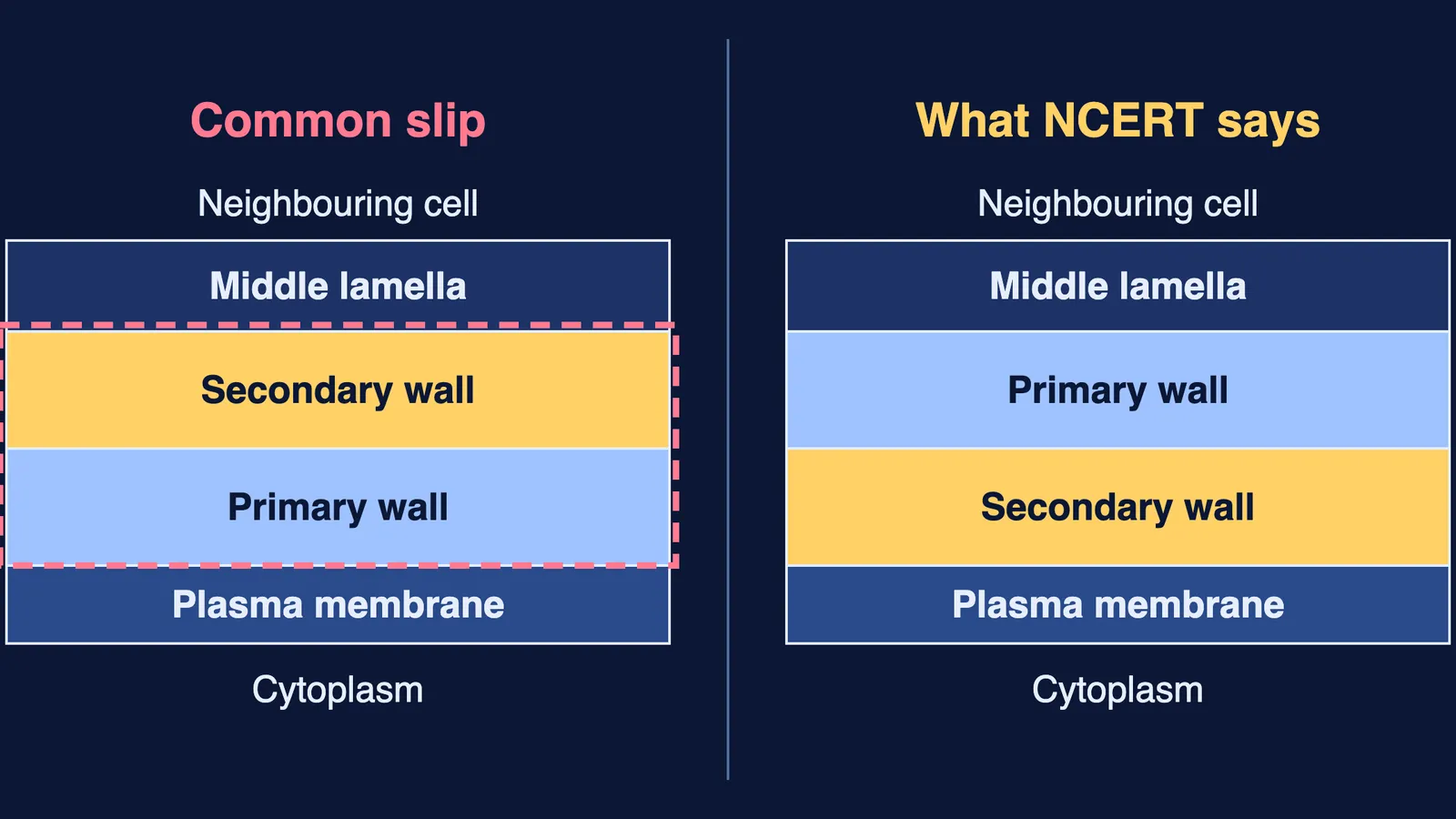
"The secondary wall is laid down outside the primary wall, because it comes second."
"Secondary" sounds like the next layer out. NCERT 8.5.2: the primary wall of a young cell can grow, an ability that fades with maturity, and the secondary wall then forms on its inner side, towards the membrane. The middle lamella, mainly calcium pectate, lies between neighbouring cells and holds them together. Check: list the layers from the boundary shared with the next cell inwards to the cytoplasm. (Middle lamella, primary wall, secondary wall, plasma membrane.) Habit: in a wall, "secondary" means formed later, and further in.
What does each label really mean?
"If a carrier protein is used, the transport is active."
Pumps are membrane proteins, so any membrane protein feels like a pump. NCERT 8.5.1 mentions the carrier before it reaches active transport: polar molecules cannot cross the nonpolar lipid bilayer, so a membrane carrier protein facilitates their crossing. Active transport has its own test: movement against the concentration gradient, lower to higher, with ATP spent; the Na+/K+ pump is NCERT's example. Check: two crossings both use a membrane protein. In one, ions go from lower to higher concentration and ATP is spent; in the other, a polar molecule goes from higher to lower and no ATP is spent. Which is active? (Only the first.) Habit: ask which way the substance moves and whether ATP is spent, not whether a protein helps.
"The contractile vacuole of Amoeba is where it digests its food."
Any protist vacuole gets labelled "food". NCERT 8.5.3.4 keeps them apart: in Amoeba the contractile vacuole handles osmoregulation and excretion, while food vacuoles form, as in many protists, by engulfing food particles. Check: an Amoeba closes a new vacuole around a particle it has just surrounded. Is that its contractile vacuole? (No, it is a food vacuole.) Habit: name a vacuole by how it forms or what it does, never by the word "vacuole" alone.
What should you check in 60 seconds before you mark?
Slime layer or capsule: is it still just the glycocalyx?
DNA or pigment: fluid compartment or membrane?
Which wall faces the plasma membrane?
What should you practise next?
Tomorrow, cover the answers and redo the eight checks, then try exam format with our Cell: The Unit of Life NCERT exceptions and odd-one-out set.
Not sure which slips are yours? Fermi's AI tutor works out what you already know and builds a plan for the session.


