

On this page
Every pKa table you meet in Class 11 puts carbonic acid at about 6.35, well below acetic acid at 4.76. The usual conclusion follows: carbonic acid is a very weak acid, about 40 times weaker than the acid in vinegar. That is correct for what is actually in a bottle of soda water. It is not correct for the H₂CO₃ molecule itself. In 2009 a group of chemists caught H₂CO₃ forming in water and measured its pKa as about 3.45. Both numbers are right, because they answer different questions. Here is why, how to connect them, and which one to use in an exam.
Why does the textbook give carbonic acid a pKa of 6.35?
When CO₂ dissolves in water, two equilibria are set up one after the other:
CO₂(aq) + H₂O ⇌ H₂CO₃ (hydration)
H₂CO₃ ⇌ H⁺ + HCO₃⁻ (ionisation)
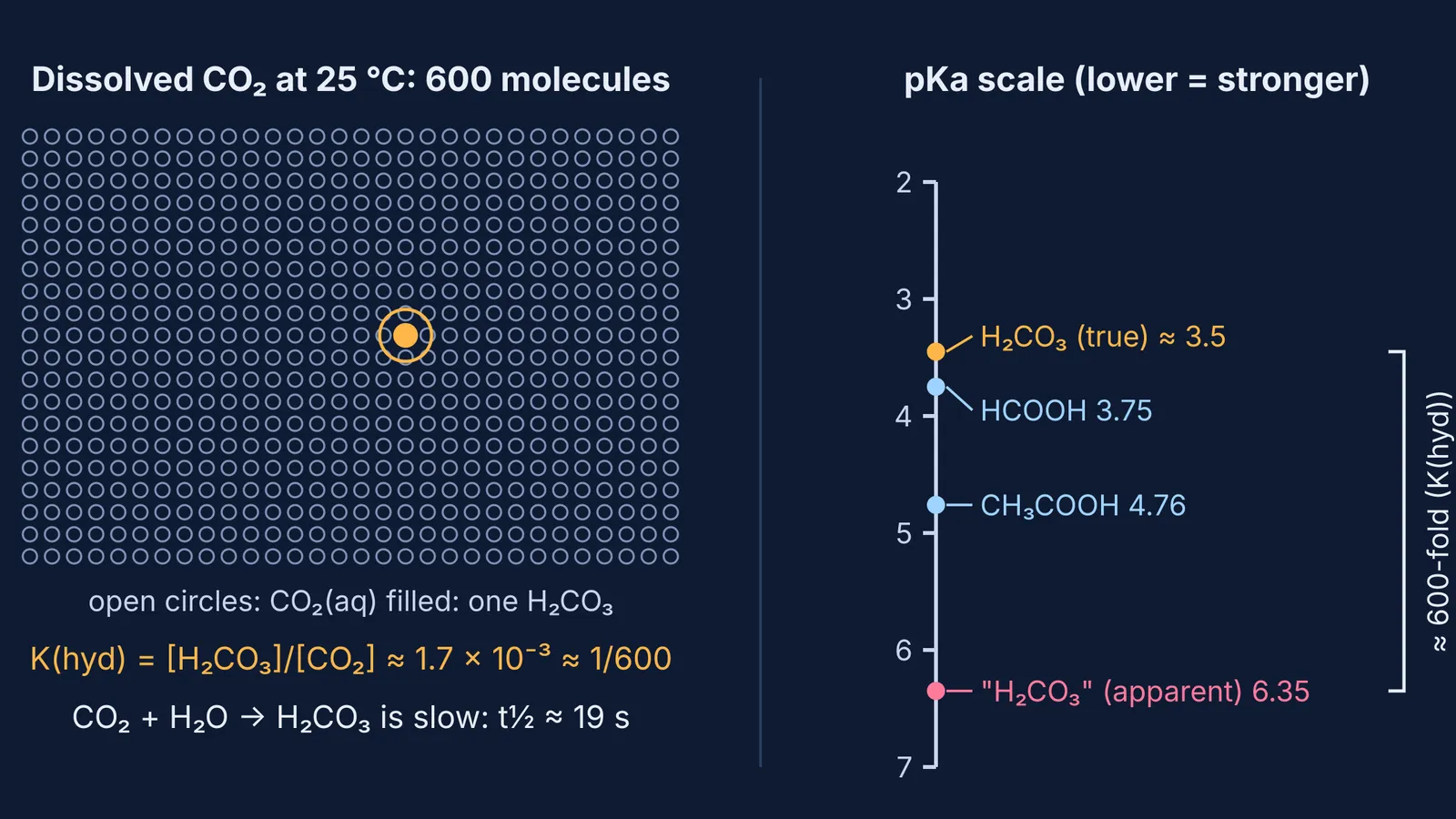
The first one lies far to the left. The ratio [H₂CO₃]/[CO₂(aq)] is called the hydration constant, K(hyd). The value usually quoted for pure water at 25 °C is about 1.7 × 10⁻³, or one H₂CO₃ molecule for every 600 or so CO₂ molecules. A careful study in salt solution found the ratio [CO₂]/[H₂CO₃] to be 848 at 25 °C (Soli and Byrne, Marine Chemistry, 200200010-5)), which is K(hyd) ≈ 1.2 × 10⁻³. Either way, almost all of the "carbonic acid" in soda water is plain dissolved CO₂.
In an ordinary experiment you cannot measure [H₂CO₃] apart from [CO₂(aq)]. So data tables lump the two together and define an apparent constant:
Ka(app) = [H⁺][HCO₃⁻] / ([CO₂(aq)] + [H₂CO₃]) ≈ 4.5 × 10⁻⁷, pKa ≈ 6.35
The denominator is mostly CO₂, which cannot give up a proton at all. Spreading the acid's effect over hundreds of non-acid molecules makes it look weak.
How strong is true carbonic acid?
Adamczyk and co-workers made H₂CO₃ directly. They used a laser pulse to trigger a "photoacid" that hands a proton to bicarbonate, and followed the H₂CO₃ that formed with infrared spectroscopy. From the speed of the proton transfer they found a pKa of 3.45 ± 0.15, which they describe as "substantially lower than the value of 6.35 that is commonly assumed" (Adamczyk et al., Science, 2009). A later study with a different photoacid and fluorescence timing gave 3.49 ± 0.05, and placed carbonic acid slightly stronger than lactic acid (Pines et al., J. Phys. Chem. B, 2016).
So true H₂CO₃ has a pKa of about 3.5. For comparison, acetic acid is 4.76 and formic acid is 3.75. Intact carbonic acid is roughly 15 to 20 times stronger than acetic acid, and a little stronger than formic acid.
How do the two constants fit together?
This is a neat exercise in combining equilibrium constants, and it shows the two values agree.
Write the true constant: Ka(true) = [H⁺][HCO₃⁻] / [H₂CO₃].
Use the hydration step: [H₂CO₃] = K(hyd) × [CO₂(aq)], so the total dissolved carbon dioxide is [CO₂(aq)] × (1 + K(hyd)).
Substitute into the apparent constant: Ka(app) = Ka(true) × K(hyd) / (1 + K(hyd)). Since K(hyd) is tiny, Ka(app) ≈ Ka(true) × K(hyd).
Put in numbers. Ka(app) = antilog(−6.35) = 4.47 × 10⁻⁷. With K(hyd) = 1.7 × 10⁻³: Ka(true) = 4.47 × 10⁻⁷ × 1.0017 / 1.7 × 10⁻³ = 2.6 × 10⁻⁴, so pKa ≈ 3.58.
With K(hyd) = 1.2 × 10⁻³ instead: Ka(true) = 3.7 × 10⁻⁴, pKa ≈ 3.43.
Compare with acetic acid (Ka = 1.8 × 10⁻⁵): 2.6 × 10⁻⁴ / 1.8 × 10⁻⁵ ≈ 14.
The laser value of 3.45 to 3.49 falls inside the 3.43 to 3.58 range. The old number and the new one describe the same chemistry; one just divides out the unhydrated CO₂.
Now a check on soda water. Take 0.10 M total dissolved CO₂ as a round figure.
[H⁺] = √(Ka(app) × C) = √(4.47 × 10⁻⁷ × 0.10) = 2.1 × 10⁻⁴ M, so pH ≈ 3.7.
Actual H₂CO₃ molecules present: 0.10 × 1.7 × 10⁻³ ≈ 1.7 × 10⁻⁴ M.
At any instant the solution holds more H⁺ ions (2.1 × 10⁻⁴ M) than intact H₂CO₃ molecules (1.7 × 10⁻⁴ M). That only works because the large pool of CO₂(aq) keeps topping up the H₂CO₃ as it ionises. The taste side of this is in why soda water tastes slightly sour.
Why does CO₂ turn into carbonic acid so slowly?
The ionisation step is almost instant, but hydration is not. Without a catalyst, the first-order rate constant for CO₂ + H₂O → H₂CO₃ at 25 °C is about 0.037 s⁻¹ (Gutknecht, Bisson and Tosteson, J. Gen. Physiol., 1977).
Half-life of hydration: t½ = 0.693 / 0.037 ≈ 19 s.
Since K(hyd) = kf / kb, the reverse (dehydration) rate constant is kb ≈ 0.037 / 1.7 × 10⁻³ ≈ 22 s⁻¹, a half-life of about 0.03 s. Measured dehydration constants vary between studies and conditions, so treat this as an order of magnitude.
Twenty seconds is far too slow for blood, which must load and unload CO₂ as it passes through tissues and lungs. That is why red blood cells carry the enzyme carbonic anhydrase; the buffer side is in how the bicarbonate buffer keeps blood pH at 7.4. The same slowness explains a lab puzzle: CO₂ from the air turns into acid over seconds, so the faint phenolphthalein pink at an end point fades gradually rather than vanishing at once.
Which pKa should you write in exams?
Use the textbook value, pKa₁ ≈ 6.35 (Ka₁ about 4.3 to 4.5 × 10⁻⁷ depending on the table). It is not wrong. It is the constant that governs a real solution of CO₂ in water, and that is what exam questions describe when they write "H₂CO₃". "Carbonic acid is weaker than acetic acid" is the expected answer, and it is true for the solution. It is why vinegar fizzes on baking soda:
CH₃COOH + HCO₃⁻ → CH₃COO⁻ + H₂O + CO₂
Use about 3.5 only if a question asks specifically about the intact H₂CO₃ molecule, which is rare outside olympiads. Also keep blood's pKa of 6.1 separate: it is measured at 37 °C in plasma, not in pure water at 25 °C.
If combining equilibrium constants still feels shaky, the Fermi Problem Library has worked problems with a step-by-step solver that explains the reasoning.
Quick checklist
K(hyd) = [H₂CO₃]/[CO₂(aq)] is about 1.2 to 1.7 × 10⁻³ at 25 °C.
Ka(app) ≈ Ka(true) × K(hyd); 6.35 is apparent, about 3.5 is true.
Measured true pKa: 3.45 (2009) and 3.49 (2016).
Hydration of CO₂ has a half-life of about 20 s without an enzyme.
In exams, use 6.35 and say carbonic acid is weaker than acetic acid.


