

On this page
If you have ever taken a sip of plain sparkling water, you might have noticed it does not taste exactly like regular tap water. Even without added lemon or sugar, carbonated water has a distinct "bite" or a slightly sour tang.
This is not your imagination, and it is a classic example of the chemistry of non-metal oxides taught in Class 10. The secret lies in what happens when gas meets water under pressure.
Why does soda water taste slightly sour?
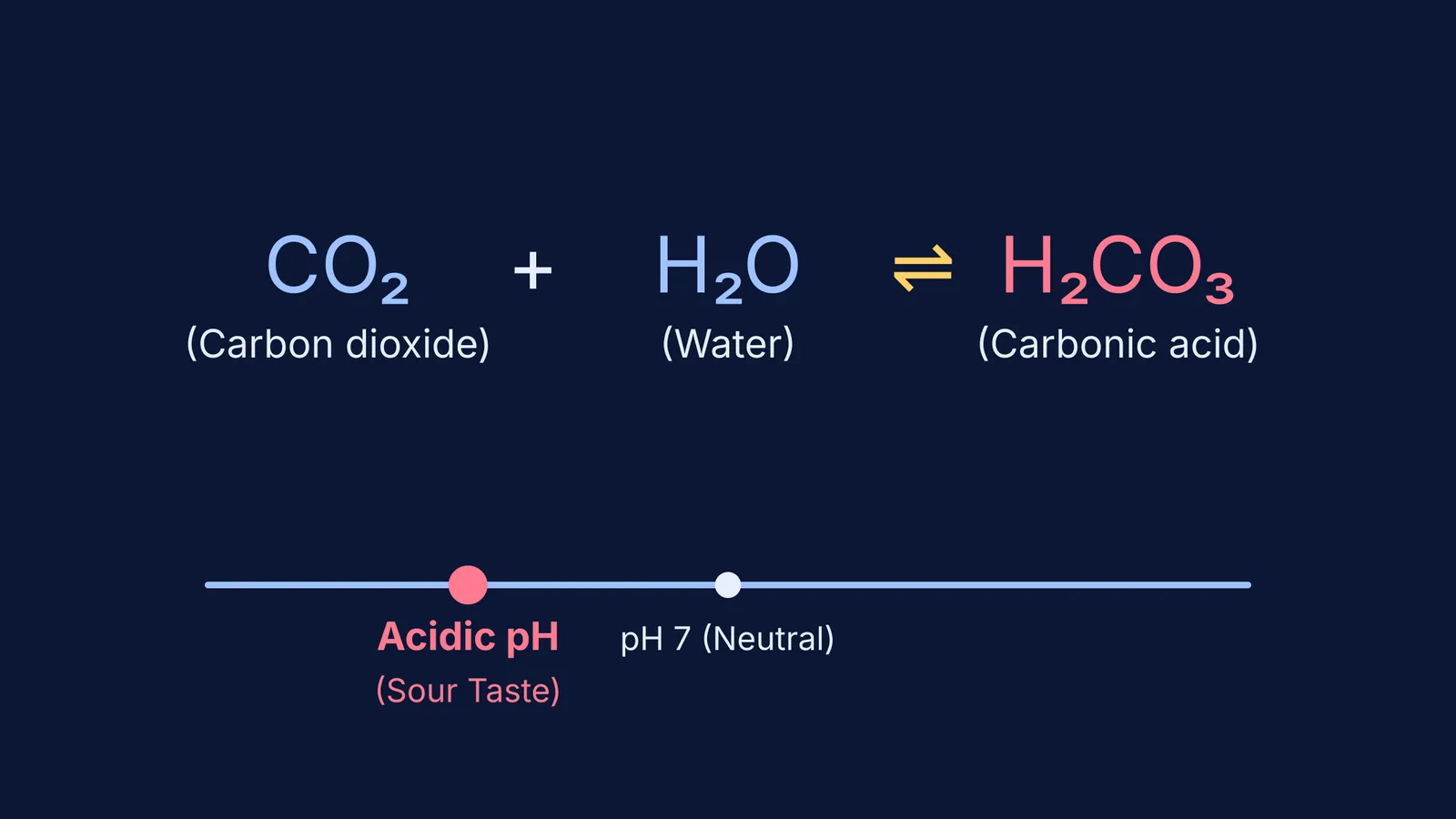
The sourness comes from a chemical reaction happening inside the bottle. When carbon dioxide (CO₂) is forced into water (H₂O) under high pressure to make it fizzy, a small amount of the gas reacts with the water molecules to form carbonic acid (H₂CO₃).
Carbonic acid is a weak acid, meaning it only partially breaks apart into hydrogen ions (H⁺) and bicarbonate ions (HCO₃⁻). However, it is strong enough to change the water's chemical properties. While pure tap water is neutral, plain sparkling water is acidic.
In biology, our tongues perceive acidity — the presence of those hydrogen ions (H⁺) — as a sour taste. The higher the concentration of hydrogen ions, the lower the pH, and the more sour the drink tastes to us. To see how concentration affects pH levels in weak acids like carbonic acid, you can explore what a pH simulation shows.
How do we taste the fizz?
The sour taste is not just a passive reaction to the acid in the glass. Our bodies have an active mechanism specifically designed to detect carbonation.
This means your tongue effectively manufactures its own sour signal the moment the gas touches your taste buds. This explains why even flat carbonated water still tastes slightly different from regular water — the chemical change has already occurred, leaving residual acid behind.
What Class 10 chemistry says about non-metal oxides
If you are studying for your board exams, this everyday observation is a perfect real-world test of a core concept in NCERT Class 10 Science, specifically in Chapter 2 (Acids, Bases and Salts) and Chapter 3 (Metals and Non-metals). It ties directly into how we classify acidic, basic and neutral salts.
The fundamental rule is: non-metal oxides are acidic in nature.
Carbon is a non-metal, making carbon dioxide a non-metal oxide. When you dissolve a non-metal oxide in water, it forms an acid. In a typical school lab experiment, if you burn sulphur (another non-metal) and dissolve the resulting sulphur dioxide (SO₂) gas in water, it forms sulphurous acid. You can prove this because the solution will turn blue litmus paper red.
The exact same chemistry happens in a soda factory when CO₂ is dissolved to make carbonic acid. Understanding these reactions on paper is one thing, but visualising the molecules helps you remember them without rote learning. If you want to see how gas molecules interact with water or how pH changes dynamically, the Fermi Simulation Lab lets you run these chemical reactions interactively, allowing you to test what happens when you alter the concentration of the gas.
Is the acid bad for your teeth?
With its raised acid level, you might wonder if drinking sparkling water is damaging to your teeth, much like drinking sugary sodas.
According to the American Dental Association, the carbonation process raises the acid level of any drink. Foods and beverages that are high in acids can wear away the enamel that protects your teeth over time. However, plain water is still a safer choice for your teeth than flavoured carbonated drinks.
Many brands add citrus flavours using citric acid, which increases the acidity further. This level of acidity is much closer to that of soft drinks or orange juice, making them more likely to erode enamel.
A quick test at home
You can prove the acidity of soda water yourself using a simple homemade indicator.
Pour some plain sparkling water into a clear glass.
Add a few drops of a natural pH indicator, such as red cabbage juice (which turns pink or red in the presence of acids and green or yellow in bases).
Compare the colour against a glass of still tap water mixed with the same indicator.
You will see the sparkling water show a clear acidic colour. If you leave the glass out overnight until the water goes completely flat, the CO₂ will escape back into the air. The carbonic acid will slowly dissociate back into water and gas, causing the pH to rise back towards neutral, and the sour taste will begin to fade.


