On this page
Carbon and its Compounds is Chapter 4 of the NCERT Class 10 Science textbook (reprint 2026-27). The CBSE Class 10 Science syllabus for 2026-27 lists its topics from covalent bonds to soaps and detergents, with ethanol and ethanoic acid limited to "only properties and uses". Below, the key terms follow the chapter in our own words. For the whole chapter, read our Carbon and its Compounds Class 10 guide.
How does carbon form bonds?
Covalent bond: a bond made when two atoms share a pair of electrons, so both reach a full outer shell. Example: the four C-H bonds in methane. Don't confuse with: an ionic bond, where electrons are transferred and ions form.
Single, double and triple bonds: one, two or three shared electron pairs between the same two atoms. Example: H2 (single), O2 (double), N2 (triple).
Electron dot structure: a drawing of only the valence electrons as dots or crosses, with shared pairs between atoms.
Tetravalency: carbon has four valence electrons, so it forms four bonds.
Covalent compounds: usually low melting and boiling points (weak forces between molecules) and poor conductors (no ions).
Allotropes: forms of the same element with different arrangements of atoms. Example: diamond (each carbon bonded to four others in a rigid 3D network) and graphite (each carbon bonded to three others in flat hexagonal layers).
Why does carbon form so many compounds?
Catenation: carbon's ability to bond to other carbon atoms in long chains, branches or rings. With tetravalency, it explains the millions of carbon compounds.
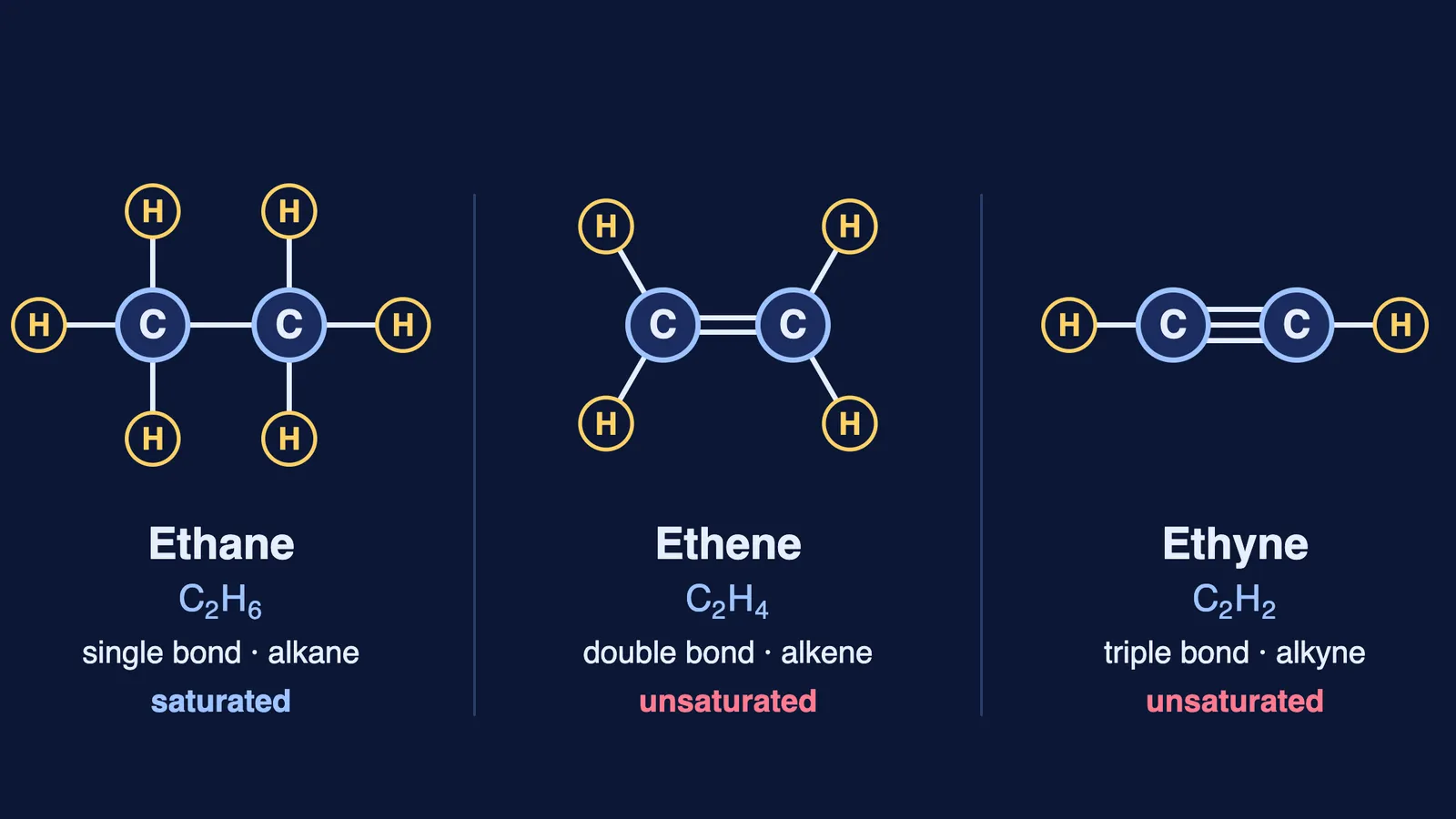
Saturated compound: carbon atoms joined only by single bonds. Example: ethane, C2H6.
Unsaturated compound: has at least one double or triple bond between carbon atoms; more reactive than saturated ones. Example: ethene, C2H4.
Hydrocarbon: a compound of carbon and hydrogen only.
Alkane, alkene, alkyne: saturated hydrocarbons; hydrocarbons with one or more double bonds; hydrocarbons with one or more triple bonds. General formulas: CnH2n+2, CnH2n and CnH2n-2.
Structural isomers: compounds with the same molecular formula but different structures. Example: C4H10 as a straight chain and as a branched chain. Don't confuse with: members of a homologous series, which have different formulas.
Cyclic compounds: carbon atoms joined in a ring. Example: cyclohexane, C6H12 (saturated), and benzene, C6H6 (unsaturated).
What are functional groups and homologous series?
Heteroatom: an atom other than carbon or hydrogen, such as chlorine or oxygen, that replaces hydrogen in a hydrocarbon chain.
Functional group: an atom or group of atoms that gives a compound its characteristic chemical properties, whatever the length of the chain. Examples: -OH (alcohol), -CHO (aldehyde), C=O within the chain (ketone), -COOH (carboxylic acid), -Cl or -Br (haloalkane).
Homologous series: a family of compounds with the same functional group, where each member differs from the next by a CH2 unit. Example: methanol, ethanol, propanol, butanol. Chemical properties stay similar; boiling points rise with mass.
Nomenclature: how compounds are named: a stem for the number of carbons (prop- for three) plus a prefix (chloro-, bromo-) or suffix (-ol, -al, -one, -oic acid, -ene, -yne). Example: propanone. Don't confuse propanal (aldehyde) with propanone (ketone).
Which reactions do carbon compounds undergo?
Combustion: a carbon compound burns in oxygen, giving carbon dioxide, water, heat and light. Saturated hydrocarbons usually burn cleanly; unsaturated ones give a yellow, sooty flame.
Incomplete combustion: burning with too little air, which leaves soot (carbon). Blackened cooking vessels mean blocked air holes.
Oxidation (of alcohols): adding oxygen to convert an alcohol into a carboxylic acid. Example: ethanol to ethanoic acid.
Oxidising agent: a substance that gives oxygen to another substance. Example: alkaline potassium permanganate, acidified potassium dichromate.
Addition reaction: an unsaturated compound adds atoms across its double or triple bond. Example: hydrogen adds to an alkene with a nickel or palladium catalyst.
Catalyst: a substance that speeds up a reaction, or lets it happen, without being used up itself.
Hydrogenation: adding hydrogen to vegetable oils, which have unsaturated chains, using a nickel catalyst. Don't confuse with: substitution, which swaps atoms instead of adding them.
Substitution reaction: one atom or group replaces another. Example: in sunlight, chlorine replaces a hydrogen in methane to give CH3Cl and HCl.
Ethanol, ethanoic acid, soaps and detergents
Figures here come from the NCERT chapter.
Absolute alcohol: pure ethanol.
Denatured alcohol: industrial ethanol made undrinkable with poisons such as methanol and dyed blue.
Dehydrating agent: a substance that removes water. Example: hot concentrated sulphuric acid turns ethanol into ethene.
Vinegar and glacial acetic acid: vinegar is a 5-8% solution of ethanoic (acetic) acid in water; pure ethanoic acid melts at 290 K, so it often freezes in cold weather, hence "glacial". Unlike HCl, it is a weak acid.
Esterification: a carboxylic acid reacts with an alcohol, with an acid catalyst, to give an ester. Esters usually smell sweet.
Saponification: an ester reacts with sodium hydroxide to give back an alcohol and the sodium salt of the acid; the reaction behind soap-making. Don't confuse with: esterification, which makes the ester.
Soap: the sodium or potassium salt of a long-chain carboxylic acid.
Hydrophilic and hydrophobic ends: a soap's ionic head is attracted to water (hydrophilic); its hydrocarbon tail avoids water and mixes with oil (hydrophobic).
Micelle: a cluster of soap molecules, tails inward around oily dirt and heads facing the water, so the dirt rinses away.
Detergent: a cleansing agent, usually a sodium salt of a sulphonic acid or an ammonium salt with chloride or bromide ions, that works in hard water because it forms no insoluble precipitate. Don't confuse with: soap, which forms insoluble scum with the calcium and magnesium salts in hard water.
How to learn these terms
Draw ethane, ethene and ethyne, then label each as saturated or unsaturated and as alkane, alkene or alkyne.
Write methanol to butanol in a column and circle the extra CH2 at each step.
Learn reactions as pairs: addition vs substitution, esterification vs saponification, complete vs incomplete combustion.
Draw a micelle and explain why soap fails in hard water.
Practise with our guides to naming carbon compounds and how soap micelles clean.
If a term still feels abstract, the Fermi Concept Library covers every concept in chemistry, each with its own lesson and its place in the map.