

On this page
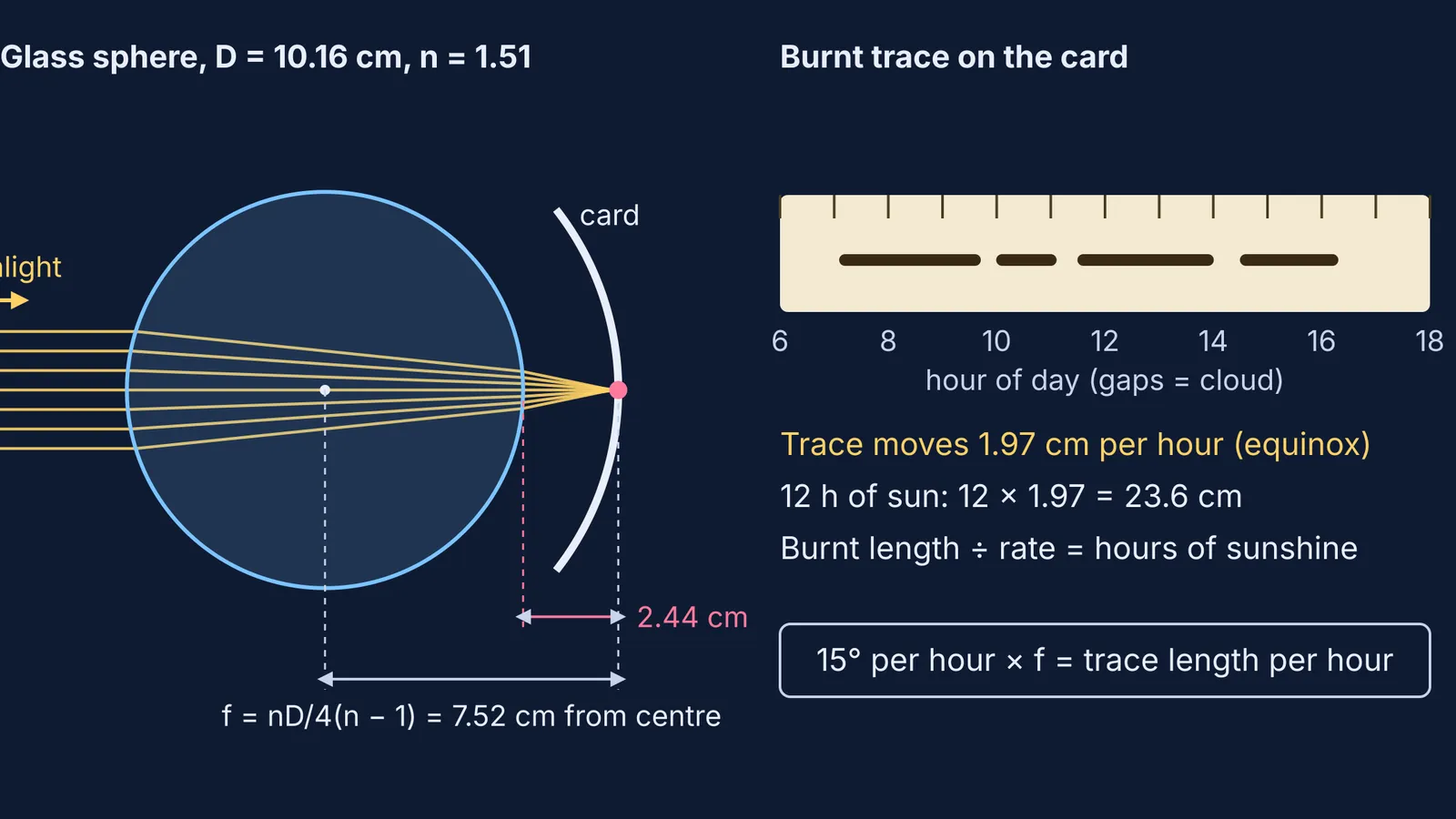
When a weather report says a city had 8.5 hours of sunshine, someone had to measure it. For over 100 years the standard instrument in many countries has been a solid glass ball about 10 cm across, set in a curved metal bowl that holds a strip of card. When the Sun shines, the ball focuses it to a spot hot enough to scorch the card. As the Earth turns, the spot moves and burns a line. Clouds break the line. At the end of the day, the length of the burnt trace is the number of hours of bright sunshine. This is the Campbell–Stokes sunshine recorder, and the physics behind it is one formula from ray optics and one number from the Earth's rotation.
How does a Campbell–Stokes sunshine recorder work?
The Japan Meteorological Agency's training notes on sunshine measurement describe it this way: a homogeneous glass sphere sits concentric with a metal bowl, the bowl has three partly overlapping grooves for cards used in summer, winter, and spring and autumn, and the burn on the card at the focal point marks the presence of sunshine at that time. The card is printed with an hour scale, so the observer reads off the burnt length.
Once it is levelled, lined up north–south and set for the station's latitude, it has no moving parts and needs no power.
Why use a glass ball instead of an ordinary lens?
A lens has one axis. To keep the Sun focused on a card, you would have to turn the lens to follow the Sun all day.
A sphere has no special axis. Any line through its centre is an axis of symmetry, so parallel light from any direction comes to a focus on the line through the centre, on the far side, at the same distance from the centre. As the Sun moves, the focus moves around the ball on a surface of fixed radius. Put a card on that surface and the focus stays sharp on it all day without anything moving.
How a sphere forms an image through its two curved surfaces is worked in refraction through a glass sphere. Here we only need the result for parallel light. For a sphere of diameter D and refractive index n, the focal length measured from the centre is
f = nD / 4(n − 1)
A road stud uses the same ball-lens result for a different job, sending headlight back to the driver, as explained in how Percy Shaw's cat's eyes bounce headlights back to you.
How far behind the ball is the card, and how fast does the burn move?
Here is a worked example. Take a sphere 10.16 cm (4 inches) across with n = 1.51. Treat this as a typical crown glass value, not a measured one.
Focal length from the centre. f = nD / 4(n − 1) = (1.51 × 10.16) / (4 × 0.51) = 15.34 / 2.04 = 7.52 cm.
Gap between glass and card. The radius is 10.16 / 2 = 5.08 cm, so the card sits 7.52 − 5.08 = 2.44 cm behind the back surface of the ball.
Check against a real instrument. Horseman and colleagues (2013) give the UK Met Office standard recorder as a glass sphere of 101.6 mm nominal diameter with a focal length of 74.9 mm. Our 75.2 mm is within half a percent. Working backwards, 74.9 mm needs n = 4f / (4f − D) = 1.513.
How fast the Sun moves. The Earth turns 360° in 24 hours, so the Sun moves 15° per hour around the sky. In radians, 15° = 0.2618 rad.
How fast the spot moves at the equinoxes. The focus is always 7.52 cm from the centre, on the line through the centre opposite the Sun. Arc length = radius × angle, so the spot moves 7.52 × 0.2618 = 1.97 cm per hour.
A full day. Twelve hours of unbroken sunshine at the equinox burn a trace 12 × 1.97 = 23.6 cm long.
At the solstices. The Sun's path is then a small circle 23.44° from the celestial equator, so the spot moves on a circle of radius f cos 23.44°. The rate is 1.97 × 0.917 = 1.81 cm per hour. That is one reason the summer and winter cards have their own shapes and scales.
Units: cm × radians per hour gives cm per hour, as it should.
Why does the spot burn the card?
The Sun is not a point. It covers about 0.53° of sky, so its image at the focus is a small disc of diameter f × θ, with θ in radians.
θ = 0.53° = 0.00925 rad.
Spot diameter = 75.2 mm × 0.00925 = 0.70 mm.
The ball collects light over a disc 101.6 mm across. If all of it landed in the 0.70 mm spot, the concentration by area would be (101.6 / 0.70)², about 21,000 times.
That figure is an upper limit. A ball lens has strong spherical aberration: rays that enter near its edge focus closer to the glass than rays near the centre, so the real spot is wider and the concentration is up to that value, never more. Some light is also reflected at the two surfaces. Even a concentration far below the ideal is enough to char card.
Does the burn length match the official definition of sunshine?
Only roughly. The World Meteorological Organization defines sunshine duration as the time during which the direct solar irradiance exceeds 120 W/m², as the JMA notes linked above state. Horseman and colleagues note that WMO gives 120 W/m² as a nominal threshold for the card to start charring. But card does not switch on and off at an exact irradiance, and a burn tends to spread across short gaps between clouds. The UK Met Office says this method significantly overestimates sunshine duration on days when passing clouds often shade the Sun. That is why many automatic stations now use electronic sunshine sensors with a set 120 W/m² threshold, while the glass ball stays in use at many non-automated stations.
India has used the instrument too. In a 2005 report on its radiation network_India_Vashistha.pdf), the India Meteorological Department listed the Campbell–Stokes recorder as its instrument for the duration of sunshine. Telling time from the Sun's steady 15° per hour is old in India: how the Konark wheel tells time shows a shadow version of the same idea.
If you want to practise ball-lens and thick-lens problems with every step shown, the Fermi Problem Library has a step-by-step solver that explains the reasoning.
Quick checklist
A glass sphere focuses parallel light from any direction, so it needs no tracking.
Focal length from the centre: f = nD / 4(n − 1). Subtract the radius to get the gap behind the glass.
For D = 10.16 cm and n = 1.51: f = 7.52 cm, card 2.44 cm behind the glass.
The spot moves f × 15° per hour (in radians): 1.97 cm per hour at the equinox, f cos δ × 15° at declination δ.
Spot size = f × 0.53° in radians, about 0.70 mm; ideal concentration up to about 21,000 times.
The burn only roughly matches WMO's 120 W/m² definition, so electronic sensors are taking over at automatic stations.


