

On this page
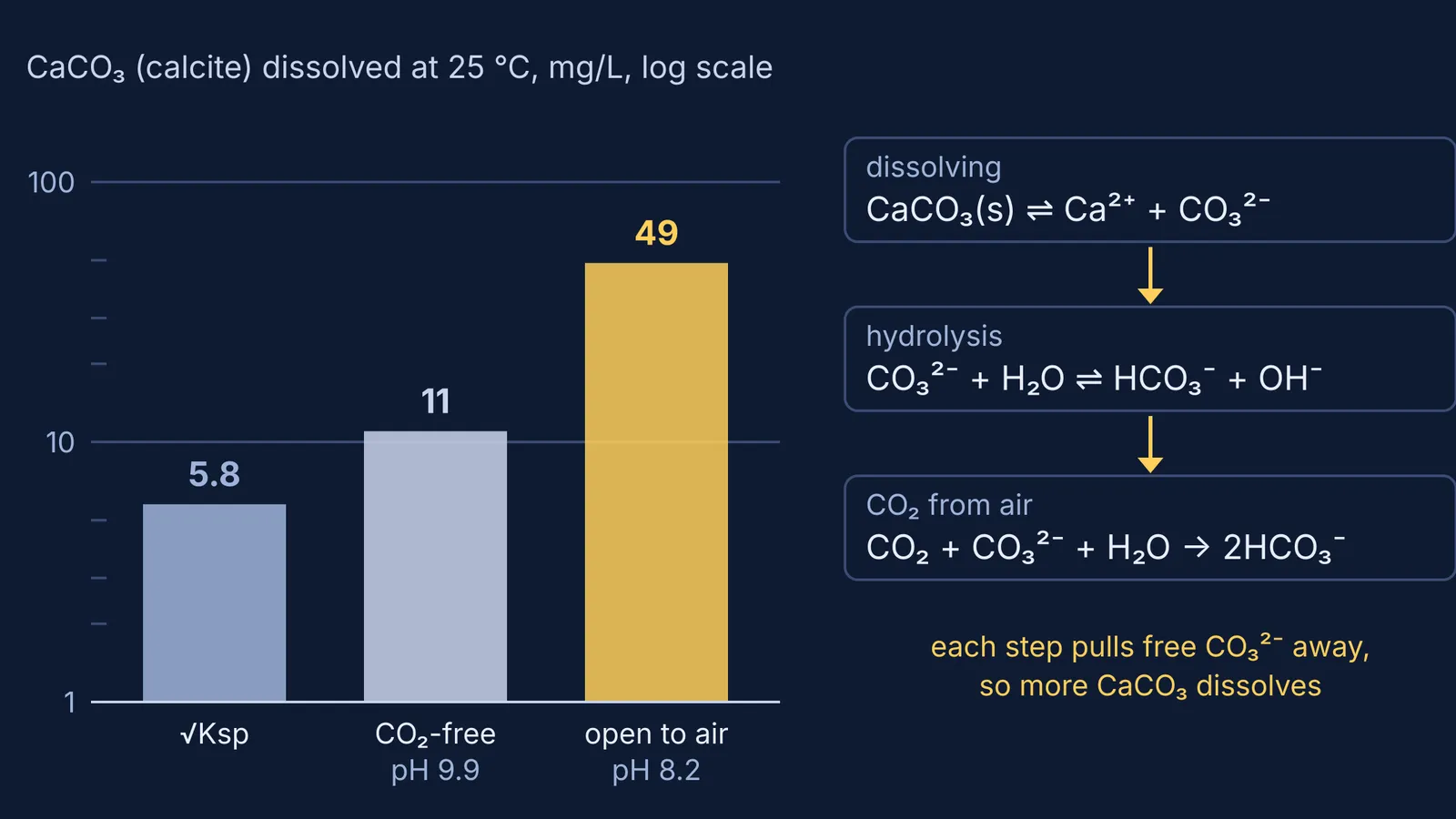
Ask how much calcium carbonate dissolves in water and the textbook route is quick: CaCO₃ is a 1:1 salt, so its molar solubility is s = √Ksp. That formula assumes the dissolved ions stay exactly as they are. Carbonate does not. It is the conjugate base of a weak acid, so it grabs protons from water, and every carbonate ion it removes lets a little more solid dissolve. In pure water at 25 °C this roughly doubles the solubility; in water open to air it raises it more than eightfold. This post works through both numbers and tells you when to use which answer in an exam.
Why is s = √Ksp not the full answer for CaCO₃?
For a 1:1 salt MX, Ksp = [M⁺][X⁻] and, if one mole of each ion forms per mole dissolved, s² = Ksp. Our post on Ksp, the common ion effect and precipitation uses exactly this for BaSO₄, and it works there because sulphate is a very weak base.
Carbonate is a much stronger base. In water it sets up a second equilibrium:
CO₃²⁻ + H₂O ⇌ HCO₃⁻ + OH⁻
Its base constant is Kb = Kw/Ka₂. With Ka₂ of carbonic acid = 4.69 × 10⁻¹¹, Kb = 1.0 × 10⁻¹⁴ / 4.69 × 10⁻¹¹ = 2.1 × 10⁻⁴. That is the same Ka₂-not-Ka₁ logic as in our post on the pH of washing soda. Ksp contains only the free CO₃²⁻ concentration. Hydrolysis keeps that free concentration low, so Ca²⁺ can rise higher before the product [Ca²⁺][CO₃²⁻] reaches Ksp.
Which constants should you use?
Tables give slightly different values for CaCO₃, so take all of them from one source. We use the 25 °C values of Plummer and Busenberg's study of calcite, aragonite and vaterite in CO₂–water solutions (Geochim. Cosmochim. Acta 46, 1011, 1982):
Ksp (calcite) = 10⁻⁸·⁴⁸ = 3.31 × 10⁻⁹
Ka₁ = 4.45 × 10⁻⁷ and Ka₂ = 4.69 × 10⁻¹¹ for carbonic acid
Henry's law constant for CO₂, K_H = 0.034 mol L⁻¹ atm⁻¹
Calcite is the common form of chalk, limestone and marble. Aragonite, the form in many shells, has a larger Ksp (10⁻⁸·³⁴ in the same study), so it is a little more soluble. We ignore activity coefficients, which at these low concentrations changes the answers by only a few per cent, so treat every result as approximate.
Worked example: how much calcite dissolves at 25 °C?
(a) The textbook answer. s = √(3.31 × 10⁻⁹) = 5.76 × 10⁻⁵ mol/L. With M(CaCO₃) = 100.1 g/mol, that is 5.8 mg/L.
(b) Pure water with no CO₂. Now let some carbonate turn into HCO₃⁻. Every CaCO₃ that dissolves gives one Ca²⁺ and one carbonate unit, so [Ca²⁺] = s = [CO₃²⁻] + [HCO₃⁻] + [H₂CO₃]. Let α₂ be the fraction of that dissolved carbonate still present as free CO₃²⁻. It depends only on [H⁺]: α₂ = Ka₁Ka₂ / ([H⁺]² + Ka₁[H⁺] + Ka₁Ka₂).
Then Ksp = s × α₂s, so s = √(Ksp/α₂). The pH is not known in advance, so guess it and check the charge balance, 2[Ca²⁺] + [H⁺] = [HCO₃⁻] + 2[CO₃²⁻] + [OH⁻]:
Try pH 9.5: α₂ = 0.129, s = 1.60 × 10⁻⁴ M. Positive charge exceeds negative charge, so the true pH is higher.
Try pH 10.0: α₂ = 0.319, s = 1.02 × 10⁻⁴ M. Now negative charge is in excess, so the true pH is lower.
Try pH 9.9: α₂ = 0.271, s = 1.10 × 10⁻⁴ M. The two sides match to within 1%.
So s ≈ 1.1 × 10⁻⁴ mol/L, or 11 mg/L, at a pH of about 9.9. That is 1.9 times √Ksp. Only about 27% of the dissolved carbonate is still CO₃²⁻; about 73% has become HCO₃⁻.
A quick estimate gets close. If you assume nearly all the carbonate is hydrolysed, [HCO₃⁻] ≈ [OH⁻] ≈ s and [CO₃²⁻] = Ksp/s. Putting these into Kb = [HCO₃⁻][OH⁻]/[CO₃²⁻] gives Kb = s³/Ksp, so s ≈ (Ksp × Kb)^(1/3) = (3.31 × 10⁻⁹ × 2.13 × 10⁻⁴)^(1/3) = 8.9 × 10⁻⁵ M. That is within about 20% of the full answer.
(c) Water open to air. Air now holds about 420 ppm of CO₂ (NOAA Global Monitoring Laboratory), so p(CO₂) ≈ 4.2 × 10⁻⁴ atm. Dissolved CO₂ reacts with carbonate, and the overall reaction is:
CaCO₃(s) + CO₂(aq) + H₂O ⇌ Ca²⁺ + 2HCO₃⁻
Add up the steps (dissolving, reversing the Ka₂ step, and the Ka₁ step) and K = Ksp × Ka₁/Ka₂ = 3.31 × 10⁻⁹ × 4.45 × 10⁻⁷ / 4.69 × 10⁻¹¹ = 3.14 × 10⁻⁵. Dissolved CO₂ is fixed by Henry's law: [CO₂] = 0.034 × 4.2 × 10⁻⁴ = 1.43 × 10⁻⁵ M. With [Ca²⁺] = s and [HCO₃⁻] = 2s, 4s³ = K × [CO₂] = 4.49 × 10⁻¹⁰, so s = 4.8 × 10⁻⁴ mol/L. Then [H⁺] = Ka₁[CO₂]/[HCO₃⁻] gives pH ≈ 8.2. Solving the full charge balance gives the same pH and s = 4.9 × 10⁻⁴ mol/L, or 49 mg/L. That is about 8.5 times √Ksp.
Two refinements push these numbers higher. Ca²⁺ and carbonate also form dissolved ion pairs, CaCO₃(aq) and CaHCO₃⁺, which Plummer and Busenberg measured in the same study, and activity coefficients are a little below 1. Including both, our calculation gives about 12 mg/L for (b) and about 54 mg/L for (c). The textbook answer of 5.8 mg/L stays too low by a factor of 2 to 9.
If you want more problems where a second equilibrium changes a Ksp answer, the Fermi Problem Library has a step-by-step solver that explains the reasoning, so you can see where the extra equilibrium enters.
How is this different from dissolving CaCO₃ in acid?
Our post on why salts of weak acids dissolve more in acid adds an acid and fixes the pH from outside. Here nothing is added in (b): the salt sets its own pH by making the water alkaline, and still dissolves about twice as much as √Ksp. In (c) the acid is the CO₂ in air, which is why the result depends on the CO₂ pressure (s rises as the cube root of p(CO₂)). The same idea applies to phosphates, fluorides and oxalates. Avoid it for metal sulphides: the second acid constant of H₂S is disputed by several powers of ten, so sulphide numbers are unreliable.
Why does this matter for limestone caves and hard water?
The 49 mg/L in (c) is the number behind limestone weathering. Rain and soil water carry more CO₂ than open air, so they dissolve even more calcite as Ca²⁺ and HCO₃⁻. When that water drips into a cave and loses CO₂, the overall reaction runs backwards and calcite deposits, as our post on how stalactites form explains in words. The same Ca(HCO₃)₂ in solution is what chemists call temporary hardness.
For exam practice on Ksp with the ionic equilibrium chapter, Fermi Test Prep covers JEE Main and Advanced preparation with an AI tutor.
Quick checklist
s = √Ksp assumes neither ion reacts with water.
Carbonate hydrolyses (Kb = Kw/Ka₂ ≈ 2.1 × 10⁻⁴), so free CO₃²⁻ falls and more CaCO₃ dissolves.
Calcite at 25 °C: 5.8 mg/L from √Ksp, about 11 mg/L in CO₂-free water (pH 9.9), about 49 mg/L in water open to air (pH 8.2).
Quick estimates: s ≈ (Ksp × Kb)^(1/3) without CO₂; 4s³ = (Ksp Ka₁/Ka₂)[CO₂] with CO₂.
In exams, use √Ksp unless the question gives Ka, pH or CO₂ data.


