

On this page
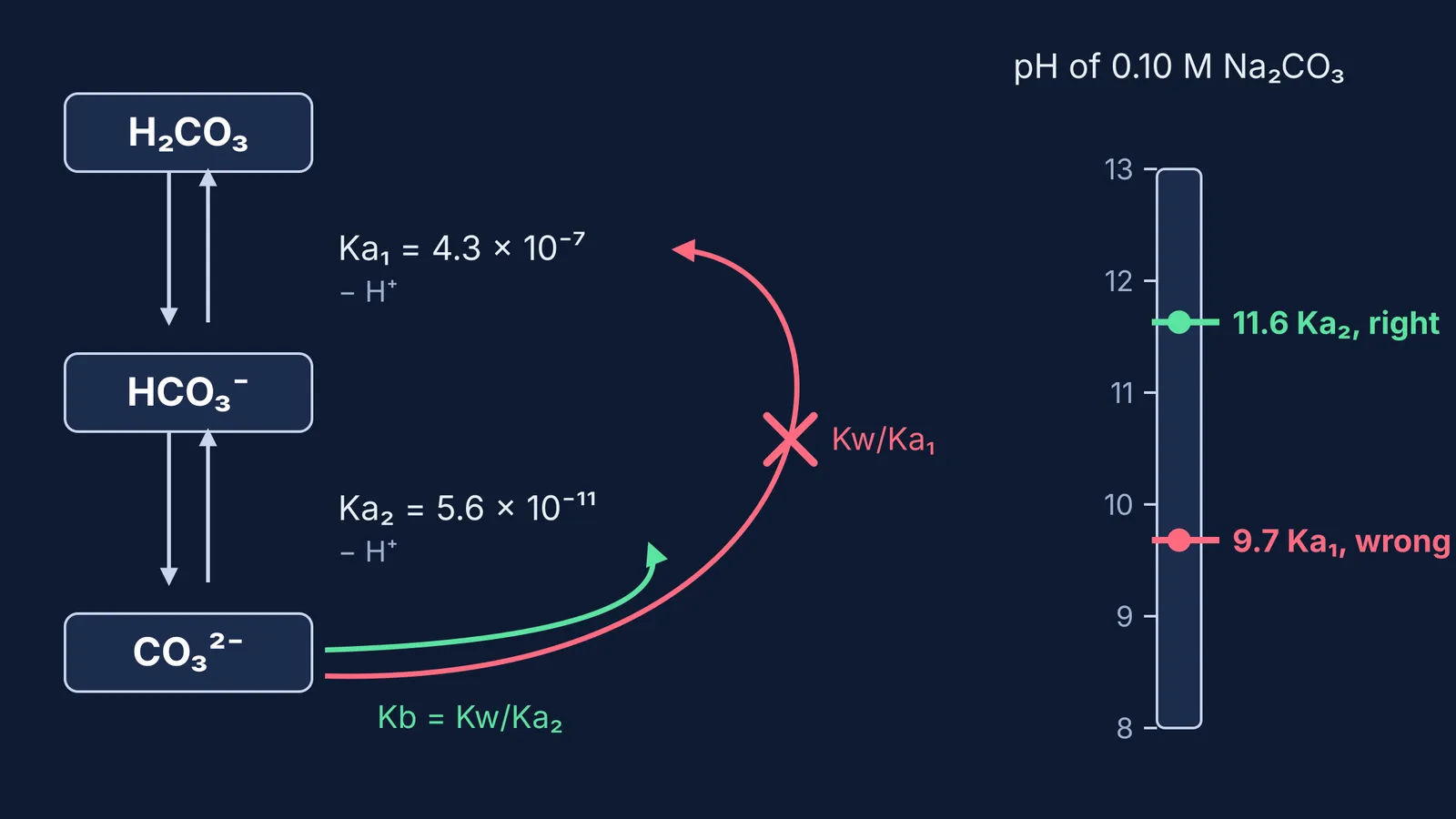
Washing soda is sodium carbonate, sold as the crystals Na₂CO₃·10H₂O. Its solution is strongly alkaline: a 0.10 M solution has a pH of about 11.6. Yet many students get 9.7 for this question, because they divide Kw by the wrong Ka. This post shows which Ka to use for carbonate and any other fully deprotonated anion, why, and what to do when the square-root shortcut breaks.
Why is sodium carbonate solution basic?
Na⁺ comes from the strong base NaOH and does nothing to the pH. The carbonate ion takes H⁺ from water:
CO₃²⁻ + H₂O ⇌ HCO₃⁻ + OH⁻
The OH⁻ released makes the solution basic. For a monoprotic parent such as acetic acid you would write Kh = Kw/Ka and move on, as in how to find the pH of a salt solution from Ka and Kb. Carbonic acid has two Ka values, so you first have to decide which one belongs to this reaction.
Which Ka do you use for carbonate, Ka₁ or Ka₂?
Write the two steps of carbonic acid with the NCERT Class 11 values (other tables give Ka₂ ≈ 4.7 × 10⁻¹¹):
H₂CO₃ ⇌ H⁺ + HCO₃⁻, Ka₁ = 4.3 × 10⁻⁷
HCO₃⁻ ⇌ H⁺ + CO₃²⁻, Ka₂ = 5.6 × 10⁻¹¹
The relation Ka × Kb = Kw holds only for a conjugate pair: two species that differ by exactly one H⁺. When CO₃²⁻ acts as a base it becomes HCO₃⁻. So its conjugate acid is HCO₃⁻, and the Ka of HCO₃⁻ is Ka₂.
You can check this by multiplying the two expressions:
Kb₁ = [HCO₃⁻][OH⁻]/[CO₃²⁻]
Ka₂ = [H⁺][CO₃²⁻]/[HCO₃⁻]
Kb₁ × Ka₂ = [H⁺][OH⁻] = Kw
Try the same with Ka₁ and nothing cancels, because Ka₁ contains H₂CO₃, which is not in the base reaction at all.
The general rule is to count back from the fully deprotonated ion. Its first base step pairs with the last Ka, the second base step with the one before, and so on:
Carbonate: Kb₁ = Kw/Ka₂, Kb₂ = Kw/Ka₁
Phosphate: Kb₁ = Kw/Ka₃, Kb₂ = Kw/Ka₂, Kb₃ = Kw/Ka₁
How do you calculate the pH of 0.10 M Na₂CO₃?
Kb for the first step. Kb₁ = 1.0 × 10⁻¹⁴ / 5.6 × 10⁻¹¹ = 1.8 × 10⁻⁴.
Set up. Let x mol/L of CO₃²⁻ react. Then [HCO₃⁻] = [OH⁻] = x and [CO₃²⁻] = 0.10 − x, so x²/(0.10 − x) = 1.8 × 10⁻⁴.
Shortcut. Assume x is small next to 0.10: x² = 1.8 × 10⁻⁵, so x = [OH⁻] = 4.2 × 10⁻³ M.
Check the 5% rule. 4.2 × 10⁻³ / 0.10 = 4.2%. That is under 5%, so the shortcut is acceptable. The quadratic gives 4.1 × 10⁻³ M, which changes the pH by only 0.01.
pH. pOH = −log(4.2 × 10⁻³) = 2.37, so pH = 14.00 − 2.37 = 11.63, about 11.6.
Second step. HCO₃⁻ + H₂O ⇌ H₂CO₃ + OH⁻ has Kb₂ = Kw/Ka₁ = 2.3 × 10⁻⁸. Since [HCO₃⁻] ≈ [OH⁻], the expression gives [H₂CO₃] ≈ Kb₂ = 2.3 × 10⁻⁸ M. That adds about 2 × 10⁻⁸ M of OH⁻ to the 4.2 × 10⁻³ M already there, so you can ignore it. Kb₁ is about 7700 times larger than Kb₂.
If your table uses Ka₂ = 4.7 × 10⁻¹¹, Kb₁ becomes 2.1 × 10⁻⁴ and the pH 11.66. The data source moves the answer by 0.04. Choosing the wrong Ka moves it by 2.
What goes wrong if you use Ka₁?
With Ka₁: Kb = 1.0 × 10⁻¹⁴ / 4.3 × 10⁻⁷ = 2.3 × 10⁻⁸. Then [OH⁻] = √(2.3 × 10⁻⁹) = 4.8 × 10⁻⁵ M, pOH = 4.32 and pH = 9.68.
That is about two units too low, and [OH⁻] is roughly 90 times too small. The mistake survives because 9.7 still looks like a sensible pH for a basic salt, so nothing warns you.
The number Kw/Ka₁ is real, but it belongs to a different ion. It is the base constant of HCO₃⁻, which is why baking soda is a much weaker base than washing soda. Do not use √(Kb·C) for NaHCO₃ either: HCO₃⁻ is amphiprotic, and its pH is ½(pKa₁ + pKa₂), about 8.3, as worked out in why the pH of sodium bicarbonate is ½(pKa₁ + pKa₂).
How do you find the pH of 0.10 M Na₃PO₄?
Phosphate is the fully deprotonated ion of a triprotic acid, so count back three steps:
PO₄³⁻ + H₂O ⇌ HPO₄²⁻ + OH⁻
Ka₃ of H₃PO₄ is about 4.5 × 10⁻¹³; tables range from about 4.2 to 4.8 × 10⁻¹³.
Kb. Kb₁ = 1.0 × 10⁻¹⁴ / 4.5 × 10⁻¹³ = 0.022. That is a large Kb, which is why PO₄³⁻ counts as a strong base in titrating phosphoric acid with NaOH.
Try the shortcut. x = √(0.022 × 0.10) = 0.047 M. That is 47% of 0.10, far over 5%. The shortcut fails.
Solve the quadratic. x²/(0.10 − x) = 0.022 rearranges to x² + 0.022x − 0.0022 = 0. So x = [−0.022 + √(0.022² + 4 × 0.0022)]/2 = (−0.022 + 0.096)/2 = 0.037 M.
pH. pOH = −log(0.037) = 1.43, so pH = 12.57.
Compare. The shortcut would give pH 12.67, 0.10 too high. About 37% of the phosphate is converted to HPO₄²⁻, so you cannot treat 0.10 − x as 0.10.
Second step. Kb₂ = Kw/Ka₂, with Ka₂ ≈ 6.2 × 10⁻⁸, is about 1.6 × 10⁻⁷. Next to 0.037 M OH⁻ this is negligible.
At 0.10 M the ions do not behave ideally, so a measured pH can differ a little from these values. Exam answers use concentrations, as here.
If you want more polyprotic salt problems with each step explained, the Fermi Problem Library has a step-by-step solver that explains the reasoning.
Quick checklist
For a fully deprotonated anion, count back: the first Kb uses the last Ka.
Na₂CO₃: Kb₁ = Kw/Ka₂ = 1.8 × 10⁻⁴, pH of 0.10 M ≈ 11.6.
Using Ka₁ gives 9.7, about two units too low.
Ignore the second hydrolysis step; its Kb is thousands of times smaller.
Check the 5% rule. It passes for 0.10 M Na₂CO₃ and fails for 0.10 M Na₃PO₄ (pH ≈ 12.57 by the quadratic).
NaHCO₃ is amphiprotic: pH ≈ ½(pKa₁ + pKa₂), not √(Kb·C).


