

On this page
A stalactite looks like a stone icicle, but it is really chemistry run backwards. The same reaction that hollows out a limestone cave also builds the spikes hanging from its roof. Learn which way it runs, and why, and you also have a ready example of a reversible reaction for your exam.
What is a stalactite made of?
Stalactites are usually made of calcite, a form of calcium carbonate (CaCO₃), according to the US National Park Service guide to speleothems. The word stalactite is Greek for “oozing out in drops”, the same page notes. Stalactites hang from the ceiling; stalagmites rise from the floor where the drops land.
How do stalactites form in limestone caves?
Follow one drop, in order.
Rain soaks through soil and picks up carbon dioxide from organic material, which makes weak carbonic acid (NPS, Ozark National Scenic Riverways).
That slightly acidic water seeps through cracks in limestone and dissolves some of it: CaCO₃(s) + CO₂(g) + H₂O(l) → Ca(HCO₃)₂(aq), as set out by New Zealand's Science Learning Hub. The calcium hydrogen carbonate stays dissolved as Ca²⁺ and HCO₃⁻ ions.
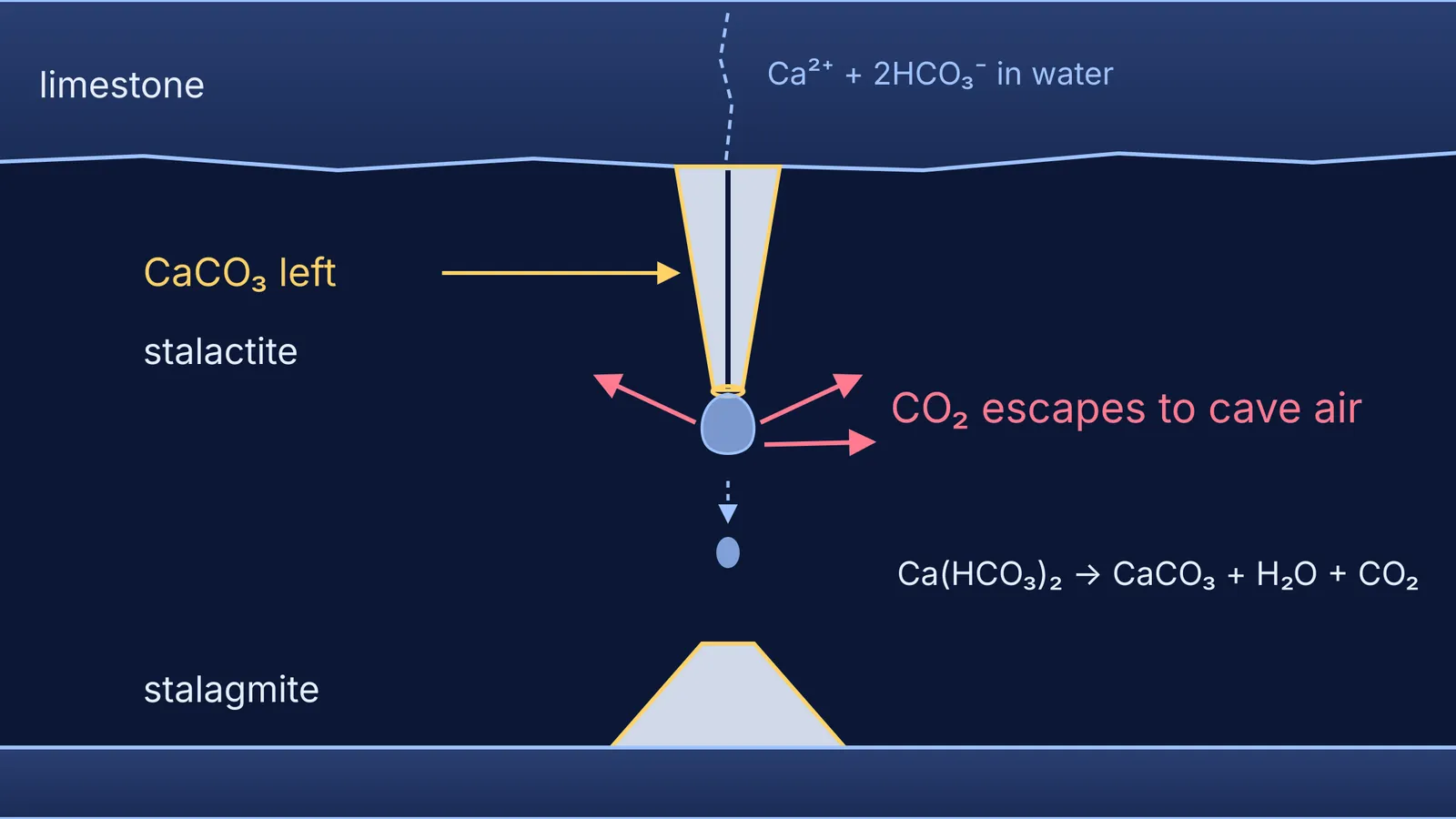
The water reaches the cave ceiling and hangs there as a drop, now exposed to cave air.
The drop releases carbon dioxide, “much like when a bottle of soda is opened”, and as it does, calcite is deposited (NPS).
The reverse reaction has now run: Ca(HCO₃)₂(aq) → CaCO₃(s) + CO₂(g) + H₂O(l) (Science Learning Hub).
Where does the solid go? A thin film of carbonate forms on the surface of the drop, and as drop after drop follows the same path, a hollow tube builds up (NPS speleothems guide). All stalactites begin as these hollow “soda straws”, the same source says, and they range from slender straws to massive pendants tens of feet long. Calcium carbonate still dissolved when the drop falls can come out on the floor, building a stalagmite (NPS).
Why is stalactite formation a reversible reaction?
Write the two steps as one equation and the logic becomes clear:
CaCO₃(s) + H₂O(l) + CO₂(aq) ⇌ Ca(HCO₃)₂(aq)
Inside the rock, the water carries plenty of dissolved carbon dioxide, so the forward reaction wins and limestone dissolves. In the cave, carbon dioxide escapes from the drop. By Le Chatelier's principle, removing a substance pushes the equilibrium to replace it, so the reaction shifts left and calcium carbonate comes out of solution.
Why does the gas leave? How much gas stays dissolved in water depends on how much of that gas is in the air above it. That is Henry's law, and our worked guide to Henry's law and gas solubility shows the numbers. A 2022 modelling study of Sofular Cave in northern Turkey, published in Frontiers in Earth Science, fits this picture: in the model, stalagmite growth slowed as the carbon dioxide concentration in the cave rose.
You have seen this equilibrium in the lab. Bubble CO₂ through limewater and it turns milky as CaCO₃ forms; keep bubbling and it clears as soluble Ca(HCO₃)₂ forms. Our post on telling CO₂ from SO₂ with limewater and other tests covers that test.
If shifting equilibria are hard to picture from an equation, watch one move. The Fermi Simulation Lab has interactive simulations for ideas that are easier to see than to read, and our Le Chatelier's principle simulation walkthrough asks you to predict the shift before you check it.
How fast do stalactites grow?
Slowly, and at different rates in different caves. One real measurement comes from Lehman Caves in Great Basin National Park, Nevada. Soda straws there that regrew on formations broken between 1885 and 1922, roughly a century ago, are mostly under an inch to about four inches long (NPS, Great Basin). The same page notes that hollow soda straws grow faster than wider formations.
A worked estimate from those numbers:
Four inches is about 100 mm. Over about 100 years, that is roughly 1 mm a year.
One inch is about 25 mm. Over 100 years, that is about 0.25 mm a year.
Even at 1 mm a year, a 1-metre soda straw would need about 1,000 years.
Treat these as rough figures, not a rule. Still, a large stalactite on a cave tour has probably been growing for centuries, and a broken tip takes generations to grow back.
How do you write this answer in an exam?
For a three-mark question such as “Explain how stalactites form”, hit these points:
Rainwater containing CO₂ dissolves limestone to form soluble calcium hydrogen carbonate.
In the cave, the dripping water loses CO₂ to the air.
The reaction reverses (write the ⇌ equation), so insoluble CaCO₃ is deposited at the drip point and slowly builds a stalactite.
For an extra mark, add the Le Chatelier reason in one line: removing CO₂ shifts the equilibrium towards CaCO₃. If equilibrium itself feels shaky, the Fermi Concept Library gives every chemistry concept its own lesson.
Next time a textbook asks for a reversible reaction in nature, point to the ceiling of a cave.


