

On this page
Here is a classic estimation puzzle. Julius Caesar breathed out for the last time in 44 BCE. How many of the molecules from that one breath are in the breath you are taking now? The answer, about one, sounds impossible. It comes straight out of pV = nRT, Avogadro's number and the mass of the atmosphere, and it is a good test of whether you can handle very large and very small numbers in one line.
How many molecules are in one breath?
A typical resting breath, the tidal volume, is about 500 mL for an average healthy man and about 400 mL for a woman (StatPearls, Physiology, Tidal Volume). We take V = 0.5 L as a round value. The air in it is at body temperature, 37 °C, and close to atmospheric pressure.
Convert to SI. V = 0.5 L = 5.0 × 10⁻⁴ m³, T = 310 K, p = 1.013 × 10⁵ Pa.
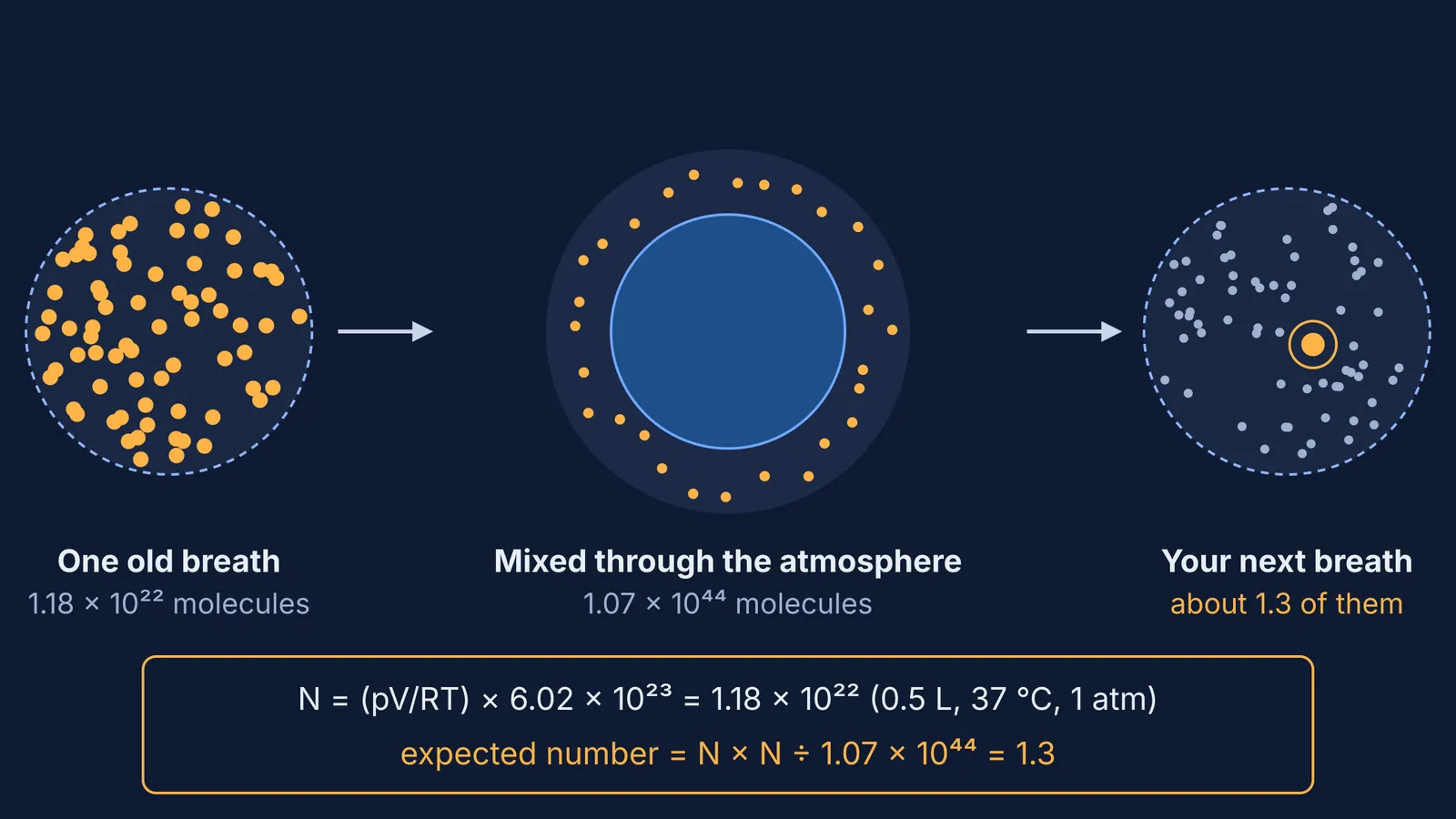
Moles. n = pV/RT = (1.013 × 10⁵ × 5.0 × 10⁻⁴) / (8.314 × 310) = 0.0196 mol.
Molecules. N = n × N_A, where N_A is Avogadro's number: N = 0.0196 × 6.022 × 10²³ = 1.18 × 10²² molecules.
The same method for a whole room is in how many air molecules are in a standard room. The reason a fixed volume of any gas at given p and T holds a fixed number of molecules is explained in deriving Avogadro's law from kinetic theory.
How many molecules are in the whole atmosphere?
The total mass of the atmosphere is about 5.15 × 10¹⁸ kg (Trenberth and Smith, Journal of Climate, 2005). How you can estimate this from surface pressure is covered in solving estimation problems in physics olympiads, so we just use the number.
Moles of air. Using the mean molar mass of dry air, 0.02897 kg/mol: 5.15 × 10¹⁸ / 0.02897 = 1.78 × 10²⁰ mol.
Molecules. 1.78 × 10²⁰ × 6.022 × 10²³ = 1.07 × 10⁴⁴ molecules.
How many of Caesar's molecules are in your breath?
Now the full worked example. Assume Caesar's last breath has had time to spread evenly through the whole atmosphere.
Fraction of the air that came from his breath. f = 1.18 × 10²² / 1.07 × 10⁴⁴ = 1.1 × 10⁻²².
Your breath samples the air. It holds 1.18 × 10²² molecules, and each one has a chance f of being one of his.
Expected number. N × f = 1.18 × 10²² × 1.1 × 10⁻²² = 1.3.
So, on average, each breath you take holds about one molecule from that single breath. The algebra shows why: the expected number is N²/N_atm, where N is the molecules in one breath and N_atm the molecules in the atmosphere.
Check the units at each step: Pa × m³ is J, and J ÷ (J mol⁻¹ K⁻¹ × K) gives mol. The fraction f and the final answer are pure numbers, as they must be.
Why does the answer come out close to one?
Divide the atmosphere into breaths. N_atm/N = 1.07 × 10⁴⁴ / 1.18 × 10²² = 9 × 10²¹. So the atmosphere holds about 9 × 10²¹ breaths of air, and one breath holds about 1.2 × 10²² molecules. These two huge numbers happen to be nearly equal. That coincidence is the whole trick.
It also makes the answer sensitive to the breath size, because the volume appears squared. With 1 L breaths on both sides, N doubles and the expected number goes up four times, to about 5.2. Any answer between roughly one and a few is fair for this estimate.
Is the answer exactly one molecule every time?
No. 1.3 is an average. Each of your 10²² molecules has a tiny, independent chance of being one of his, so the count in any one breath follows a Poisson distribution with mean 1.3.
The chance of getting none is e^(−1.3) = 0.27.
So the chance of getting at least one is 1 − 0.27 = 0.73, about 73%.
Some breaths will hold two or three.
If you want more estimation sums like this, with each step reasoned out rather than just answered, the Fermi Problem Library has a step-by-step solver that explains the reasoning.
What does this estimate leave out?
The model makes two big assumptions, and a good answer says so.
Mixing takes time. Exchange of air between the northern and southern hemispheres is slow. Studies of tracer gases put the exchange time at about a year (Journal of the Meteorological Society of Japan, 1992), with other estimates up to about two years. After 2,000 years, the even-mixing assumption is fine.
Molecules do not all stay in the air. Oxygen is taken up and released by living things, and carbon dioxide moves in and out of plants and the oceans. Many of Caesar's O₂ and CO₂ molecules will have been through a plant, an animal or the sea since. Nitrogen is a better choice. It makes up about 78% of the air by volume and only a tiny fraction of it is pulled out by living things each year. Counting only his nitrogen molecules gives 0.78 × 1.3 = 1.0 per breath. Argon, a noble gas that hardly reacts at all, stays in the air too, though there are far fewer argon molecules in a breath.
We also ignored the water vapour and extra CO₂ in exhaled air. They change the count by a few percent, far less than the uncertainty in the breath size.
Quick checklist
One 0.5 L breath at 37 °C and 1 atm: n = pV/RT = 0.0196 mol, N = 1.18 × 10²².
Atmosphere: 5.15 × 10¹⁸ kg ÷ 0.02897 kg/mol × N_A = 1.07 × 10⁴⁴ molecules.
Expected number of old molecules in a new breath = N²/N_atm = 1.3.
It is an average: Poisson gives a 73% chance of at least one.
The answer depends on the breath size squared; 1 L breaths give about 5.
State the assumptions: full mixing, and molecules that stay in the air (nitrogen, argon).


