

On this page
Order-of-magnitude estimates are a staple of physics competitions. Often called Fermi problems, they test your ability to make reasonable assumptions when exact data is missing.
In a standard physics class, you are given all the variables and asked to find a precise answer. But as Sanjoy Mahajan argues in his book *Street-Fighting Mathematics*, real life often hands us partly defined problems needing only moderately accurate solutions. Estimation problems teach you how to think about the physical world without getting stuck in the algebra.
What is a Fermi problem?
The goal is to find an answer to the nearest power of ten. In competitions such as the US Science Olympiad, a correct order of magnitude earns 5 points, being one power of ten away earns 3 points, and being two powers away earns 1 point. You do not need a calculator. In fact, calculators are often banned.
If you estimate the mass of a car, saying 1000 kg or 2000 kg is the same order of magnitude (both are 10³ kg). The exact figure does not matter as much as the exponent. The trick is to break a question you cannot answer into smaller questions you can. By relying on logical steps, you remove the pressure of having perfect memory. You only need to know a few fundamental quantities, and you can derive the rest on the fly.
How do you decompose a Fermi problem?
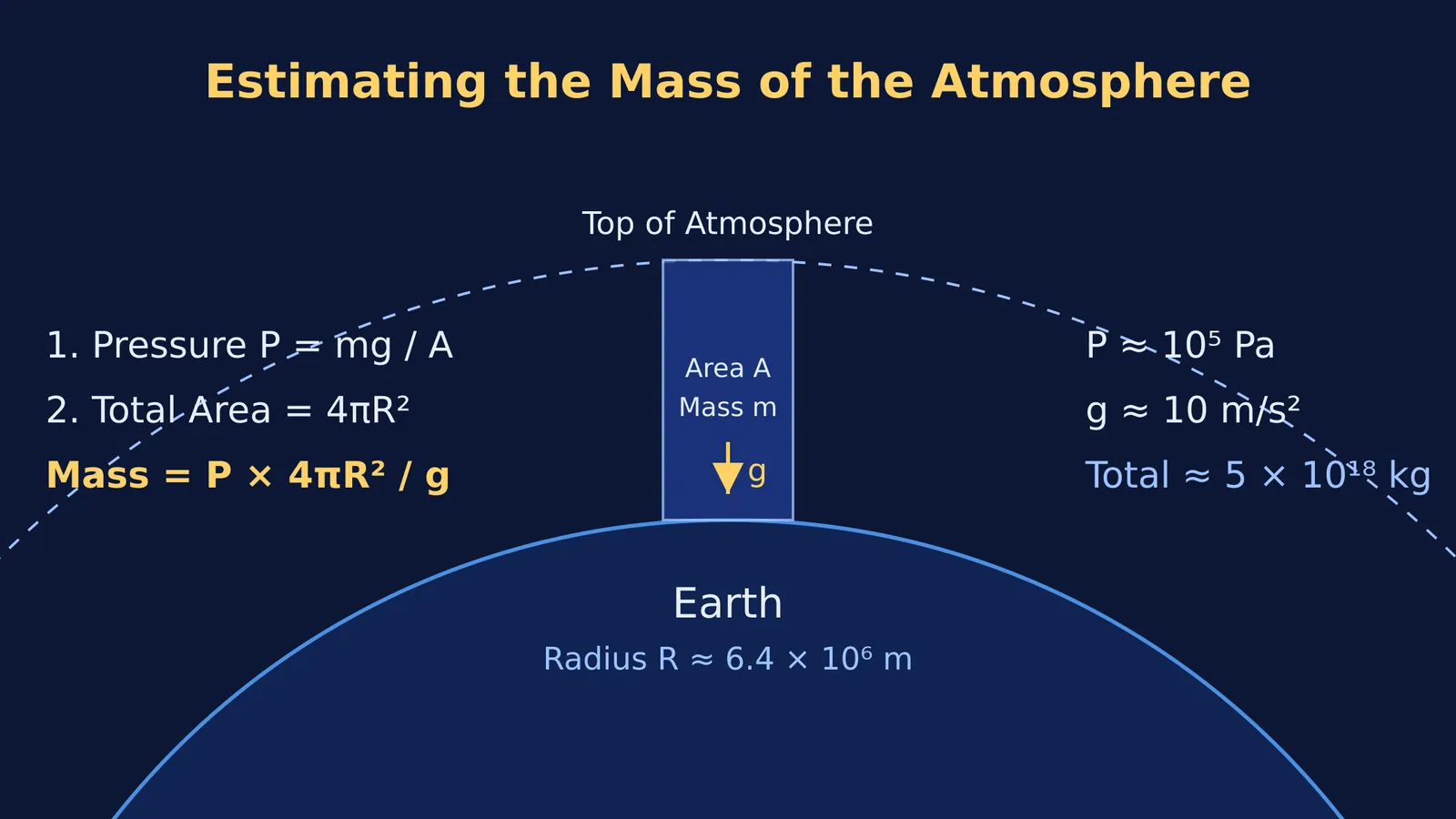
If a question asks for the mass of the Earth's atmosphere, you cannot guess it directly. But you can break it into a chain of links.
Atmospheric pressure at sea level is the weight of the air above a unit area. Weight is mass times gravity (W = mg). So, the total mass of the atmosphere is the pressure multiplied by the surface area of the Earth, divided by g.
Now you need the radius of the Earth (roughly 6400 km) and atmospheric pressure (10⁵ pascals), standard values you can find in physics references. By stringing these facts together, you find the mass is around 5 × 10¹⁸ kg. If you ever hit a wall with a long problem, the Fermi Problem Library has worked problems with a step-by-step solver that explains the reasoning rather than printing an answer.
How can dimensional analysis help?
When you do not know the formula linking your variables, let the units guide you. This is the most powerful tool in the physics olympiad.
Suppose you need to estimate the speed of water waves in a shallow tank. The speed (v, in m/s) can only depend on the depth of the water (h, in m), the density of water (ρ, in kg/m³), and gravity (g, in m/s²).
Density has mass in it, but no other variable does. Since speed does not depend on mass, density cannot be in the formula. The only way to combine depth and gravity to get m/s is √(gh). You have just derived the physics without solving a complex fluid dynamics equation. This technique works equally well for estimating the period of a pendulum or the energy of an explosion. Whenever you are stuck, write down the units of the answer you want, and combine your given variables until the units match. (For more on units, see Converting a quantity between unit systems using dimensions).
How do you handle geometric simplifications?
The real world is incredibly complex, but estimation problems reward those who prefer ideal shapes. When estimating the volume of a crumpled piece of paper or a jagged rock, do not worry about the exact contours and irregular edges. Instead, model the object as a perfect sphere or a simple cube.
The same principle applies to planetary scales. If you need the volume of an asteroid, treat it as a sphere. If you need the surface area of a river, treat it as a long rectangle. By stripping away the real-world complexity, you reduce the problem to basic geometry. You might lose a few percentage points of accuracy, but in an order-of-magnitude calculation, those minor deviations are swallowed by the final rounding step.
Why do a sanity check?
Always test the limits of your model. If you derive a formula for the time it takes a block to slide down a ramp, what happens if the friction goes to zero? What if the angle is 90 degrees? If the limit gives a non-physical answer (like infinite time when there is no friction), your model is wrong.
You can also apply sanity checks to your final numerical answers. If your calculation suggests a person eats ten thousand meals a year, or that a car travels at the speed of sound, you know you have dropped a decimal point or flipped a fraction somewhere in your chain of logic. If you are struggling to picture the physical limits of a system, the Fermi Simulation Lab has interactive simulations for the ideas that are easier to see than to read.
Which benchmark numbers should you know?
You cannot estimate without a foundation of basic facts. You should know these standard constants to one significant figure (as commonly taught in physics references):
Earth's radius: 6 × 10⁶ m
Density of water: 1000 kg/m³
One year: π × 10⁷ seconds
Speed of light: 3 × 10⁸ m/s
Avogadro's number: 6 × 10²³ (as used in Josef Loschmidt and the first estimate of molecule size)
Memorising these is not about rote learning; it is about giving your intuition a sense of scale. If you are preparing for a competition, Fermi's AI tutor works out what you already know and builds a plan for the session, helping you practice these estimation leaps until they become second nature.


