

On this page
We breathe it, walk through it and barely notice it, but the air around us is packed with matter. Gas molecules are tiny and moving fast, meaning a vast number of them fit into an ordinary living space. But exactly how many?
For a standard bedroom or small classroom, we can work this out from first principles. By treating air as an ideal gas, we can relate its pressure, volume and temperature to the total number of particles.
What is the volume of a standard room?
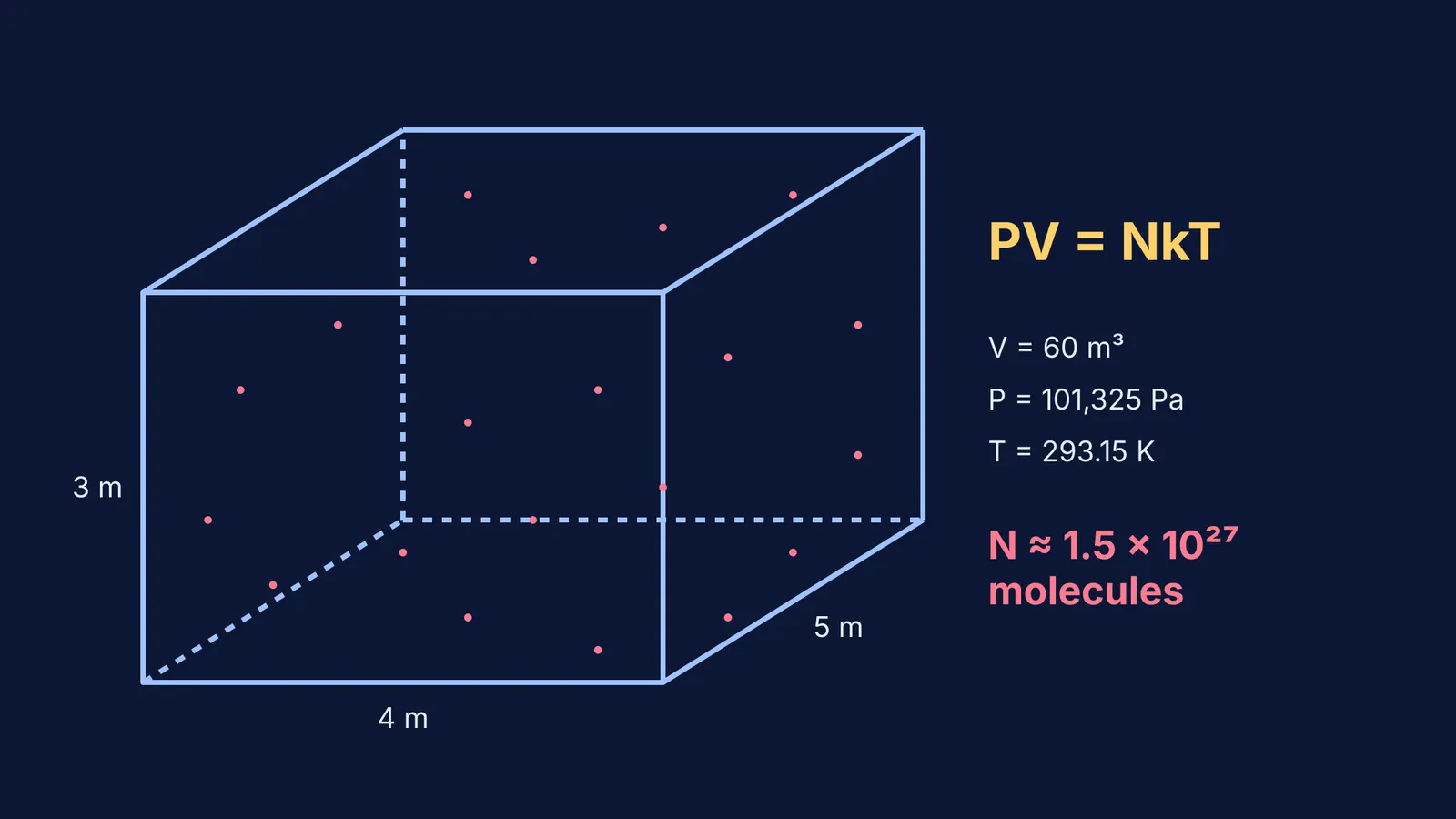
First, we need to know how much space we are measuring. Let's take a room that is 4 metres wide, 5 metres long and 3 metres high.
The volume of this room is simply its length, width and height multiplied together: 4 × 5 × 3 = 60 cubic metres (m³).
Next, we need the conditions of the air inside. Standard atmospheric pressure is exactly 101,325 Pascals) (Pa). We will assume a comfortable room temperature of 20 °C.
To use the ideal gas law, temperature must be in Kelvin. You convert Celsius to Kelvin by adding 273.15, so our room temperature is 293.15 K.
How to use the ideal gas law to find the number of molecules?
The ideal gas law in physics relates pressure (P), volume (V) and temperature (T) to the number of molecules (N). The equation is PV = NkT.
Here, k is the Boltzmann constant. According to the 2018 CODATA recommended values, the Boltzmann constant is exactly 1.380649 × 10⁻²³ J/K.
To find the number of molecules, we rearrange the equation: N = PV / kT
Now we substitute our values:
P = 101,325 Pa
V = 60 m³
k = 1.380649 × 10⁻²³ J/K
T = 293.15 K
N = (101,325 × 60) / (1.380649 × 10⁻²³ × 293.15)
N = 6,079,500 / (4.047 × 10⁻²¹)
This gives N ≈ 1.50 × 10²⁷ molecules.
That is 1.5 octillion molecules — a 15 followed by 26 zeros. Even in an empty-looking room, you are sharing the space with an unimaginably large swarm of particles.
If you want to read more about how gases behave and mix, our post on the average molar mass of a gas mixture works through air and vapour examples. Or, to explore how physicists first measured these tiny scales, read about Josef Loschmidt and the first estimate of molecule size.
How much do these air molecules weigh?
It is easy to think of air as weightless, but 1.5 × 10²⁷ molecules add up.
Air is mostly nitrogen (about 78%) and oxygen (about 21%). The average molar mass of air is roughly 29 grams per mole (0.029 kg/mol).
Since our 60 m³ room contains about 2,494 moles of air, its total mass is: 2,494 moles × 0.029 kg/mol ≈ 72 kilograms.
The air in a typical bedroom weighs as much as an adult human. The reason you don't feel it crushing you is that the pressure inside your body pushes back with equal force. (If you were to let this gas expand into a vacuum, it would do no work against its surroundings — a principle explored in our guide to the free expansion of an ideal gas).
If you are a student working through thermodynamics, finding the right equation is only half the battle. When you are stuck on a numerical problem and the answer key isn't enough, the Fermi Problem Library has worked problems with a step-by-step solver that explains the reasoning rather than printing an answer. And to understand the core physics behind temperature and pressure, the Fermi Concept Library holds every concept in physics, chemistry, biology, mathematics and computing, each with its own lesson and its place in the map.


