

On this page
What does Avogadro's law state in molecular terms?
In 1811, Italian physicist Amedeo Avogadro proposed that equal volumes of all gases, at the same temperature and pressure, contain the same number of molecules. His essay in the *Journal de Physique* resolved contradictions between John Dalton's early atomic theory and Joseph Louis Gay-Lussac's law of combining volumes (Science History Institute). While contemporaries initially doubted that elementary gases could form diatomic molecules, Stanislao Cannizzaro showed in 1860 (Science History Institute) that Amedeo Avogadro's hypothesis provided the consistent foundation for atomic weights.
Today, Avogadro's law states that equal volumes of gases at identical pressure (P) and temperature (T) contain equal numbers of particles (N). The 9th edition of the SI Brochure sets the fundamental Avogadro constant at exactly 6.02214076 × 10²³ mol⁻¹ (BIPM), establishing the standard molar volume at standard temperature and pressure. Kinetic gas theory explains why this macroscopic observation is a direct result of Newtonian mechanics applied to colliding particles.
How does kinetic theory express gas pressure?
The kinetic model treats an ideal gas as a collection of identical particles in continuous, random thermal motion. When particles of mass m collide elastically with the container walls of volume V, their momentum changes generate pressure (OpenStax).
Under the CBSE Senior Secondary Physics curriculum for the kinetic theory of gases, the pressure P exerted by N molecules is: P = (1/3) × (N/V) × m × (v_rms)² where v_rms is the root-mean-square speed. Multiplying by V yields: PV = (1/3) × N × m × (v_rms)² = (2/3) × N × [ (1/2) × m × (v_rms)² ]
The bracketed term is the average translational kinetic energy per molecule (KE_avg). Thus: PV = (2/3) × N × KE_avg
How do you derive Avogadro's law step by step?
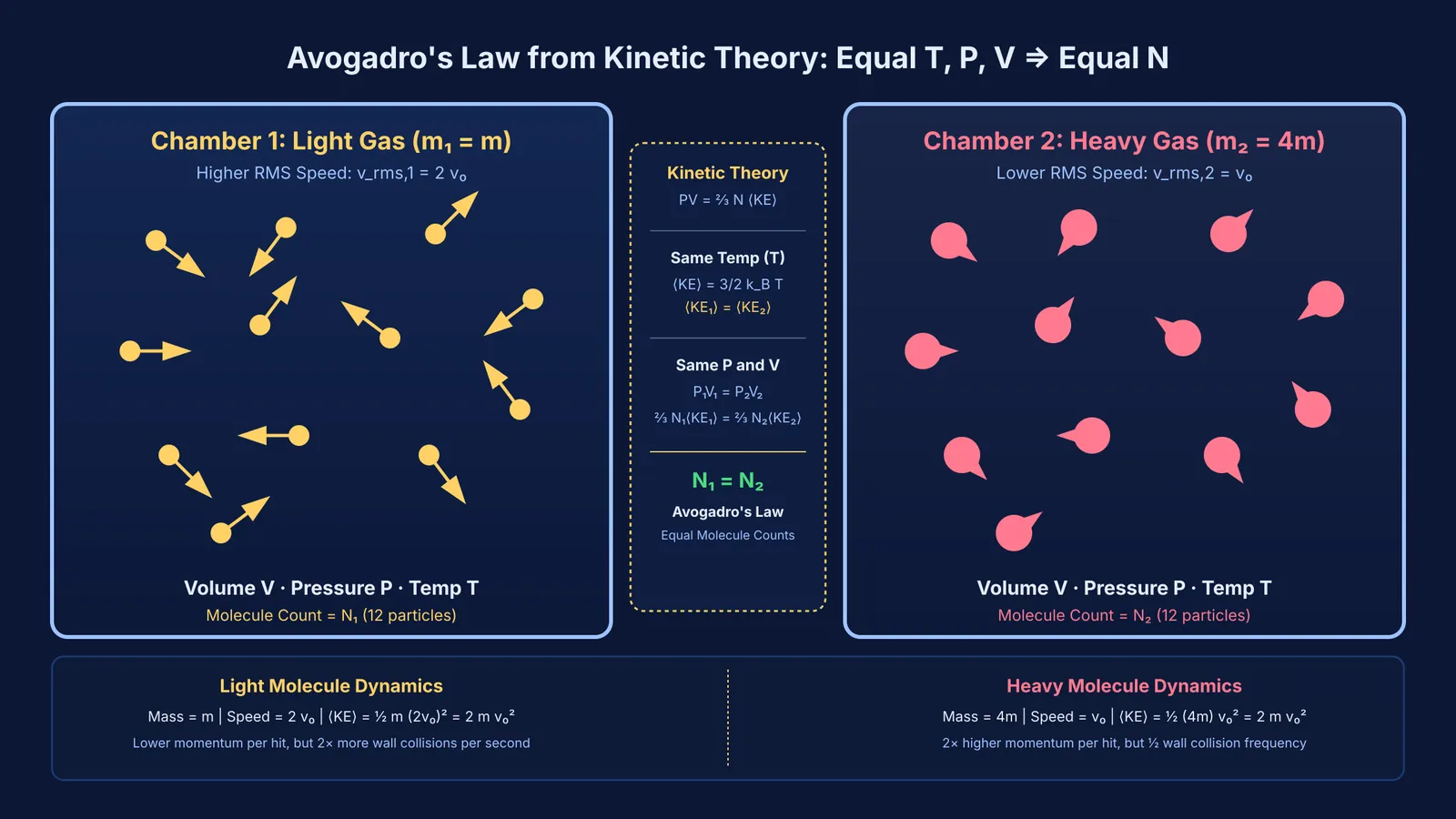
Consider two ideal gases (Gas 1 and Gas 2) held at identical pressure P, volume V, and temperature T (CBSE Academic):
Express the pressure for Gas 1: PV = (2/3) × N₁ × KE_avg,1
Express the pressure for Gas 2: PV = (2/3) × N₂ × KE_avg,2
Equate the PV products: Because P and V are identical, (2/3) N₁ KE_avg,1 = (2/3) N₂ KE_avg,2, which reduces to N₁ KE_avg,1 = N₂ KE_avg,2.
Apply the kinetic interpretation of temperature: Average translational kinetic energy depends solely on temperature (OpenStax), where KE_avg = (3/2)k_B T. Because T is identical, KE_avg,1 = KE_avg,2.
Cancel the kinetic energy terms: Dividing both sides by the equal kinetic energy gives N₁ = N₂.
This establishes Avogadro's law. For practice with derivations and gas mixtures, the Fermi Problem Library provides worked problems with a step-by-step solver that explains the reasoning rather than printing an answer.
Why must lighter molecules move faster at the same temperature?
Temperature dictates average kinetic energy rather than speed (OpenStax). Because KE_avg = (1/2)m(v_rms)² = (3/2)k_B T, root-mean-square speed relates inversely to molecular mass: v_rms = √(3 k_B T / m)
For helium (atomic mass 4 u) and oxygen (molecular mass 32 u) at the same temperature, oxygen is 8 times heavier. Helium atoms move at √8 times (approximately 2.83 times) the speed of oxygen molecules (OpenStax). While an oxygen molecule delivers 2.83 times more momentum per wall impact, a helium atom hits the wall 2.83 times more frequently. The two factors balance, producing identical pressure.
For students visualising molecular collisions, the Fermi Simulation Lab offers interactive simulations for the ideas that are easier to see than to read.
What common mistakes do students make in this derivation?
In classroom and board examinations, students often make three errors:
Overlooking degrees of freedom: Diatomic gases have rotational degrees of freedom, but only the 3 translational degrees of freedom contribute to momentum transfer on the walls, maintaining KE_avg = (3/2)k_B T in the pressure equation (OpenStax).
Confusing single-particle mass with sample mass: In the derivation, m is the mass of one molecule, while total sample mass is M = Nm (OpenStax).
Equating mass density with particle density: Equal volumes containing equal molecule counts have different mass densities whenever their molar masses differ.
When mapping how molecular mechanics links to bulk thermodynamics, the Fermi Concept Library maps every concept in physics, chemistry, biology, mathematics and computing, each with its own lesson and its place in the map.


