

On this page
Drop pieces of sodium metal into a hot solution of an ester in dry ethanol, and the ester is reduced to two alcohols. This is the Bouveault–Blanc reduction, reported by the French chemists Louis Bouveault and Gustave Louis Blanc in 1903. For decades it was a standard laboratory way to reduce esters, until metal hydride reagents such as LiAlH₄ came into common use. It still turns up in JEE reagent questions.
What is the Bouveault–Blanc reduction?
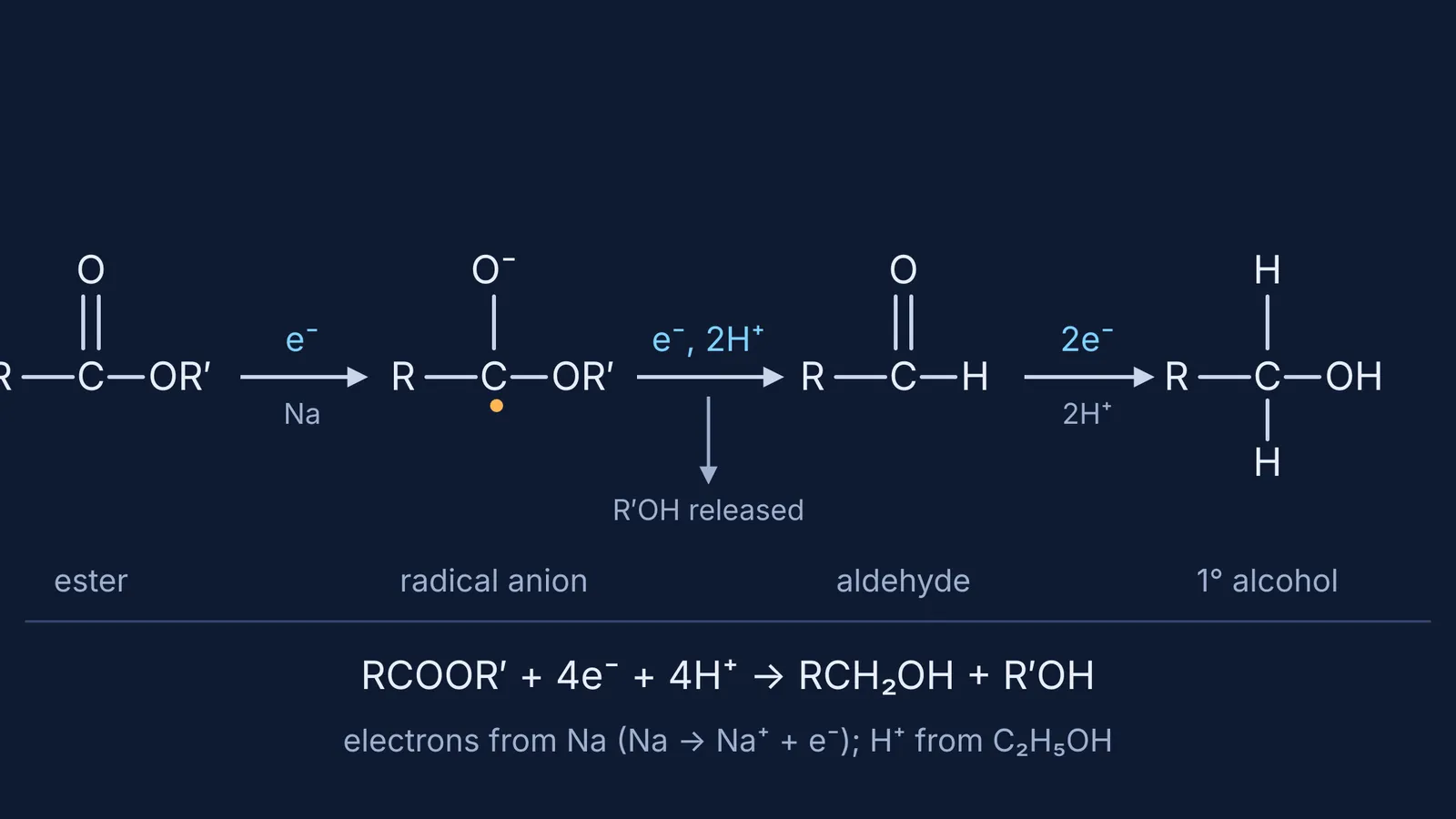
It is the reduction of an ester by sodium in ethanol. The acyl part of the ester becomes a primary alcohol, and the alkoxy part is set free as a second alcohol:
RCOOR′ + 4[H] → RCH₂OH + R′OH (reagent: Na / C₂H₅OH)
Sodium supplies the electrons and ethanol supplies the protons. The products first form as sodium alkoxides in the strongly basic mixture; adding water at the end gives the free alcohols. Sodium is used in excess, because part of it simply reacts with the ethanol: 2C₂H₅OH + 2Na → 2C₂H₅ONa + H₂.
A quick way to read any example: count the carbons in the acyl part, R–CO–. The primary alcohol has exactly that many carbons, with the old C=O carbon now a CH₂OH group.
Why reduce an ester with sodium instead of NaBH₄?
Under ordinary conditions NaBH₄ reduces aldehydes and ketones but not esters. The lone pair on the –OR′ oxygen is delocalised onto the carbonyl group, which makes the ester carbon less electrophilic than a ketone carbon, too weak a target for the mild hydride. The full comparison of the two hydrides is in the difference between LiAlH₄ and NaBH₄.
Sodium works differently. It does not deliver a hydride ion at all. It hands over electrons one at a time, and an ester C=O can accept them. That is why a cheap metal and a common solvent can do a job that NaBH₄ cannot.
What is the mechanism of Bouveault–Blanc reduction?
At JEE level, think of it as four electrons from sodium and four protons from ethanol, added in two rounds. Textbooks differ on the fine details, but the outline is:
First electron. A sodium atom gives one electron to the C=O group. The ester becomes a radical anion: the carbon carries an unpaired electron and the oxygen a negative charge.
Protonation. Ethanol protonates the O⁻, giving a neutral radical.
Second electron and proton. A second sodium atom gives another electron, making a carbanion, which ethanol protonates. The result is a hemiacetal, R–CH(OH)–OR′.
Aldehyde stage. The hemiacetal breaks down, releasing R′OH and giving the aldehyde RCHO. Overall so far: RCOOR′ + 2e⁻ + 2H⁺ → RCHO + R′OH.
Second round. The aldehyde is reduced faster than the ester, so it does not build up. Two more electrons and two more protons, by the same electron-then-proton route, convert it to RCH₂OH (as the alkoxide until water is added).
This is the same dissolving-metal idea as the Birch reduction and the reduction of alkynes by sodium in liquid ammonia: electrons from the metal, protons from a weak acid.
How does it compare with LiAlH₄ and catalytic hydrogenation?
LiAlH₄ in dry ether, followed by dilute acid, gives the same two alcohols from an ester. It works at room temperature, but it also reduces carboxylic acids, amides and nitriles, and it reacts violently with water.
DIBAL-H at low temperature stops at the aldehyde instead of going to the alcohol, as explained in why DIBAL-H stops at the aldehyde for esters.
Catalytic hydrogenation of an ester needs high temperature, high pressure and special catalysts such as copper chromite. Under those conditions any C=C bond in the molecule is hydrogenated too.
Sodium and ethanol need no hydride and no pressure vessel. The costs are a large excess of sodium, which must be handled with care, and a long reaction time at reflux.
Does Bouveault–Blanc reduction affect C=C double bonds?
An isolated C=C bond generally survives. A dissolving metal needs a group that can accept an electron into a low-lying empty orbital. The π* orbital of C=O is low enough; that of a simple, isolated alkene is not. This selectivity is why the reaction was used to turn esters of unsaturated fatty acids, such as ethyl oleate, into unsaturated fatty alcohols such as oleyl alcohol, keeping the C=C in place. High-pressure hydrogenation of the same ester would have saturated the chain.
State the rule carefully. It applies to isolated double bonds. A C=C conjugated with the C=O, or an aromatic ring under different dissolving-metal conditions, can be reduced.
Worked example: ethyl butanoate to butan-1-ol
Question. 11.6 g of ethyl butanoate is reduced completely with sodium and ethanol. Write the balanced equation, name the products, and find the mass of butan-1-ol formed and the minimum mass of sodium needed. (C = 12, H = 1, O = 16, Na = 23)
Step 1: split the ester. Ethyl butanoate is CH₃CH₂CH₂COOC₂H₅. The acyl part, CH₃CH₂CH₂CO–, has four carbons, so it becomes butan-1-ol, CH₃CH₂CH₂CH₂OH. The ethoxy part becomes ethanol.
Step 2: balance. Each ester needs 4 electrons (4 Na) and 4 protons (4 C₂H₅OH):
CH₃CH₂CH₂COOC₂H₅ + 4Na + 4C₂H₅OH → CH₃CH₂CH₂CH₂OH + C₂H₅OH + 4C₂H₅ONa
Check: carbon 6 + 8 = 4 + 2 + 8 = 14; hydrogen 12 + 24 = 10 + 6 + 20 = 36; oxygen 2 + 4 = 1 + 1 + 4 = 6; sodium 4 = 4.
Step 3: moles of ester. Molar mass of C₆H₁₂O₂ = 72 + 12 + 32 = 116 g/mol. Moles = 11.6 / 116 = 0.100 mol.
Step 4: butan-1-ol. The ratio is 1 : 1. Molar mass of C₄H₁₀O = 48 + 10 + 16 = 74 g/mol. Mass = 0.100 × 74 = 7.4 g. The same 0.100 mol of ethanol (4.6 g) comes from the ethoxy group.
Step 5: sodium. 4 mol Na per mol ester, so 0.400 mol × 23 = 9.2 g. This is the minimum; in practice more is added because some sodium reacts with the solvent to give H₂.
These are theoretical amounts for complete conversion. With more precise atomic masses the butan-1-ol figure is still 7.40 g.
Which reagent reduces which group?
These are the comparisons that turn up in reagent-matching questions:
Ester to alcohols: LiAlH₄ yes, Na/C₂H₅OH yes, NaBH₄ no.
Ketone to secondary alcohol: all three yes. So NaBH₄ is the reagent that reduces a ketone and leaves an ester untouched.
Carboxylic acid to primary alcohol: LiAlH₄ yes, NaBH₄ no. With Na/C₂H₅OH the acid is turned into its sodium salt, and the carboxylate ion is not reduced, which is why acids were first converted into esters.
Isolated C=C: none of the three reduces it.
For other routes to alcohols, from alkenes, carbonyl compounds and Grignard reagents, see methods of preparation of alcohols compared. If you want to practise reagent and product questions like these, the Fermi Problem Library has a step-by-step solver that explains the reasoning at each stage.
Quick checklist
Bouveault–Blanc: ester + Na + C₂H₅OH → primary alcohol + R′OH.
Na gives electrons one at a time; ethanol gives the protons.
Route: ester → radical anion → aldehyde → alkoxide → alcohol, 4e⁻ in total.
Same products as LiAlH₄; NaBH₄ does not reduce esters.
Isolated C=C bonds generally survive.
Balance with 4Na and 4C₂H₅OH per ester.


