On this page
If a question gives you an ester or a nitrile and asks for an aldehyde, the reagent it expects is usually DIBAL-H (diisobutylaluminium hydride) at low temperature. Swap in LiAlH4 and the same starting material ends up as an alcohol or an amine. The difference comes down to two things: how many hydrides each reagent carries, and when the aldehyde actually appears in the flask.
What does DIBAL-H do to an ester and a nitrile?
L. I. Zakharkin and I. M. Khorlina reported the reduction of esters to aldehydes with diisobutylaluminium hydride in Tetrahedron Letters in 1962 (Zakharkin and Khorlina, 196270918-X)). It is still a standard method: a 2025 paper in the Journal of Organic Chemistry calls stoichiometric DIBAL-H at cryogenic temperatures, for example −78 °C, one of the most often used reagents for turning esters into aldehydes (Ločmele et al., 2025).
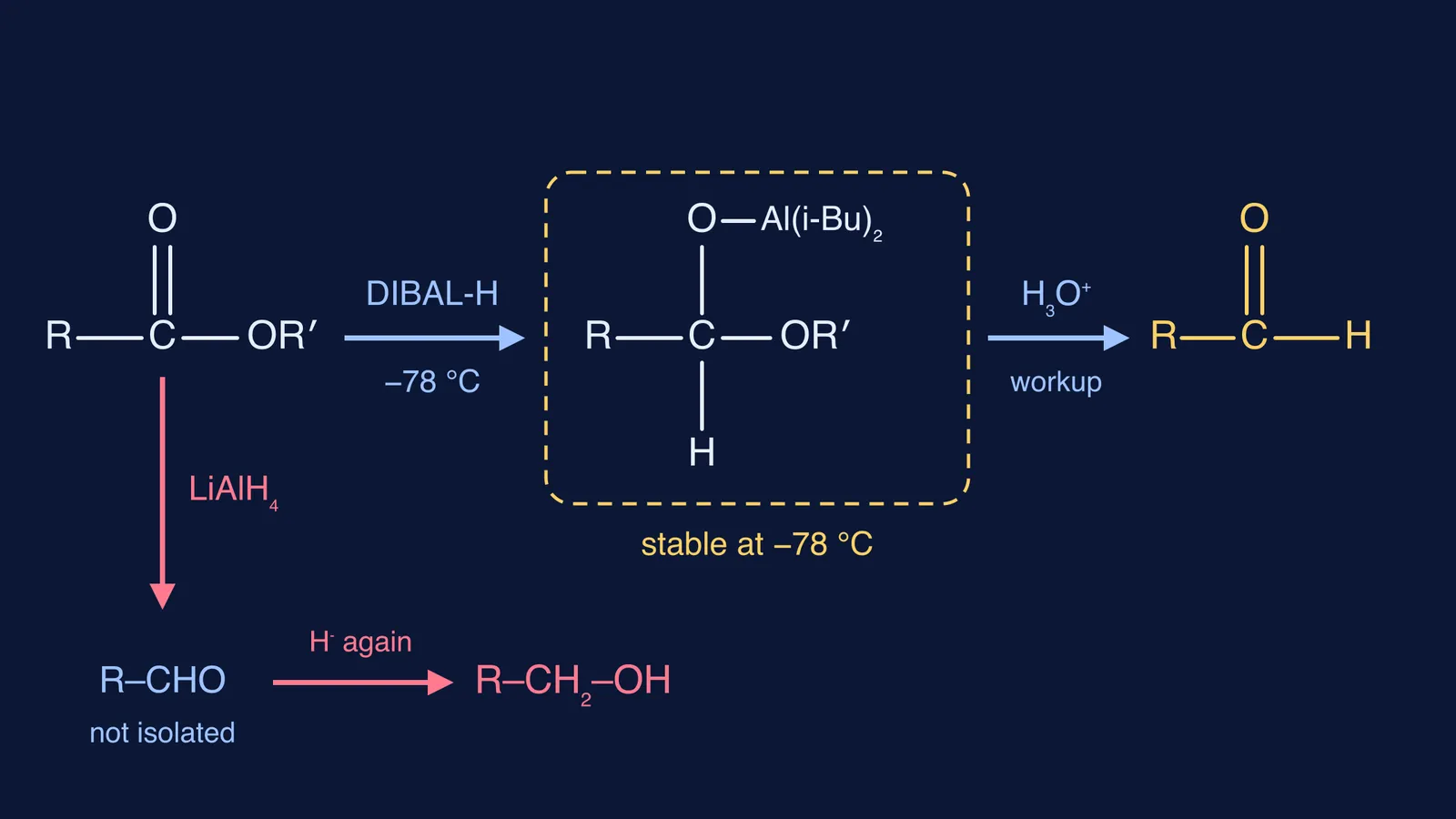
Ester: RCOOR′ with DIBAL-H at −78 °C, then aqueous acid, gives RCHO plus the alcohol R′OH.
Nitrile: RC≡N with DIBAL-H at low temperature gives an imine–aluminium complex, which acid workup hydrolyses to RCHO (LibreTexts, Chemistry of Nitriles/20:_Carboxylic_Acids_and_Nitriles/20.07:_Chemistry_of_Nitriles)).
The −78 °C figure is the temperature of a dry ice–acetone bath, a temperature often quoted for this reaction (Master Organic Chemistry). It sits alongside other routes in our guide to methods of preparing aldehydes and ketones in Class 12.
Why does DIBAL-H stop at the aldehyde but LiAlH4 does not?
Three features work together. The mechanism points below follow Master Organic Chemistry's DIBAL explainer and LibreTexts/20:_Carboxylic_Acids_and_Nitriles/20.07:_Chemistry_of_Nitriles).
It grabs before it gives. Aluminium has an empty p orbital, so DIBAL-H is a Lewis acid. It first binds the carbonyl oxygen (or the nitrile nitrogen), then delivers its hydride. DIBAL-H is described as an electrophilic reducing agent, whereas LiAlH4 is a nucleophilic one (Wikipedia: Diisobutylaluminium hydride).
It has one hydride to give. Each DIBAL-H molecule has a single Al–H bond, while LiAlH4 can in principle deliver four hydrides.
The cold keeps the intermediate closed. After one hydride adds to an ester, the carbon becomes tetrahedral, holding R, H, OR′ and an O–Al group. At −78 °C this intermediate does not fall apart. The aldehyde is effectively trapped in it until workup, when acid turns it into a hemiacetal that quickly loses R′OH to give the aldehyde. By then any leftover hydride has been destroyed by the water.
Nitriles follow the same logic. DIBAL-H adds one hydride to make an imine anion held on aluminium, and because it has only a single hydride, a second addition does not occur; LiAlH4 adds twice and gives a primary amine after workup (LibreTexts/20:_Carboxylic_Acids_and_Nitriles/20.07:_Chemistry_of_Nitriles)).
With LiAlH4 and an ester, the tetrahedral intermediate collapses in the flask and releases the aldehyde while plenty of hydride is still around. An aldehyde is usually more reactive toward the reducing agent than the ester it came from (Ločmele et al., 2025; our post on why aldehydes react faster with nucleophiles explains the electronic side of this), so it is reduced at once to a primary alcohol.
The control is real but delicate. DIBAL-H reliably reduces nitriles to aldehydes, but its reduction of esters to aldehydes often gives large amounts of alcohol (Wikipedia).
Worked example: one ester, one nitrile, two reagents
Take ethyl benzoate, C6H5COOC2H5.
DIBAL-H, −78 °C, then H3O+: benzaldehyde, C6H5CHO, plus ethanol.
LiAlH4, then H3O+: benzyl alcohol, C6H5CH2OH, plus ethanol.
Now propanenitrile, CH3CH2CN.
DIBAL-H, low temperature, then H3O+: propanal, CH3CH2CHO.
LiAlH4, then water: propan-1-amine, CH3CH2CH2NH2.
Check your products by counting carbons. The ester's acyl part keeps its carbons and the OC2H5 part leaves as ethanol. The nitrile carbon stays in the product, so three carbons in propanenitrile give three carbons in propanal. If you want to try variations of these conversions with the reasoning shown step by step, the Fermi Problem Library has worked problems with a solver that explains each step rather than printing an answer.
How do you avoid mistakes in DIBAL-H questions?
Run this checklist before you write a product:
Is the starting material an ester, a lactone or a nitrile? DIBAL-H at low temperature points to an aldehyde (a lactone gives a hemiacetal, per Wikipedia).
Is the low temperature stated? If it is missing, think about over-reduction to the alcohol before you commit.
Is the reagent LiAlH4? Then esters go to primary alcohols and nitriles to primary amines.
Did you show the workup? The aldehyde forms only when water or acid is added.
Do the carbons add up? No carbon–carbon bonds form or break; only the ester's OR′ group leaves.
It also helps to see this as one member of a family of reactions that stop at the aldehyde by design, like hydroboration of a terminal alkyne. If Lewis acids, hydride donors or tetrahedral intermediates still feel shaky, the Fermi Concept Library gives each concept in chemistry its own lesson and shows where it sits in the map.
Next time you see an ester and an aldehyde in the same question, ask one thing first: is the hydride still there when the aldehyde appears?