

On this page
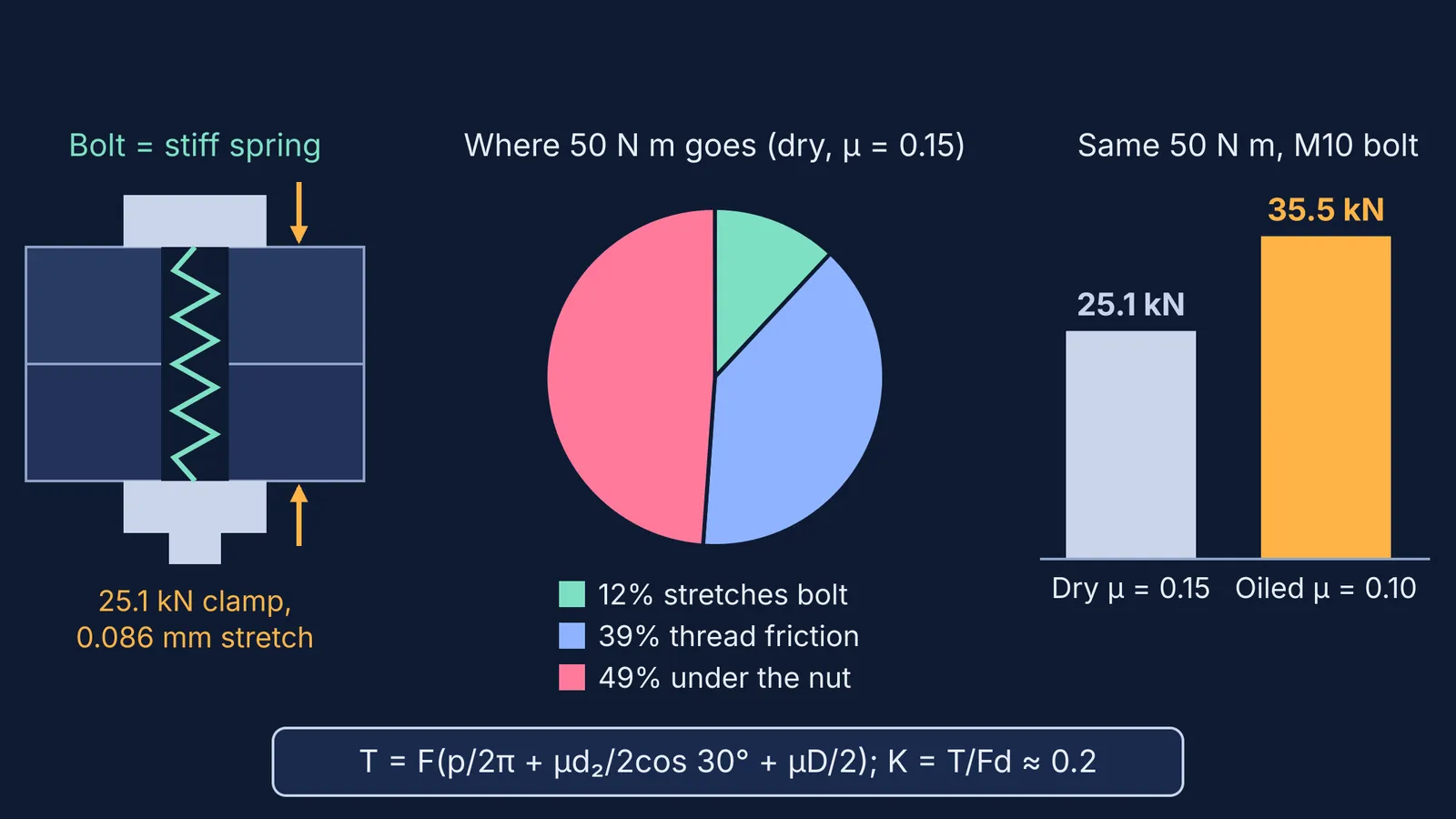
When you tighten a bolt with a spanner, what you control is torque. What the joint needs is clamping force: the tension in the bolt that squeezes the parts together. The two are linked by friction, and friction swallows most of your effort. On a typical dry steel M10 bolt, only about 12% of the torque you apply goes into stretching the bolt. The rest is lost rubbing the threads and the face under the nut.
What does tightening torque actually do to a bolt?
Once the nut is snug, every extra turn pulls the bolt's threads up through the nut by one pitch per revolution. The bolt shank stretches and the clamped plates squeeze a little. A tightened bolt behaves like a stiff spring. Its tension F, called the preload, is the clamping force holding the joint shut.
The stretch is tiny. You can find it with Young's modulus, ΔL = FL/AE, the same relation used in how a wire's extension changes when its length and radius change. For a bolt, the area A is not the shank area but a standard tensile stress area that allows for the threads.
Where does the torque go when you tighten a nut?
A screw thread is an inclined plane wrapped round a cylinder. The screw jack post works the thread as a friction slope and leaves out the friction at the collar. A nut cannot leave it out, because the nut's face rubs on the plate as it turns. The torque splits three ways:
T = F × [p/2π + μd₂/(2 cos 30°) + μD_b/2]
Pitch term, p/2π. The useful part. Turning through 2π raises the nut along the bolt by one pitch p, so this is the work that actually stretches the bolt.
Thread friction, μd₂/(2 cos 30°). Friction on the V-shaped thread flanks, at the pitch diameter d₂. Metric threads have a 60° profile, so each flank is tilted 30°, which raises the normal force by 1/cos 30°.
Bearing friction, μD_b/2. Friction under the nut or bolt head, acting at the mean bearing diameter D_b.
The same three ingredients (thread helix, thread friction with the thread angle, and collar friction) appear in the torque coefficient formula in NASA's Fastener Design Manual, RP-1228.
How much clamping force does 50 N m give on an M10 bolt?
Take an M10 coarse bolt. A manufacturer's metric coarse thread table gives pitch p = 1.5 mm, pitch diameter d₂ = 9.026 mm and minor diameter 8.160 mm. The standard stress area formula, A = (π/4) × ((d₂ + d₃)/2)², gives 58.0 mm². Take the mean bearing diameter as about 13 mm (between the 11 mm clearance hole and the nut's bearing face) and μ = 0.15 on both threads and face, an illustrative value for dry steel.
Pitch term. 1.5/2π = 0.239 mm.
Thread friction term. 0.15 × 9.026/(2 × 0.866) = 0.782 mm.
Bearing term. 0.15 × 13/2 = 0.975 mm.
Add. 0.239 + 0.782 + 0.975 = 1.995 mm. This is the torque needed per newton of tension.
Preload. F = 50 N m/1.995 mm = 50/0.001995 = 25,100 N, about 25.1 kN.
Shares. Pitch 0.239/1.995 = 12%. Thread friction 39%. Bearing friction 49%.
Stress. 25,060 N/58.0 mm² = 432 MPa.
Units check: N m divided by m gives N. Notice that half the torque goes under the nut, not into the thread at all.
How far does the bolt stretch, and how much energy does it store?
Suppose the plates are 40 mm thick, so the stretched length is about 40 mm, and E = 200 GPa for steel (treat the plates as rigid for now).
Stretch. ΔL = FL/AE = 25,060 × 40/(58.0 × 200,000) = 0.0864 mm, about 86 µm, roughly the thickness of a sheet of paper.
Angle turned after snug. One turn advances 1.5 mm, so 0.0864/1.5 × 360° = 20.7°.
Energy stored. U = ½FΔL = ½ × 25,060 × 0.0000864 = 1.08 J. You get the same answer from ½ × stress × strain × volume, as in strain energy per unit volume.
Work done by the spanner. Torque rises from 0 to 50 N m over 20.7° (0.362 rad), so W = ½ × 50 × 0.362 = 9.05 J.
Efficiency. 1.08/9.05 = 12%, exactly the pitch share from step 6 above. Energy and torque bookkeeping agree, as they must.
The other 88%, about 8 J, becomes heat at the rubbing surfaces. Real plates also compress a little, so the nut turns slightly further than this, but the split of torque does not change.
Why does oil on the threads change the clamping force?
Repeat the sum with μ = 0.10, a lubricated joint. The terms become 0.239 + 0.521 + 0.650 = 1.410 mm, so 50 N m now gives 35.5 kN, 42% more, and a stress of 612 MPa. That is above the 580 MPa proof stress listed for property class 8.8 bolts up to M16 in ISO 898-1 (Fastenal: mechanical properties of metric fasteners). Same spanner, same reading, and the bolt is now loaded past the level it is tested to carry without permanent stretch.
Engineers often fold all of this into one empirical number, the nut factor K, in T = KFd, where d is the nominal diameter. From the dry example, K = 50/(25,100 × 0.010) = 0.20. The oiled one gives 0.14. NASA's manual says the commonly assumed K is 0.2 but warns it should not be used blindly, and its table gives K = 0.189 for friction coefficients of 0.15. A lubricant maker reports that K typically lies between 0.1 and 0.25 (DuPont: know your fastener). This scatter is why critical joints are tightened by angle or by measuring stretch, not by torque alone. The numbers here are a physics exercise, not a tightening specification for any real machine or vehicle.
To practise friction-on-an-incline and elasticity steps like these, the Fermi Problem Library has a step-by-step solver that explains the reasoning.
Quick checklist
Clamping force (preload) is the bolt's tension; torque is only an indirect way to set it.
T = F[p/2π + μd₂/(2 cos 30°) + μD_b/2]: pitch, thread friction, bearing friction.
M10, μ = 0.15, 50 N m: 25.1 kN, 432 MPa, shares 12%, 39%, 49%.
Stretch over 40 mm: 86 µm; stored energy 1.08 J out of 9.05 J of work.
Oil (μ = 0.10) gives 35.5 kN at the same torque, past an 8.8 bolt's 580 MPa proof stress.
Nut factor K ≈ 0.2 for dry steel is an empirical average, with wide scatter.


