On this page
Stretch a steel wire gently and it springs back; the work you did is stored in the metal as elastic energy. Exam questions often ask for the energy in each cubic metre: the strain energy per unit volume. It has three forms, all from one picture: the area under a straight line.
What is the strain energy per unit volume formula?
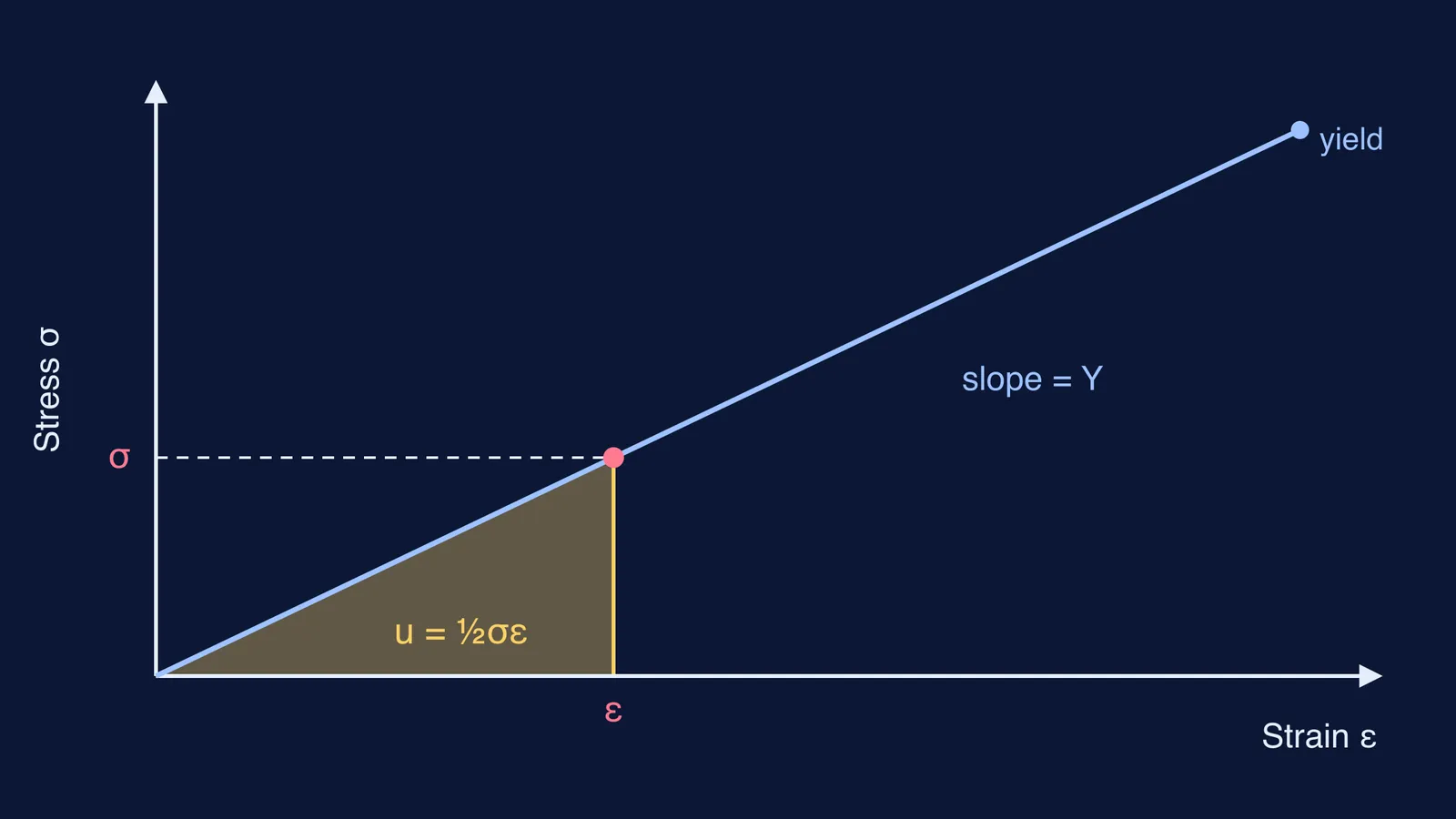
In his MIT mechanics of materials notes, David Roylance explains that the area under the stress-strain curve, up to a given strain, is the mechanical energy per unit volume used to strain the material that far (Roylance, Stress-Strain Curves, LibreTexts/01:_Tensile_Response_of_Materials/1.04:_Stress-Strain_Curves)). In the elastic range that area is a triangle, so it equals half of stress times strain.
NCERT defines Young's modulus as the ratio of stress to longitudinal strain, Y = σ/ε, notes that strain has no units, and derives u = ½σε for a stretched wire in Eq. 8.14 (NCERT Class 11 Physics, Mechanical Properties of Solids). Using σ for stress, ε for strain and Y for Young's modulus, the three equivalent forms are:
u = ½ σ ε
u = σ² / (2Y)
u = ½ Y ε²
Stress is in N/m² and strain is a pure number, so u comes out in N/m², which is the same as J/m³.
Why is there a half in the formula?
When you start loading a wire, the stress is zero. It rises steadily to its final value σ as the wire stretches. The work done per unit volume adds up stress × (small increase in strain) over the whole stretch: the area under the graph.
Within Hooke's law the graph is a straight line through the origin, so the area is a triangle: ½ × base ε × height σ. Put another way, the average stress during loading is half the final stress. A spring stores ½kx² for the same reason; our Hooke's law simulation of spring extension shows that straight-line graph and where it ends.
How do you get stress squared over 2Y?
Use Hooke's law, σ = Yε, to swap one quantity for the other.
Start with u = ½ σ ε.
Replace ε with σ/Y: u = ½ σ (σ/Y) = σ²/(2Y).
Or replace σ with Yε: u = ½ Y ε².
Pick the form that matches the data you are given. For the total energy, multiply by the volume AL; the result equals ½ × F × ΔL, which is the spring formula in disguise.
Worked example: how much energy does a steel wire store?
A steel wire 2 m long with a cross-section of 1 mm² (1 × 10⁻⁶ m²) carries a stress of 1.0 × 10⁸ N/m². NCERT's Table 8.1 gives steel a Young's modulus of 200 × 10⁹ N/m² and a yield strength of 250 × 10⁶ N/m², so this stress is well below the yield point (NCERT Class 11 Physics, Table 8.1).
Strain: ε = σ/Y = (1.0 × 10⁸) / (2.0 × 10¹¹) = 5 × 10⁻⁴.
Energy per unit volume: u = σ²/2Y = (1.0 × 10⁸)² / (4.0 × 10¹¹) = 2.5 × 10⁴ J/m³.
Check with the other form: ½σε = ½ × 1.0 × 10⁸ × 5 × 10⁻⁴ = 2.5 × 10⁴ J/m³. Same answer.
Volume: V = AL = 1 × 10⁻⁶ × 2 = 2 × 10⁻⁶ m³.
Total energy: U = uV = 2.5 × 10⁴ × 2 × 10⁻⁶ = 0.05 J.
Cross-check with force: F = σA = 100 N and ΔL = εL = 1 × 10⁻³ m, so ½FΔL = ½ × 100 × 10⁻³ = 0.05 J.
What mistakes cost marks in strain energy questions?
Run through this checklist before you circle an answer (Y values from NCERT Table 8.1):
Dropped half. If your answer is exactly double an option, you used the rectangle.
Per unit volume or total? Read the question again. One is in J/m³, the other in J.
Unit slips. 1 mm² = 10⁻⁶ m², and 1 GPa = 10⁹ Pa.
Stiffer is not always more. At the same stress, u = σ²/2Y, so a less stiff material stores more. Aluminium (Y = 70 × 10⁹ N/m²) stores about 2.9 times as much energy per cubic metre as steel (Y = 200 × 10⁹ N/m²) at equal stress. At equal strain, u = ½Yε² and the order flips.
Squares matter. Double the stress and u becomes four times as large.
Past the elastic limit, the triangle breaks. The area is no longer a triangle, and not all the energy comes back. Our guide to reading a stress-strain curve shows where the straight part ends, and our post on elastic hysteresis in rubber shows how a loading loop means lost energy.
If you get the formula right but the number wrong, try a few stretched-wire questions in the Fermi Problem Library, where a step-by-step solver explains the reasoning rather than printing an answer. If Young's modulus itself feels shaky, the Fermi Concept Library gives each concept its own lesson and its place in the map.