

On this page
Bohr's model fixes the angular momentum of the electron in a hydrogen atom: L = nħ, with n a whole number. Gravity has the same inverse-square form as the Coulomb force, so an NCERT Class 12 Atoms exercise asks the obvious question: if the same rule held for the Earth going round the Sun, what would n be? The answer is a number with 75 digits, and it explains in one line why nobody sees quantised planetary orbits. Here is the calculation, the two traps, and what the result really means.
Can Bohr's quantisation rule be applied to a planet?
Formally, yes. Both problems are a light body on a circular orbit held by an inverse-square attraction.
Hydrogen: ke²/r² = mv²/r with mvr = nħ gives r ∝ n². The full derivation is in how to derive the radius and energy of the nth Bohr orbit.
Earth and Sun: replace ke² by GM_sM, where M_s is the Sun's mass and M the Earth's. Then GM_sM/r² = Mv²/r and Mvr = nħ give r = n²ħ²/(GM_sM²). Again r ∝ n².
So the rule would allow only certain radii. The question is how close together those radii are.
How do you find the quantum number of Earth's orbit?
Question. Treat the Earth's orbit as a circle of radius 1.496 × 10¹¹ m travelled once in 365.256 days. Take the Earth's mass as 5.972 × 10²⁴ kg and ħ = 1.055 × 10⁻³⁴ J s. If L = nħ held, what would n be?
Convert the period. T = 365.256 × 86,400 s = 3.156 × 10⁷ s.
Find the orbital speed. v = 2πr/T = 2π × 1.496 × 10¹¹ / 3.156 × 10⁷ = 2.98 × 10⁴ m/s, about 30 km/s.
Find the orbital angular momentum. L = Mvr = 5.972 × 10²⁴ × 2.98 × 10⁴ × 1.496 × 10¹¹ = 2.66 × 10⁴⁰ kg m²/s. Units: kg × m/s × m = kg m²/s, the same as J s.
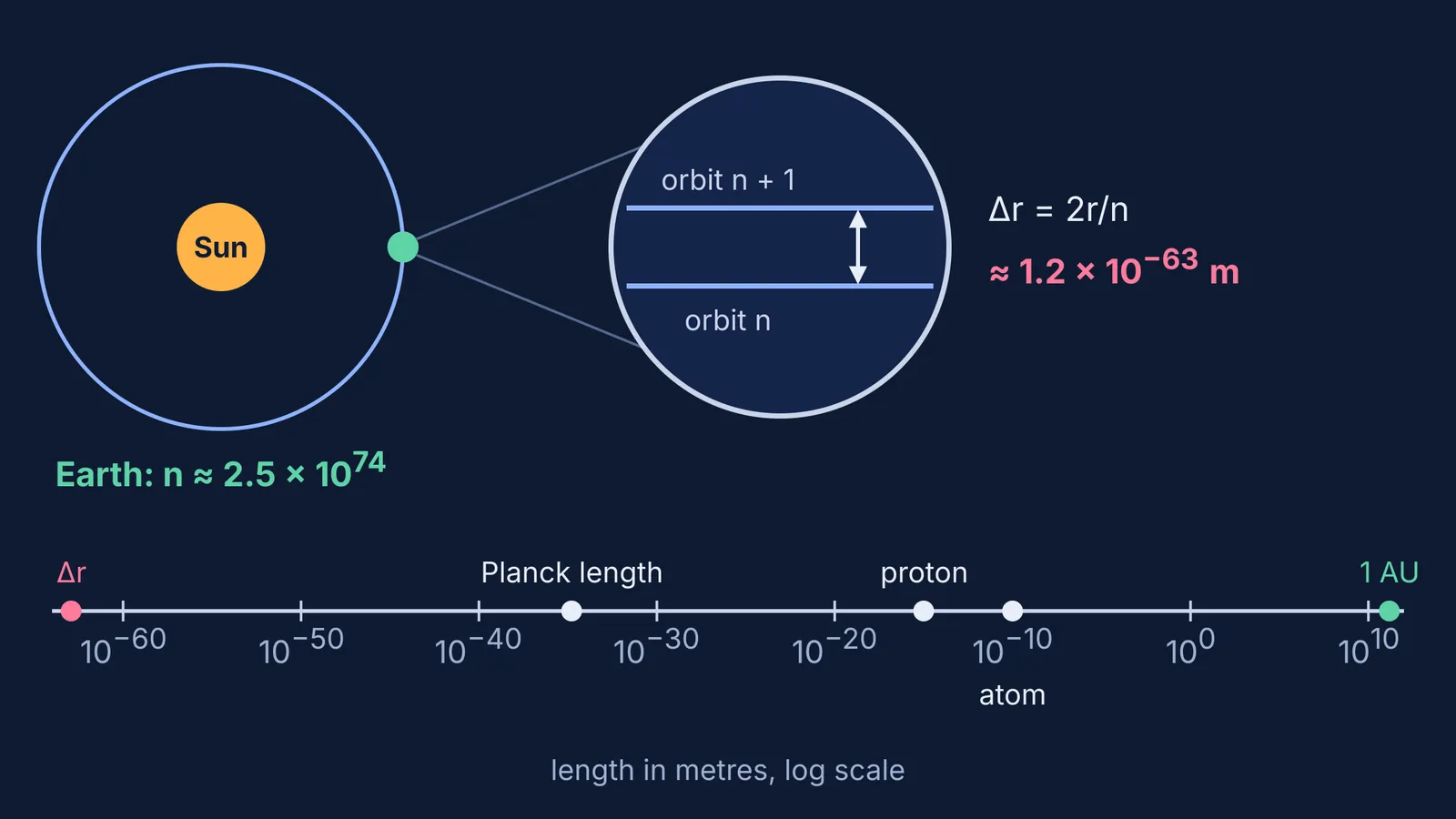
Divide by ħ. n = L/ħ = 2.66 × 10⁴⁰ / 1.055 × 10⁻³⁴ = 2.5 × 10⁷⁴.
The answer often quoted for this exercise is about 2.6 × 10⁷⁴. That comes from rounding the data to r = 1.5 × 10¹¹ m and M = 6 × 10²⁴ kg. Either is fine; the point is the order of magnitude, 10⁷⁴.
Why must you use orbital angular momentum and ħ?
Two slips change the answer by large factors.
Spin instead of orbit. The Earth's spin angular momentum is only about 6 to 7 × 10³³ kg m²/s, depending on the moment of inertia you use. That estimate is worked in angular momentum of Earth due to rotation. The orbital value is about 4 million times larger. Bohr's rule here is about the motion round the Sun, so use Mvr.
h instead of ħ. Bohr's condition is L = nh/2π = nħ. Dividing by h instead gives 4.0 × 10⁷³, which is 2π times too small.
How far apart would neighbouring Bohr orbits of the Earth be?
Since r ∝ n², a small change in n gives Δr/r ≈ 2Δn/n. For neighbouring orbits, Δn = 1, so:
Δr ≈ 2r/n = 2 × 1.496 × 10¹¹ / 2.52 × 10⁷⁴ = 1.2 × 10⁻⁶³ m.
Compare with the Planck length, 1.616 × 10⁻³⁵ m (CODATA value at NIST), often taken as the scale below which our ideas of distance stop making sense. The spacing is about 10²⁸ times smaller than that.
A proton is about 10⁻¹⁵ m across. The spacing between allowed orbits is about 10⁴⁸ times smaller than a proton.
The energies tell the same story. The orbital energy is E = −GM_sM/2r ≈ −2.65 × 10³³ J. Since E ∝ 1/n², neighbouring levels differ by about 2|E|/n ≈ 2.1 × 10⁻⁴¹ J. No instrument could ever pick out a step that small in an energy of 10³³ J.
Why don't we see quantised planetary orbits?
Because the allowed orbits are so close together that they form, for every practical purpose, a continuum. Any radius you could ever measure contains an astronomically large number of allowed orbits. The quantisation is there in principle and invisible in practice.
This is Bohr's correspondence principle: when quantum numbers are very large, quantum results merge with classical ones. In hydrogen, n is 1, 2 or 3, and the gaps between levels decide the colours of the spectrum. For the Earth, n is about 10⁷⁴, and classical mechanics works perfectly.
Be careful about how strongly you state this. Planetary orbits are not quantised in any measurable sense. Real orbits are also ellipses, and the other planets constantly tug on them, changing L by amounts enormously larger than ħ. This exercise is a scale argument: it shows why a rule that dominates the atom has no visible effect on the solar system. It is not a claim that Bohr's model describes planets.
The de Broglie picture gives the same message. Bohr's rule is equivalent to fitting a whole number of wavelengths round the orbit, as shown in Bohr's quantisation from de Broglie waves. For the Earth, the de Broglie wavelength h/Mv is about 3.7 × 10⁻⁶³ m, so 10⁷⁴ wavelengths fit round the orbit.
How is this different from a hydrogen atom held by gravity?
A related exercise turns the problem inside out: keep the hydrogen atom, but replace the electric force by gravity, and find the new Bohr radius. That gives a radius far larger than the observable universe and is covered in if gravity held the hydrogen atom. Here the force and the scale are both planetary, and the question is the size of n. Do not mix up the two.
If you want more practice on Bohr-model numericals with every step shown, the Fermi Problem Library has a step-by-step solver that explains the reasoning.
Quick checklist
Bohr's rule for a planet: Mvr = nħ, with gravity giving r = n²ħ²/(GM_sM²).
v = 2πr/T ≈ 2.98 × 10⁴ m/s; L = Mvr ≈ 2.66 × 10⁴⁰ kg m²/s.
n = L/ħ ≈ 2.5 × 10⁷⁴ (about 2.6 × 10⁷⁴ with rounded data).
Use orbital, not spin, angular momentum, and ħ, not h.
Neighbouring orbits: Δr ≈ 2r/n ≈ 1.2 × 10⁻⁶³ m, far below the Planck length.
Large n means classical behaviour: the correspondence principle.


