

On this page
Here is a thought experiment from the NCERT Class 12 chapter on atoms. Suppose the electron and the proton in a hydrogen atom attracted each other only by gravity, with no electric force at all. How big would the first Bohr orbit be? The answer is about 1.2 × 10²⁹ m, roughly 270 times the radius of the observable universe. Working it out takes four lines, and it shows in one number how weak gravity is between particles.
What does the question ask you to change?
Only the force. Everything else in the Bohr model stays the same: the electron moves in a circle around a fixed proton, and its angular momentum is quantised as mvr = nħ.
In real hydrogen the attraction is the Coulomb force, F = ke²/r², with k = 1/(4πε₀). Under gravity it becomes F = Gm_e m_p/r². Both are inverse-square forces, so the algebra is identical. You only swap the constant in the numerator:
Coulomb: ke²
Gravity: Gm_e m_p
Note that it is m_e m_p, the electron mass times the proton mass, because the force acts between an electron and a proton. Writing Gm_e² is a common slip, and it makes the answer about 1,840 times too large.
How do you get the Bohr radius for any inverse-square force?
Call the force constant K, so that F = K/r². The two Bohr conditions are:
Centripetal force: m_e v²/r = K/r²
Quantised angular momentum: m_e v r = nħ
From the second, v = nħ/(m_e r). Put this into the first and solve for r:
r = n²ħ²/(m_e K)
For K = ke² this is the familiar a₀ = 5.29 × 10⁻¹¹ m. If you want the full derivation with the Coulomb force, see how to derive the radius and energy of the nth Bohr orbit. Here you just use the general result with the new K.
Worked example: the gravitational Bohr radius
Data (standard values): ħ = 1.055 × 10⁻³⁴ J s, G = 6.674 × 10⁻¹¹ N m² kg⁻², m_e = 9.109 × 10⁻³¹ kg, m_p = 1.673 × 10⁻²⁷ kg.
Set K = Gm_e m_p and n = 1. Then r = ħ²/(G m_e² m_p). The electron mass appears squared: once from K and once from the m_e already in the formula.
Numerator. ħ² = (1.055 × 10⁻³⁴)² = 1.112 × 10⁻⁶⁸ J² s².
Denominator. m_e² = 8.297 × 10⁻⁶¹ kg². Multiply by G and m_p: 6.674 × 10⁻¹¹ × 8.297 × 10⁻⁶¹ × 1.673 × 10⁻²⁷ = 9.26 × 10⁻⁹⁸ N m² kg.
Divide. r = 1.112 × 10⁻⁶⁸ / 9.26 × 10⁻⁹⁸ ≈ 1.2 × 10²⁹ m.
Check the units. J² s² / (N m² kg⁻² × kg³) = (kg² m⁴ s⁻²) / (kg² m³ s⁻²) = m. A length, as it should be.
So the gravitational "hydrogen atom" would have a radius of about 1.2 × 10²⁹ m.
How big is 1.2 × 10²⁹ m?
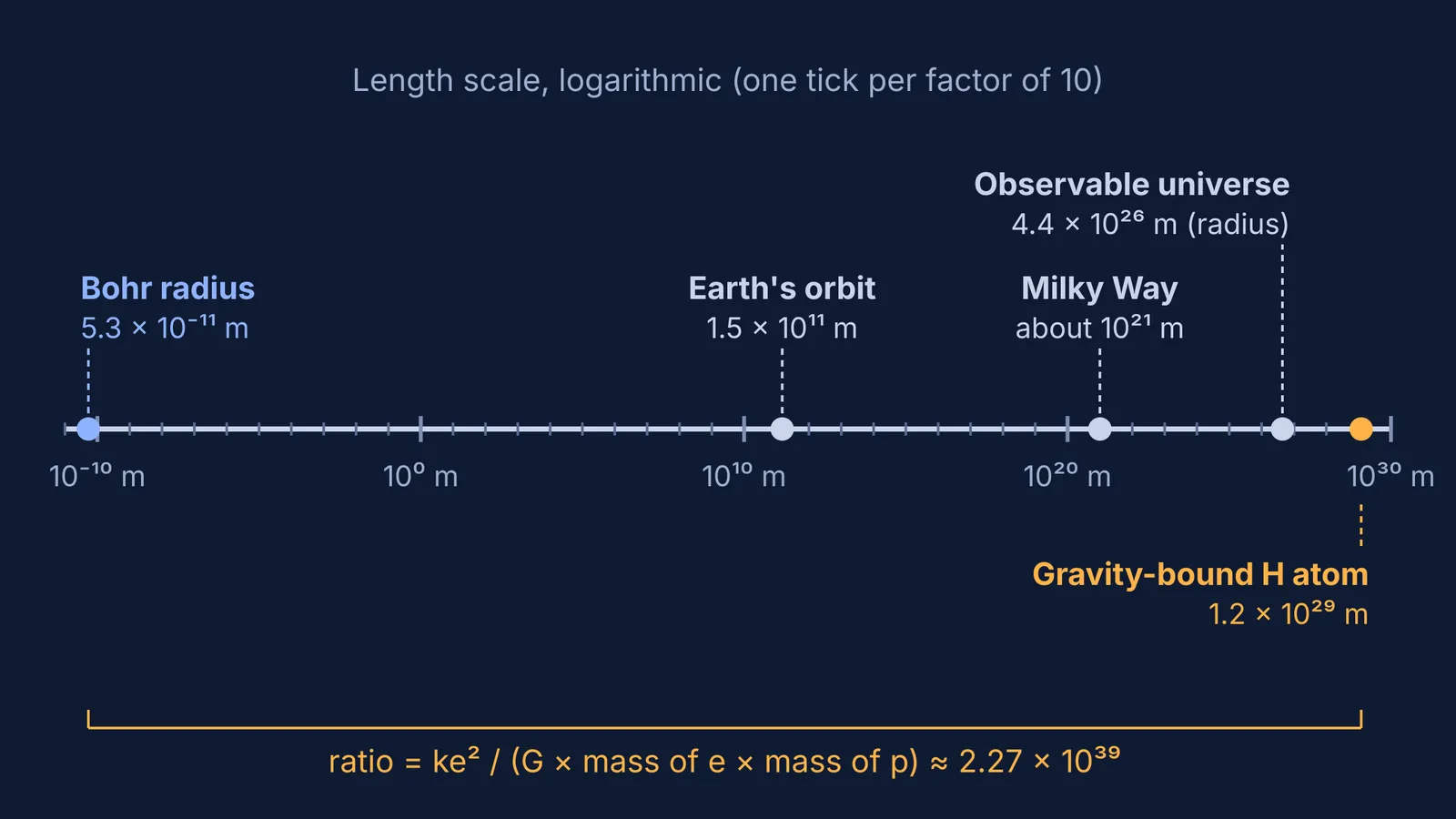
The numbers are hard to picture, so put them on one scale:
Real Bohr radius: 5.3 × 10⁻¹¹ m
Earth's orbit around the Sun: 1.5 × 10¹¹ m
The Milky Way: roughly 10²¹ m across
Radius of the observable universe: about 4.4 × 10²⁶ m (about 46 billion light-years)
Gravitational Bohr radius: 1.2 × 10²⁹ m
The last two give 1.2 × 10²⁹ / 4.4 × 10²⁶ ≈ 270. A single "atom" held by gravity would be a few hundred times wider than everything we can observe.
Use 46 billion light-years for the radius of the observable universe, not 13.8 billion. Light that left 13.8 billion years ago has travelled for that long, but space has expanded since, so the sources are now much farther away. The 13.8 billion figure is the age, not the radius.
Why is the radius bigger by exactly the force ratio?
Because r is proportional to 1/K and nothing else changes. The ratio of the two radii is:
r(gravity)/a₀ = ke²/(Gm_e m_p)
That is the ratio of the electric to the gravitational force between an electron and a proton at any distance, about 2.27 × 10³⁹. It is computed in detail in the ratio of electric to gravitational force between electron and proton. This question turns that ratio into something you can see: weaken the force by 10³⁹ and the orbit grows by the same factor.
The energy changes even more. For any inverse-square force, E = −m_e K²/(2n²ħ²). The energy goes as K², so it falls by the square of the ratio, about 5.1 × 10⁷⁸:
Real hydrogen: E₁ = −13.6 eV
Gravitational hydrogen: E₁ ≈ −2.6 × 10⁻⁷⁸ eV
The orbital speed v = K/(nħ) also scales with K. It would be about 10⁻³³ m/s, compared with 2.2 × 10⁶ m/s in real hydrogen. One orbit would take around 10⁵⁵ years.
The same "change one input, keep the Bohr structure" method appears in muonic hydrogen, where the orbiting mass changes instead of the force. There the radius shrinks by about 186 times because m_e is replaced by a heavier mass.
If you want to practise more of these scaling questions, the Fermi Problem Library has a step-by-step solver that explains the reasoning, not just the final number.
What does this thought experiment really show?
It does not say that such atoms exist. A system bound this weakly would be pulled apart by almost anything: a passing photon, the gravity of a nearby particle, the expansion of space. The point is a comparison of strengths. Inside atoms, gravity is so weak that ignoring it costs nothing. That is why every atomic and chemical calculation in your syllabus uses only electric forces.
Gravity wins only at large scales, for two reasons. Mass is never negative, so it always adds up. Charges come in plus and minus, and large bodies are almost exactly neutral, so the electric forces cancel.
A small correction you can ignore: the proton is not truly fixed. Using the reduced mass changes the answer by about 0.05%, far below the precision of a two-significant-figure estimate.
What mistakes cost marks on this question?
Writing Gm_e² instead of Gm_e m_p for the gravitational force.
Forgetting that m_e appears twice in r = ħ²/(G m_e² m_p).
Multiplying a₀ by the force ratio the wrong way round and getting a tiny radius.
Comparing with 13.8 billion light-years as if it were the size of the universe.
Saying the energy changes by 10³⁹. It changes by about 10⁷⁸, the square.
Quick checklist
Swap ke² for Gm_e m_p in the Bohr formulas.
r = ħ²/(G m_e² m_p) ≈ 1.2 × 10²⁹ m, about 270 times the radius of the observable universe.
The radius grows by the force ratio, 2.27 × 10³⁹.
The energy falls by the square of that ratio, to about −2.6 × 10⁻⁷⁸ eV.
Check units: the answer must come out in metres.
It is a comparison of forces, not a real atom.


