

On this page
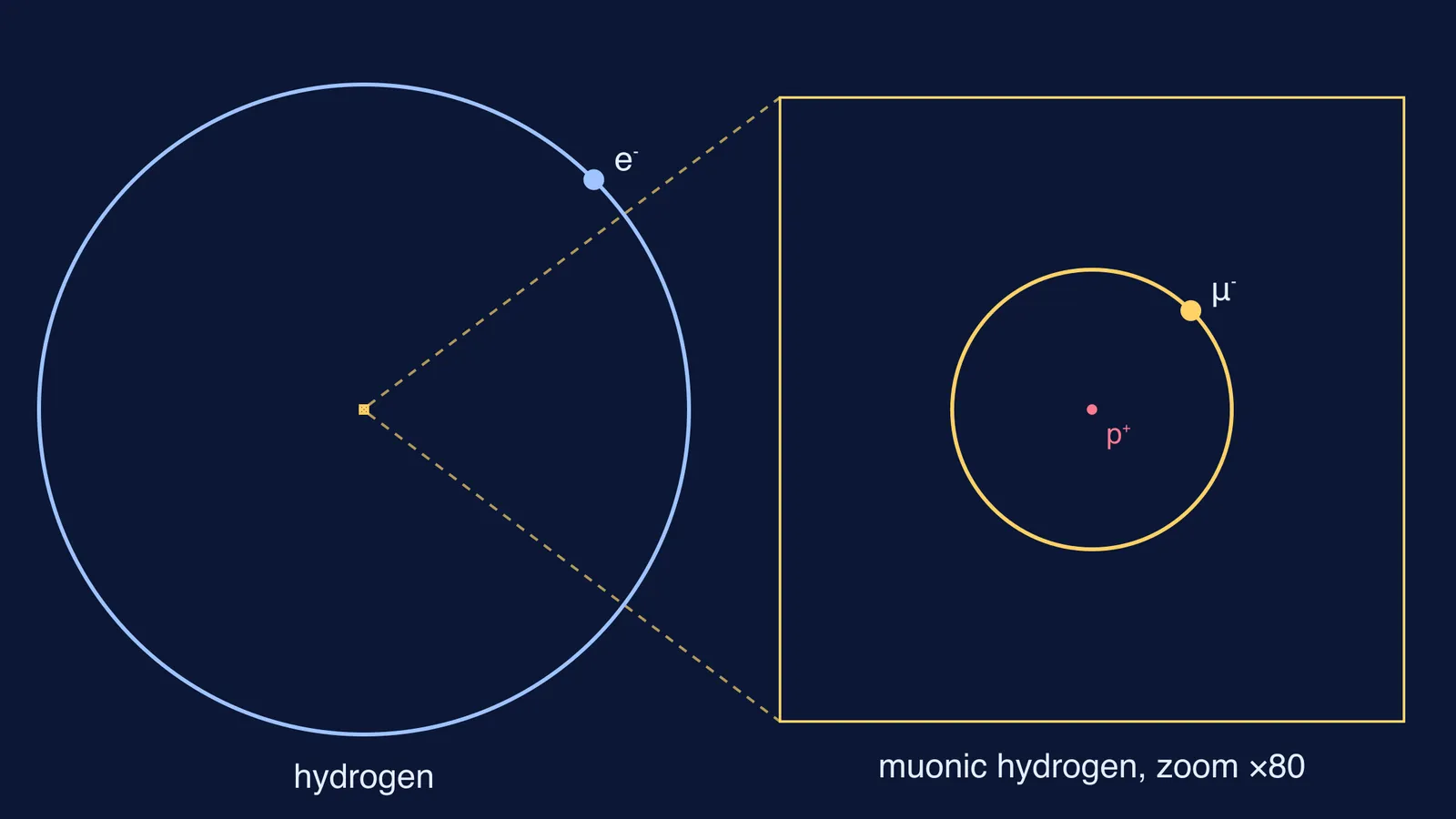
Swap the electron in a hydrogen atom for a muon and the atom shrinks about 186-fold and binds about 186 times more tightly, computed from the CODATA 2022 constants published by NIST. The muon has the same charge as the electron, so the Bohr model needs only one change: the mass.
What is muonic hydrogen?
Muonic hydrogen is a proton with a negative muon bound to it in place of the electron. The muon is a heavier cousin of the electron, first spotted in cosmic rays (how Anderson and Neddermeyer discovered the muon). The muon's mass is 206.768 times the electron's mass, according to the CODATA 2022 muon-electron mass ratio at NIST.
How does a heavier particle change the Bohr radius and energy?
If you have derived the radius and energy of the nth Bohr orbit, you already have the two results you need:
Radius: r = n² × 4πε₀ħ² / (m e²), so r goes as 1/m.
Energy: E = −m e⁴ / (8ε₀² h² n²), so E goes as m.
Make the orbiting particle k times heavier and the radius divides by k while every energy level is multiplied by k. The hydrogen reference values are the Bohr radius, 5.29177 × 10⁻¹¹ m (NIST, CODATA 2022), and the Rydberg energy, 13.6057 eV (NIST, CODATA 2022). Both assume a nucleus that never moves.
Why use the reduced mass instead of 207?
In reality the proton and the orbiting particle both circle their common centre of mass. The fix is to replace m with the reduced mass, μ = mM / (m + M), where M is the nuclear mass.
For ordinary hydrogen this barely matters. The proton is 1836.15 times the electron's mass (NIST, CODATA 2022), so μ = 0.99946 electron masses.
For the muon it matters a lot. Dividing 1836.15 by the muon's 206.77 (NIST, CODATA 2022) shows the proton is only about 8.9 times heavier than the muon, so the proton wobbles noticeably. The reduced mass of muonic hydrogen is (206.768 × 1836.153) / (206.768 + 1836.153) ≈ 185.84 electron masses.
Worked example: radius and energy of muonic hydrogen
Using the CODATA 2022 Bohr radius and Rydberg energy from NIST:
Reduced mass: μ ≈ 185.84 electron masses.
Ground-state radius: r₁ = a₀ × (mₑ/μ) = 52,918 fm / 185.84 ≈ 285 fm, or 2.85 × 10⁻¹³ m.
Ground-state energy: E₁ = −13.606 eV × 185.84 ≈ −2528 eV, about −2.53 keV.
Ordinary hydrogen (μ = 0.99946 mₑ) gives r₁ ≈ 52,946 fm and E₁ ≈ −13.598 eV, so the muonic atom is 185.84 / 0.99946 ≈ 186 times smaller and more tightly bound.
First Lyman line (n = 2 to n = 1): ΔE = ¾ × 2528 eV ≈ 1.9 keV. Hydrogen's is 10.2 eV (ultraviolet); this one is an X-ray.
The same scaling works for every level: r = 285 fm × n² and E = −2528 eV / n². For more practice, try these hydrogen spectrum problems.
Why do physicists care about such a small atom?
A smaller orbit puts the muon much closer to the proton. The proton's charge radius is 0.84075 fm (NIST, CODATA 2022), so the muon's ground-state radius is only about 340 proton radii, against about 63,000 for the electron in ordinary hydrogen. In the quantum ground state, the probability density at the nucleus scales as 1/r₁³, so for the muon it is about 186³, or 6.4 million, times larger.
In 2010, Randolf Pohl and colleagues' Nature paper, "The size of the proton" noted that muonic hydrogen's much smaller Bohr radius enhances effects related to the proton's finite size. From a measured muonic Lamb shift they found a proton charge radius of 0.84184 fm, 5.0 standard deviations from the CODATA value of the time, 0.8768 fm (abstract on PubMed). The CODATA 2022 value, 0.84075 fm, sits close to the muonic result.
How do you solve muonic atom questions in an exam?
Name the orbiting particle (charge, mass in electron masses) and the nucleus (Z).
Check whether the nucleus is treated as infinitely heavy: if so, use 207; if not, the reduced mass.
Scale from hydrogen: radius divides by Zμ, energy multiplies by Z²μ.
Sanity-check the direction: heavier particle means smaller orbit and deeper levels.
Watch units: muonic radii come out in femtometres, not picometres.
If a scaling step keeps going wrong, the Fermi Problem Library has worked problems with a step-by-step solver that explains the reasoning rather than printing an answer. To revisit reduced mass or the Bohr model itself, each idea has its own lesson in the Fermi Concept Library.
Next time you meet a positronium or muonic atom question, start with one line: find μ, then scale.


