

On this page
Bohr's second postulate says the electron's angular momentum can only be a whole-number multiple of h/2π. Bohr brought the rule in as a postulate in his 1913 paper On the constitution of atoms and molecules, and the NCERT Class 12 Atoms chapter calls it "perhaps the most puzzling" of his postulates. Section 12.6 of that chapter shows where the rule comes from: treat the electron as a wave and ask which waves can survive on a circle.
What does it mean to fit whole wavelengths around an orbit?
Start with a plucked string. The NCERT chapter explains that only the waves that fit the string survive as standing waves; waves with other wavelengths interfere with themselves and their amplitudes quickly drop to zero.
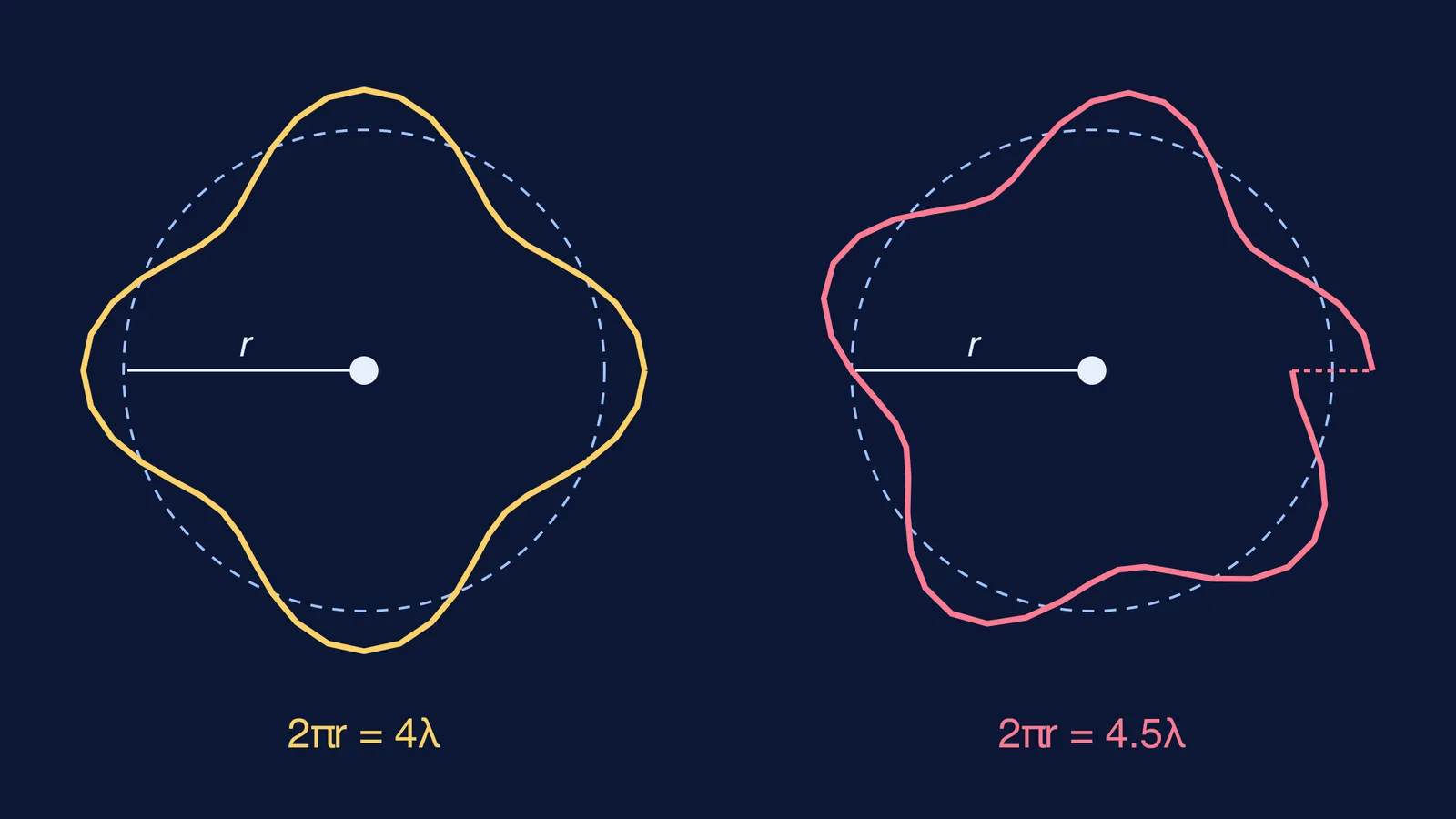
A circular orbit has no ends, but the same idea applies. After one lap, the wave arrives back where it started. If the circumference holds exactly 4 wavelengths, crest lands on crest and the pattern repeats on every lap. If it holds 4.5 wavelengths, crest lands on trough and the wave cancels itself out.
So the standing-wave condition for the nth orbit is 2πr = nλ, with n = 1, 2, 3 and so on (NCERT, Eq. 12.12).
How do you get mvr = nh/2π from 2πr = nλ?
The whole derivation is four lines:
Standing-wave condition: 2πr = nλ.
de Broglie wavelength: λ = h/p, and for speeds much less than light, p = mv. So λ = h/mv.
Substitute: 2πr = nh/mv.
Rearrange: mvr = nh/2π.
Line 4 is L = nh/2π, Bohr's quantisation condition, now derived instead of assumed. In the NCERT text's words, "only resonant standing waves can persist."
Notice that n now does two jobs: it is the principal quantum number and the number of de Broglie waves in the nth Bohr orbit.
The wave idea was more than a trick. C. Davisson and L. H. Germer reported electron diffraction from a nickel crystal in 1927 (Physical Review 30, 705).
Does it work with real numbers for hydrogen?
Yes. Use the CODATA values from NIST: the Bohr radius is 5.29 × 10⁻¹¹ m, the Planck constant is 6.626 × 10⁻³⁴ J s, and the electron mass is 9.109 × 10⁻³¹ kg.
Speed in the first orbit, from mvr = h/2π: v = h/(2πmr) ≈ 2.19 × 10⁶ m/s, matching the atomic unit of velocity NIST lists.
de Broglie wavelength: λ = h/mv ≈ 3.32 × 10⁻¹⁰ m.
Circumference: 2πr = 2π × 5.29 × 10⁻¹¹ m ≈ 3.32 × 10⁻¹⁰ m. Exactly one wavelength, so n = 1.
Now try n = 2. The radius grows as n², so r = 4 × 5.29 × 10⁻¹¹ m ≈ 2.12 × 10⁻¹⁰ m (NCERT summary). Since mvr = 2h/2π and r is four times bigger, v is halved to about 1.09 × 10⁶ m/s. That doubles λ to about 6.65 × 10⁻¹⁰ m. The circumference is 2π × 2.12 × 10⁻¹⁰ m ≈ 1.33 × 10⁻⁹ m, which is 2 wavelengths. For the full radius and energy formulas, see how to derive the radius and energy of the nth Bohr orbit.
Where do students lose marks on this derivation?
Using the string condition on a ring. A string fixed at both ends fits half-wavelengths, L = nλ/2. On a closed orbit there are no ends, so the condition is simply circumference = nλ.
Skipping the momentum step. Write λ = h/p, then p = mv, and say why: the electron's speed is much less than that of light.
Overclaiming. This argument explains Bohr's postulate; it does not make the orbit picture correct. NCERT's Points to Ponder note that the orbital picture is inconsistent with the uncertainty principle and was replaced by quantum mechanics.
Mixing up the postulates. Know which of Bohr's three postulates this explains. Our explainer on what each Bohr postulate fixes lays them side by side.
How should you practise it before boards or JEE?
A 10-minute recall plan, done twice a few days apart:
On a blank page, draw rings with 4 and 4.5 wavelengths. Say aloud why only one survives.
Write the four derivation lines from memory, including v much less than c.
Redo the hydrogen check for n = 1.
Extend it: combine mvr = nh/2π with the force balance to get the radius, then the energy.
Revise only the line you hesitated on.
If one link in the chain feels shaky, the Fermi Concept Library covers each concept in physics with its own lesson and shows where it sits in the map. For practice questions, the Fermi Problem Library has worked problems with a step-by-step solver that explains the reasoning rather than printing an answer.
Once you can draw the ring and write the four lines without looking, the postulate becomes a result you can rebuild, not a rule to memorise.


