

On this page
Every slip below is checked against NCERT Class 11 Biology, Chapter 15, Body Fluids and Circulation (NCERT chapter kebo115, Reprint 2026-27), which the NMC's NEET (UG) 2026 syllabus places in Unit 5, Human Physiology. Each has the wrong belief, why it tempts, what NCERT says, our own check and a habit. For the whole unit, our Human Physiology for NEET preparation plan is the place to begin.
Which blood numbers get swapped?
Section 15.1 of the NCERT chapter packs percentages and counts close together, so they swap easily.
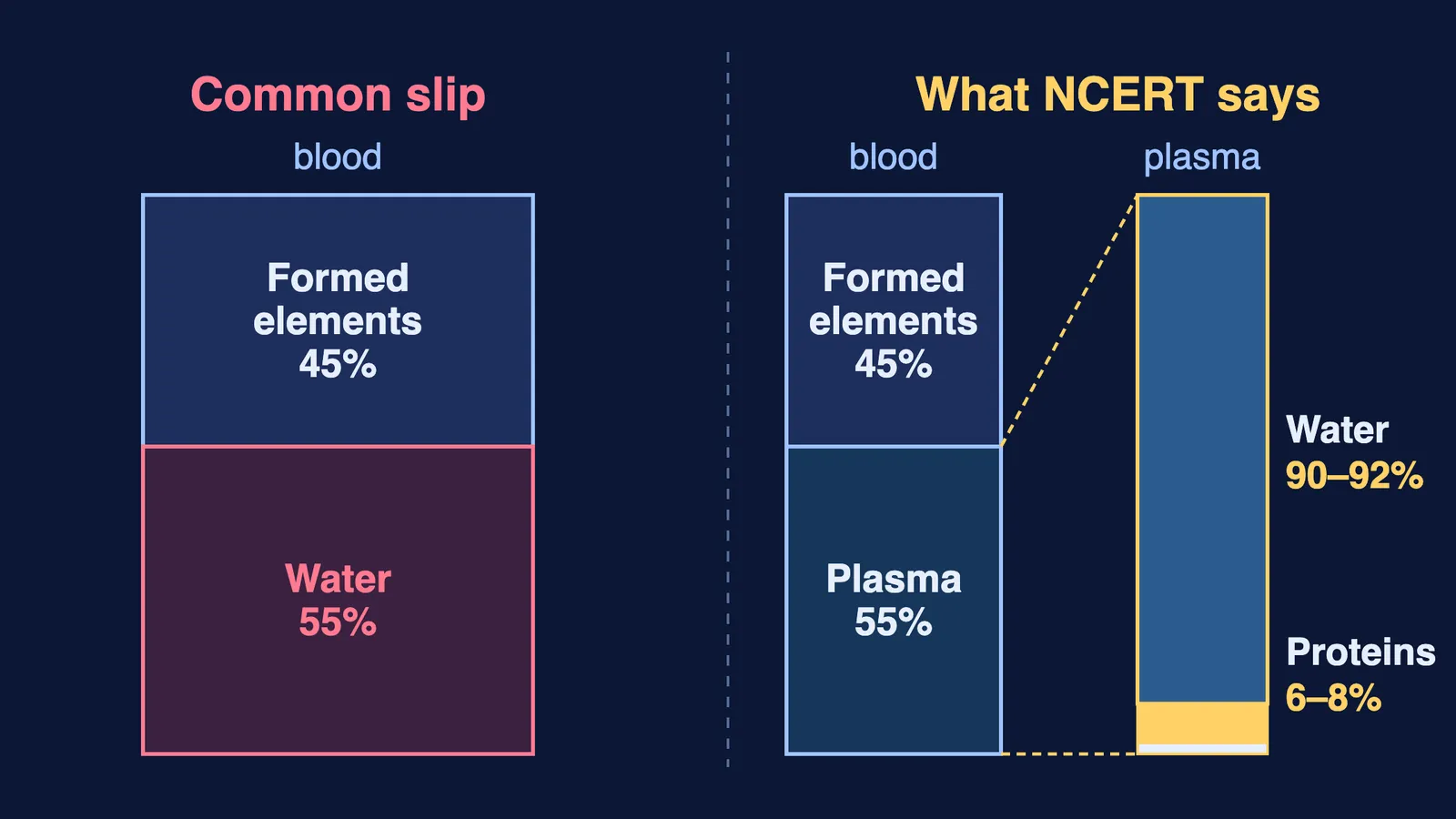
"Plasma is 55 per cent water."
Why it tempts: two figures, 55 and 90-92, both describe the liquid part of blood, so they merge into one.
What NCERT says (15.1.1): plasma makes up nearly 55 per cent of blood, while water makes up 90-92 per cent of the plasma itself and proteins 6-8 per cent. Formed elements are the remaining 45 per cent of blood (15.1.2).
Check: in a 100 mL blood sample, about how much is plasma, and roughly how much of that plasma is water? (About 55 mL, of which around 50 mL is water.)
Habit: before writing any percentage, name its whole: per cent of blood, or per cent of plasma.
"Neutrophils are the most abundant cells in blood."
Why it tempts: NCERT does call neutrophils the most abundant, but that sentence is about leucocytes only.
What NCERT says (15.1.2): erythrocytes are the most abundant of all blood cells; a healthy adult man averages 5 to 5.5 million RBCs per mm³. WBCs average 6000-8000 per mm³, and neutrophils are 60-65 per cent of them.
Check: rank RBCs, neutrophils and lymphocytes by count per mm³. (RBCs, then neutrophils, then lymphocytes, which are 20-25 per cent of WBCs.)
Habit: underline the group every superlative belongs to: all blood cells, or total WBCs.
"RBCs are made in the spleen."
Why it tempts: the spleen is the organ named in NCERT's RBC paragraph, as their graveyard, so it gets both jobs.
What NCERT says (15.1.2): in adults, RBCs form in the red bone marrow. After an average life span of 120 days they are broken down in the spleen, which NCERT calls their graveyard.
Check: for an adult RBC, fill the blanks: made in ___, removed in ___. (Red bone marrow; spleen.)
Habit: learn each cell as a life line: made where, lasts how long, removed where.
Why do ABO and Rh antibodies behave differently?
"An Rh-negative person always has anti-Rh antibodies in the plasma."
Why it tempts: ABO teaches that plasma carries antibodies against the antigen its own RBCs lack, and students stretch that rule to Rh.
What NCERT says: in ABO grouping (15.1.3.1), plasma contains two natural antibodies, laid out group by group in Table 15.1. In Rh grouping (15.1.3.2), an Rh-negative person makes anti-Rh antibodies only after being exposed to Rh-positive blood.
Check: someone with group B, Rh-negative blood has never had a transfusion or a pregnancy. Which antibody does NCERT's account place in their plasma? (Anti-A only.)
Habit: tag ABO antibodies "natural" and Rh antibodies "made after exposure".
This is a study summary, not medical advice.
Where does it happen: chambers, nodes or vessels?
These follow Sections 15.3 and 15.3.1 of the NCERT chapter.
"In amphibians, the two kinds of blood mix in the atria."
Why it tempts: "incomplete double circulation" sounds like mixing everywhere.
What NCERT says (15.3): amphibians and most reptiles have two atria and one ventricle. The left atrium takes in oxygenated blood from the gills, lungs or skin, the right atrium takes deoxygenated blood from the body, and the two are mixed in the one ventricle, which sends out mixed blood.
Check: in a frog's heart, which chamber receives oxygenated blood, and where does NCERT say mixing happens? (Left atrium; the ventricle.)
Habit: trace one drop, chamber by chamber, before naming the circulation type.
"Open circulation means there are no blood vessels."
Why it tempts: "open" suggests blood simply washing around.
What NCERT says (15.3): in arthropods and molluscs the heart pumps blood through large vessels, and these open into body spaces called sinuses. In the closed pattern of annelids and chordates, blood never leaves its network of vessels.
Check: in an insect, what does blood travel through after leaving the heart and before reaching the sinuses? (Large vessels.)
Habit: define "open" by where the blood ends up, not by whether vessels exist.
"Only the SAN can generate action potentials."
Why it tempts: the label "pacemaker" makes the SAN sound like the single source of impulses.
What NCERT says (15.3.1): all nodal musculature is autoexcitable, but the number of action potentials per minute differs across the nodal system. The SAN sets the pace because it produces the most, 70-75 per minute.
Check: NCERT says the rate varies across parts of the nodal system. Why would that line make no sense if the AVN could not fire at all? (A rate can only vary between tissues that all fire.)
Habit: read "pacemaker" as "fastest", never as "only".
Which nerve signal does what to the heart?
"Parasympathetic signals change only the heart rate."
Why it tempts: "slows the heart" is the usual one-line summary, so the second effect drops out.
What NCERT says (15.5): sympathetic signals speed the heartbeat and make the ventricles contract more strongly, so cardiac output rises. Parasympathetic signals lower the heart rate and also slow the conduction of the action potential, so cardiac output falls. Adrenal medullary hormones can also raise cardiac output.
Check: list each branch's effects in two columns. Which item appears only under parasympathetic, and which only under sympathetic? (Conduction speed; strength of ventricular contraction.)
Habit: learn each branch's list as NCERT gives it, never by flipping the other.
A 60-second self-check before you mark
Percentage: of blood, or of plasma?
Superlative: of all blood cells, or of one type?
Organ: where a cell is made, or where it is removed?
Antibody: natural (ABO) or made after exposure (Rh)?
Chamber: atrium or ventricle, and on which side?
Nerve signal: which branch, and which of rate, strength or conduction?
For practice in a different format, try our NCERT exceptions and odd-one-out questions on this chapter.
Not sure which of these slips is yours? Fermi's AI tutor works out what you already know and builds a plan for the session.


