On this page
The NEET (UG) 2026 syllabus puts Biomolecules in the Biology unit on Cell Structure and Function (Unit 3), as the chemical constituents of living cells; learn it from Chapter 9 of Class 11 NCERT Biology. Many slips here come from stretching a narrow rule one step too far.
Below are nine frequent slips, grouped by the kind of mix-up. Each one has why it catches people, what the NCERT chapter (Reprint 2026-27) actually says with its section number, a quick original check, and a habit to prevent it. If you are only starting the chapter, our NCERT-first plan for preparing Biomolecules sets out the order.
What is actually inside a cell?
"The acid-soluble pool holds only organic compounds."
Why it happens: the chapter stresses the thousands of organic compounds in the filtrate, so students stop there.
What NCERT says (9.1): inorganic compounds such as sulphate and phosphate also show up in the acid-soluble fraction, and the ash left after a dried tissue is fully burnt carries inorganic elements like calcium and magnesium.
Check: a filtrate from ground liver tests positive for phosphate ions. Did the experiment go wrong? (No. That is expected.)
Habit: read "acid-soluble" as "small", not as "organic".
"After water, carbohydrates must be the biggest share of a cell."
Why it happens: sugars dominate the energy chapters, so they feel abundant.
What NCERT says (Table 9.4, section 9.3): by share of total cellular mass, water is 70-90%, proteins 10-15%, then nucleic acids at 5-7%, carbohydrates at 3%, lipids at 2% and ions at 1%.
Check: rank carbohydrates, lipids and nucleic acids from largest share to smallest. (Nucleic acids, then carbohydrates, then lipids.)
Habit: learn Table 9.4 as a ranked list from top to bottom, not as loose numbers.
Which look-alike terms get swapped?
"Fats and oils are chemically different classes of lipid."
Why it happens: a solid and a liquid feel like different substances.
What NCERT says (9.1): both are glycerides, fatty acids esterified with glycerol; the name follows the melting point, and oils melt at the lower temperature.
Check: glyceride A sets solid on a cool morning while glyceride B stays runny. Which is the oil, and which has the higher melting point? (B is the oil; A melts higher.)
Habit: say "same chemistry, different melting point" whenever fat and oil appear together.
"A co-enzyme is just another name for a vitamin."
Why it happens: NAD and niacin are taught in the same breath.
What NCERT says (9.8.6): a co-enzyme is an organic cofactor that joins the apoenzyme only briefly; vitamins are essential chemical parts of many co-enzymes, so NAD and NADP contain niacin rather than being niacin.
Check: in "NADP contains niacin", which word names the co-enzyme and which names the vitamin? (NADP is the co-enzyme; niacin is the vitamin inside it.)
Habit: read "contains" as part-of, never as equals.
"Secondary metabolites are leftovers with no use."
Why it happens: "secondary" sounds like "second-rate".
What NCERT says (9.2): the roles of all secondary metabolites in their host organisms are not yet understood, but many serve human welfare (rubber, drugs, spices, scents, pigments) and some have ecological importance.
Check: "Because their roles in the host are not all known, secondary metabolites are useless to people." Which half does NCERT support? (Only the first.)
Habit: "not fully understood" never means "useless".
How do the protein structure levels get mixed up?
"At the secondary level, the whole chain coils into one long helix."
Why it happens: diagrams often show one neat helix.
What NCERT says (9.7): only some stretches of the thread form helices, all right-handed, while other stretches fold into other forms; Figure 9.3 shows a beta-pleated sheet beside the alpha helix.
Check: a sketch shows one chain as an unbroken helix from N-terminal to C-terminal. What does NCERT correct? (Only some portions are helical.)
Habit: picture secondary structure as local patches along one chain.
"Haemoglobin has four identical subunits."
Why it happens: the number four sticks; the two kinds get dropped.
What NCERT says (9.7): adult human haemoglobin has 4 subunits, two of the α type and two of the β type, and how they sit together is its quaternary structure.
Check: how many kinds of subunit does adult human haemoglobin have, and how many copies of each? (Two kinds, two copies each.)
Habit: write it as 2α + 2β, never as a bare "4".
What does an enzyme change, and what does it leave alone?
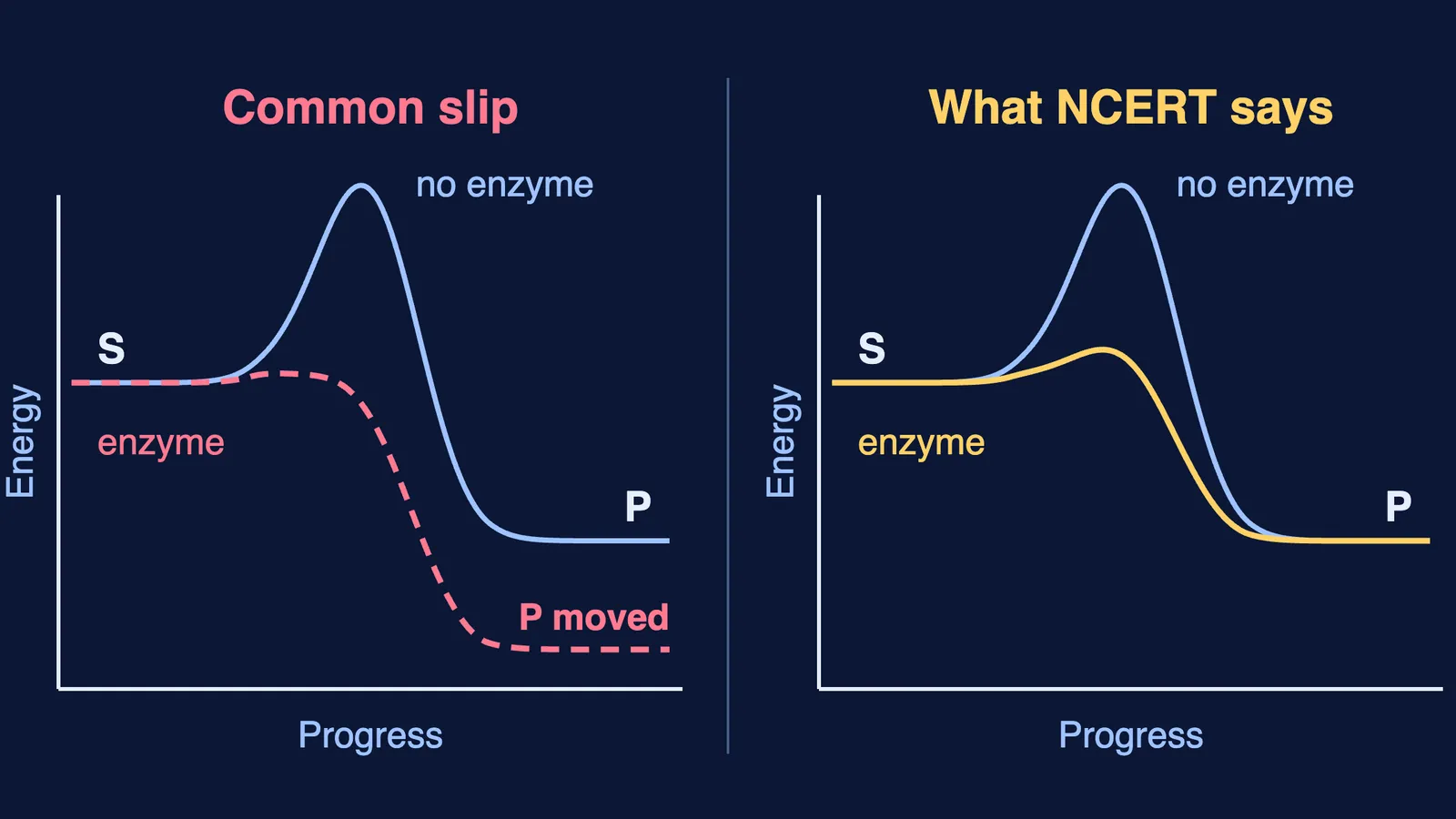
"An enzyme makes a reaction give out more energy."
Why it happens: "lowers the barrier" gets heard as "lowers the product".
What NCERT says (9.8.2): a reaction is exothermic when the product sits below the substrate, and enzymes bring down the activation energy, the climb from substrate to transition state. In Figure 9.4 both paths start at one substrate level and end at one product level.
Check: without the enzyme, P sits above S. Once the enzyme is added, is the reaction exothermic? (No. Only the hump got lower.)
Habit: on any energy graph, move only the peak when you add an enzyme.
"A competitive inhibitor can bind anywhere on the enzyme."
Why it happens: "competes" gets read loosely as "interferes".
What NCERT says (9.8.4): a competitive inhibitor closely resembles the substrate and competes with it for the substrate-binding site, as malonate does with succinate at succinic dehydrogenase.
Check: chemical X looks nothing like the substrate and attaches far from the active site, yet activity drops. Does X fit NCERT's description of a competitive inhibitor? (No. It has neither feature.)
Habit: before writing "competitive", confirm two things: it looks like the substrate, and it fights for the same site.
A 60-second self-check before you mark
When a check above trips you, write the wrong belief and NCERT's version side by side with the section number, then redo the check two days later without looking. For the rules NCERT itself bends, such as ribozymes and inulin, try our Biomolecules exceptions and odd-one-out questions.
Not sure which of these slips are yours? Fermi's AI tutor works out what you already know and builds a plan for the session.