

On this page
Potassium fluoride soaks up hydrogen fluoride to give a stable white salt, KHF₂, potassium hydrogen difluoride. Try the same with potassium chloride and hydrogen chloride and nothing useful happens: no KHCl₂ forms. The reason is one unusually strong hydrogen bond. It holds the bifluoride ion, HF₂⁻, together, and it also explains two odd facts about HF: why concentrated HF behaves as a stronger acid than dilute HF predicts, and why fluorine is made by electrolysing KHF₂ dissolved in HF.
What is the bifluoride ion, HF₂⁻?
HF₂⁻ forms when a fluoride ion accepts a hydrogen bond from an HF molecule:
HF + F⁻ ⇌ HF₂⁻
It balances: 1 H, 2 F and a 1− charge on each side.
Salts of it are easy to make: KF + HF → KHF₂, or KOH + 2HF → KHF₂ + H₂O. NaHF₂ and NH₄HF₂ are made the same way.
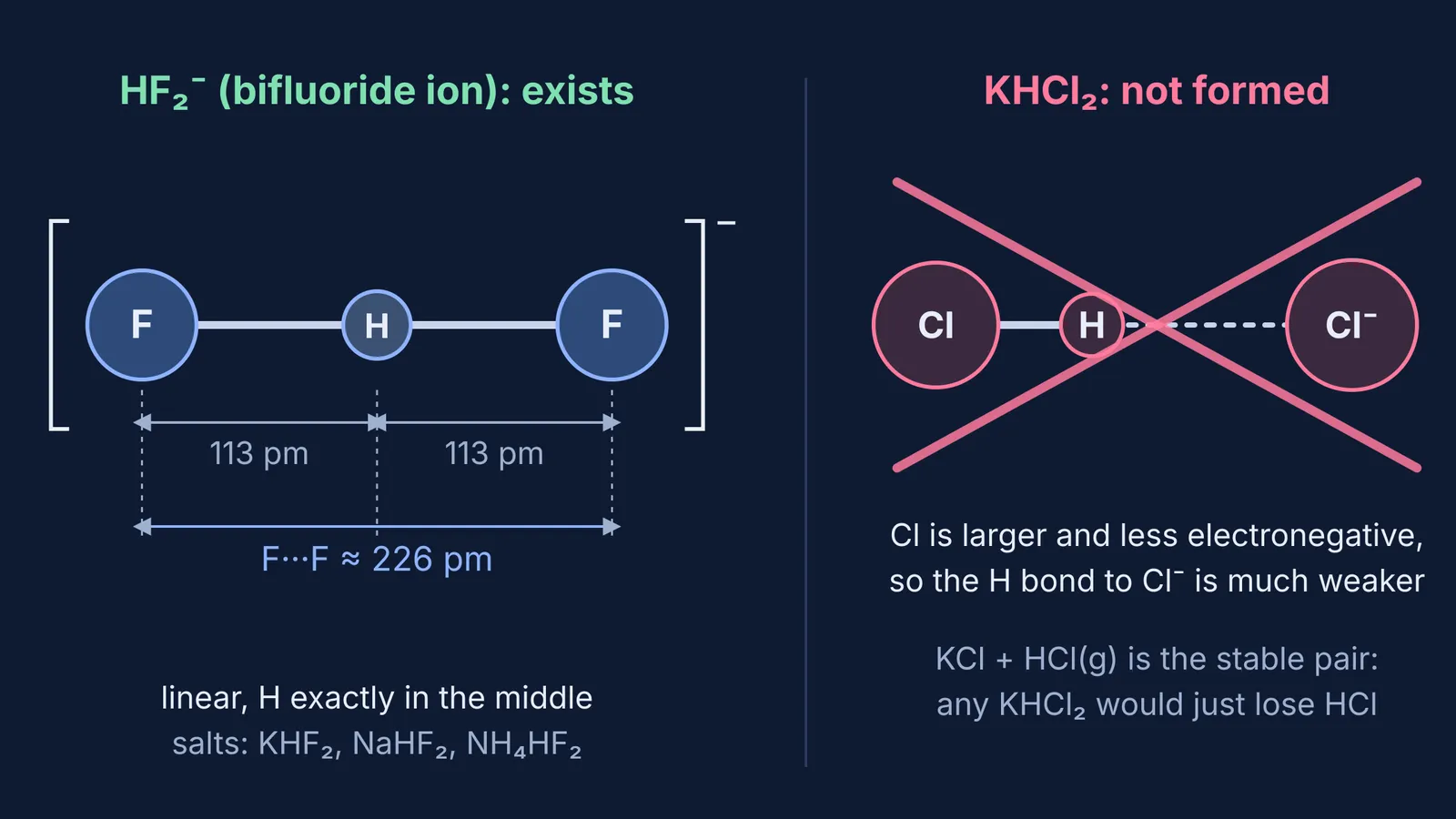
The ion is linear: F···H···F. X-ray and neutron studies of KHF₂ put the two fluorines about 226 pm apart with the hydrogen exactly in the middle, 113 pm from each. Compare that with the H–F bond in an HF molecule, which is about 92 pm. Both F–H distances are equal, so the hydrogen is shared by two fluorines in a three-centre bond, not a normal bond plus a hydrogen bond.
Why is the F–H–F hydrogen bond so strong?
A hydrogen bond is strongest when the donor and the acceptor are both small and very electronegative, and when the acceptor carries a full negative charge. HF₂⁻ meets every condition:
Fluorine is the most electronegative element (4.0 on the Pauling scale), so the H in HF carries a large partial positive charge.
Fluorine is small (covalent radius about 64 pm), so the charge is packed into a small volume and the atoms can get very close.
The acceptor is F⁻, a full anion, not the δ− end of a neutral molecule.
The result is a hydrogen bond worth roughly 160 to 190 kJ/mol in the gas phase (reported values differ with the method). An ordinary hydrogen bond, such as the one between two water molecules, is closer to 20 kJ/mol. That makes F–H–F the strongest hydrogen bond known, as strong as some covalent bonds. The weaker H-bonds in pure HF are what make it a liquid at room temperature, which is covered in why HF is a liquid but HCl is a gas.
Why does HCl not form KHCl₂?
Chlorine is larger (covalent radius about 99 pm) and less electronegative (3.0 on the Pauling scale). Both changes weaken the hydrogen bond. The H in HCl is less positive, and the charge on Cl⁻ is spread over a bigger ion, so H and Cl⁻ cannot get as close.
That is the answer to write in the exam, but it is slightly oversimplified. The HCl₂⁻ ion is not impossible. It has been detected in the gas phase and in salts with very large cations such as tetraalkylammonium ions. What fails is the potassium salt. Two things work against it:
The H-bond to Cl⁻ is much weaker, so forming HCl₂⁻ releases far less energy than forming HF₂⁻.
K⁺ prefers small Cl⁻. KCl has a high lattice energy. Swapping Cl⁻ for a bigger HCl₂⁻ ion would lower the lattice energy, and the weak H-bond cannot pay for that. So any KHCl₂ would simply give off HCl gas and fall back to KCl.
In water there is a third reason: HCl is a strong acid, so almost no HCl molecules are left to bond to Cl⁻.
How does HF₂⁻ make concentrated HF a stronger acid?
Dilute HF is a weak acid. The reasons, mainly the strong H–F bond and the way F⁻ is held by water, are explained in why HF is a weak acid but HI is a strong acid. There are two equilibria to track:
HF ⇌ H⁺ + F⁻, Ka ≈ 6.8 × 10⁻⁴ (tables give about 6.3 to 7.2 × 10⁻⁴)
HF + F⁻ ⇌ HF₂⁻, K ≈ 4 L/mol (reported values vary)
Add them and you get 2HF ⇌ H⁺ + HF₂⁻. The second step removes F⁻, which by Le Chatelier's principle pulls the first equilibrium to the right, and more so as [HF] rises.
Worked example: how much does HF₂⁻ raise [H⁺] in 1.0 M HF?
Treat the solution as ideal and ignore activity effects.
Without HF₂⁻. Let x = [H⁺] = [F⁻]. Then x²/(1.0 − x) = 6.8 × 10⁻⁴. Solving gives x ≈ 0.026 M, so the pH is about 1.59.
With HF₂⁻, write the charge balance. The positive ion is H⁺, the negative ions are F⁻ and HF₂⁻, so [H⁺] = [F⁻] + [HF₂⁻].
Express each anion through [HF] and [H⁺]. From step 1 of the equilibria, [F⁻] = Ka[HF]/[H⁺]. From step 2, [HF₂⁻] = K[HF][F⁻] = K·Ka[HF]²/[H⁺].
Substitute and rearrange. [H⁺]² = Ka[HF](1 + K[HF]).
First estimate with [HF] ≈ 1.0 M. [H⁺]² = 6.8 × 10⁻⁴ × 1.0 × 5.0 = 3.4 × 10⁻³, so [H⁺] ≈ 0.058 M.
Refine. Some HF has been used up: solving the full set of equations gives [HF] ≈ 0.905 M. Then [H⁺]² = 6.8 × 10⁻⁴ × 0.905 × 4.62 ≈ 2.84 × 10⁻³, so [H⁺] ≈ 0.053 M and the pH is about 1.27.
Compare. The bifluoride step roughly doubles [H⁺] in 1.0 M HF. At equilibrium there is about 0.042 M HF₂⁻ but only about 0.012 M free F⁻.
The factor (1 + K[HF]) in step 4 is the key. In 0.01 M HF it is only about 1.04, so HF₂⁻ hardly matters and HF behaves as a plain weak acid. In 1 M HF it is about 5, and it keeps growing. This is why concentrated HF is a much stronger acid than you would predict from Ka alone. Real concentrated solutions are far from ideal, so treat these numbers as a model.
If you want to practise multi-equilibrium problems like this one, the Fermi Problem Library has a step-by-step solver that explains the reasoning at each stage.
Why is fluorine made by electrolysing KHF₂ in HF?
Pure liquid HF is a very poor conductor of electricity, because it ionises only slightly. Dissolving KHF₂ in it provides plenty of K⁺ and HF₂⁻ ions, so current can flow. Moissan isolated fluorine this way in 1886; industry now uses molten KF·2HF.
At the anode: 2F⁻ → F₂ + 2e⁻
At the cathode: 2HF + 2e⁻ → H₂ + 2F⁻
Overall: 2HF → H₂ + F₂
Each equation balances in atoms and charge. HF is used up and topped up; water must be kept out completely. Why no chemical oxidising agent can do this job is explained in why fluorine is made by electrolysis.
Quick checklist
HF₂⁻ is linear, with H in the centre and F···F about 226 pm.
The F–H–F hydrogen bond is the strongest known, because F is small and the most electronegative element, and F⁻ is a full anion.
KHCl₂ does not form: the H-bond to Cl⁻ is weak, and K⁺ prefers the small Cl⁻ in KCl. HCl₂⁻ exists only with very large cations.
HF + F⁻ ⇌ HF₂⁻ removes F⁻ and pulls HF ⇌ H⁺ + F⁻ forward, so [H⁺]² = Ka[HF](1 + K[HF]).
F₂ is made by electrolysing KHF₂ in anhydrous HF; overall 2HF → H₂ + F₂.


