

On this page
In Class 12 inorganic chemistry, competitive exams frequently ask why halogens like chlorine and bromine can be prepared by chemical oxidation, whereas fluorine cannot. To isolate any free element from its anion, you must strip away electrons through oxidation. For fluoride ions (F⁻), this requirement collides with the thermodynamic limits of chemical reagents.
Why cannot chemical oxidants isolate elemental fluorine?
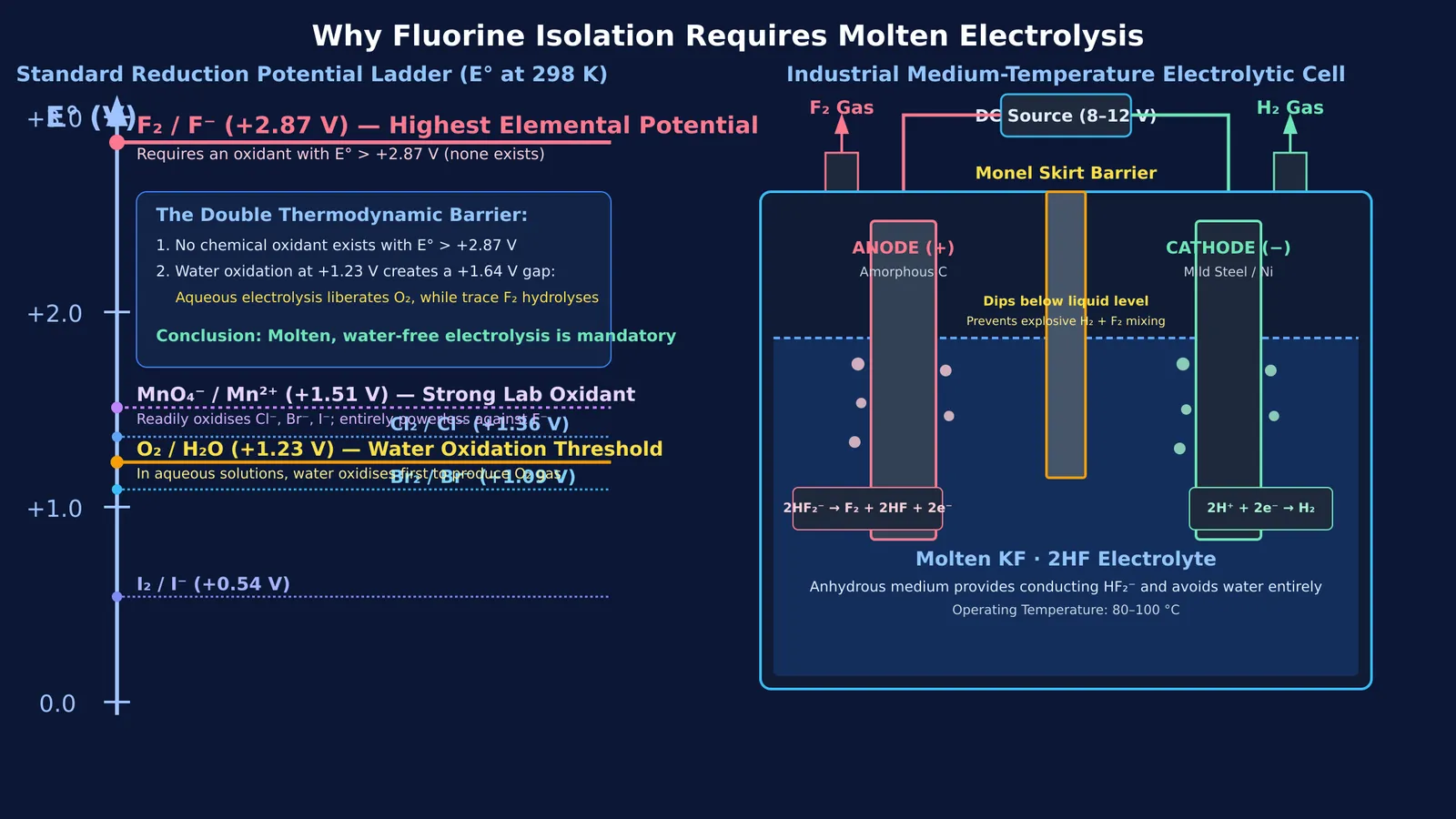
Standard reduction potential measures the thermodynamic driving force for a chemical species to gain electrons. According to standard half-cell potentials tabulated in OpenStax Chemistry 2e, fluorine sits at the top of the electrochemical series with a standard reduction potential of +2.87 V for the half-reaction:
F₂(g) + 2e⁻ → 2F⁻(aq)
By comparison, chlorine has a standard reduction potential of +1.36 V, bromine sits at +1.09 V, and iodine at +0.54 V. Because chlorine, bromine, and iodine have moderate reduction potentials, laboratory oxidants like manganese dioxide or acidified potassium permanganate (+1.51 V) readily oxidise chloride, bromide, and iodide ions.
For a chemical oxidant to oxidise fluoride into fluorine gas, the net cell potential must be positive. This requires an oxidising agent with a standard reduction potential exceeding +2.87 V. No known chemical reagent reaches this threshold. As noted in our guide to electrode potentials of transition metals, species with lower potentials cannot take electrons from species with higher potentials. If you mix an oxidant with fluoride, fluorine would oxidise the reagent instead.
Why does electrolysis of aqueous fluoride fail to produce fluorine?
If chemical oxidants cannot oxidise fluoride, the alternative is electrical energy. However, electrolysing an aqueous solution of sodium fluoride or potassium fluoride fails to produce fluorine.
The limitation is the electrochemical window of water. In aqueous solutions, water oxidation follows:
2H₂O(l) → O₂(g) + 4H⁺(aq) + 4e⁻
According to OpenStax half-cell data, water oxidises at a standard potential of +1.23 V. Because water surrenders electrons at +1.23 V while fluoride requires +2.87 V, water oxidises preferentially at the anode, releasing oxygen gas. Furthermore, fluorine vigorously attacks water:
2F₂(g) + 2H₂O(l) → 4HF(aq) + O₂(g)
Any transient fluorine formed at the anode immediately hydrolyses into hydrofluoric acid.
How does the modern electrolytic cell isolate fluorine?
To produce fluorine electrolytically, water must be strictly excluded. Pure anhydrous hydrogen fluoride (HF) is a covalent liquid with negligible self-ionisation and near-zero electrical conductivity. Dissolving potassium fluoride in anhydrous HF forms conducting hydrogen difluoride ions (HF₂⁻).
As outlined in OpenStax halogen chemistry, the primary industrial preparation of fluorine is electrolytic oxidation of a molten mixture of potassium hydrogen fluoride and anhydrous hydrogen fluoride. Electrolysis decomposes HF, evolving fluorine gas at the anode and hydrogen gas at the cathode.
Modern industrial cells use three critical design choices:
Anode: Ungraphitised amorphous carbon. Crystalline graphite cannot be used because fluorine intercalates between the carbon sheets, causing the anode to swell and disintegrate.
Cathode: Mild steel or nickel, which resists corrosion under cathodic reducing conditions.
Diaphragm: A Monel or steel skirt suspended into the electrolyte melt. Because hydrogen and fluorine react explosively upon contact to reform HF, this physical barrier keeps the evolved gases separated.
The cell reactions are: At the anode: 2HF₂⁻ → F₂(g) + 2HF + 2e⁻ At the cathode: 2H⁺ + 2e⁻ → H₂(g) Overall decomposition: 2HF(l) → H₂(g) + F₂(g)
Henri Moissan first isolated fluorine in 1886 by electrolysing potassium fluoride dissolved in liquid hydrogen fluoride, earning the 1906 Nobel Prize in Chemistry for his investigation and isolation of the element (NobelPrize.org). In 1986, Karl O. Christe demonstrated a laboratory chemical route by reacting K₂MnF₆ and SbF₅ at 150 °C to displace unstable MnF₄, which releases elemental fluorine gas upon decomposition (Inorganic Chemistry). However, commercial fluorine production remains entirely dependent on molten electrolysis.
How can you solve redox spontaneity numericals in chemistry exams?
Exam questions in Class 12 electrochemistry often ask whether a given reagent can oxidise a halide. You can evaluate this using thermodynamic relations described in OpenStax electrochemistry thermodynamics across three steps:
Identify reduction potentials for the oxidant and halide half-reactions.
Calculate cell EMF: E°cell = E°cathode - E°anode.
Check thermodynamic spontaneity using ΔG° = -nFE°cell. Spontaneous reactions require E°cell > 0 and ΔG° < 0.
Worked numerical: Can acidified potassium permanganate (MnO₄⁻/Mn²⁺, E° = +1.51 V) oxidise fluoride ions under standard conditions?
Reduction: 2MnO₄⁻ + 16H⁺ + 10e⁻ → 2Mn²⁺ + 8H₂O (E° = +1.51 V) Oxidation: 10F⁻ → 5F₂ + 10e⁻ (E° = +2.87 V)
E°cell = +1.51 V - (+2.87 V) = -1.36 V
Using Faraday's constant (96,485 C/mol) and n = 10 electrons: ΔG° = -(10) × (96,485 C/mol) × (-1.36 V) = +1,312 kJ/mol
Because E°cell is negative and ΔG° is positive, the reaction is non-spontaneous. For more on cell energetics, see our guide on cell EMF to Gibbs energy, or explore halide properties in Finkelstein and Swarts reactions.
To explore the thermodynamics of electrode potentials further, the Fermi Concept Library covers every concept in chemistry, each with its own lesson and its place in the map. When practising redox equilibria numericals, the Fermi Problem Library offers worked problems with a step-by-step solver that explains the reasoning rather than printing an answer.


