

On this page
A Baul singer from Bengal often holds an instrument with one wire string, a round resonator at the bottom and a bamboo neck split into two arms. While one hand plucks, the other hand squeezes the two arms, and the note slides smoothly up and down with no frets at all. This one-string instrument is the Baul ektara, also called the gopiyantra or gopichand. The physics behind the slide is the formula for a stretched string, plus one surprising fact about steel: a tiny change in length makes a big change in tension.
How is the Baul ektara built?
The name "ektara" simply means "one string", and it is used for several different instruments across India. Here we mean the Bengal kind. The Horniman Museum's catalogue entry for a Baul ektara from West Bengal describes it as a variable tension chordophone with a split bamboo forked neck, a single tuning peg, and a wire string tied to the peg and to the skin at the base of the resonator.
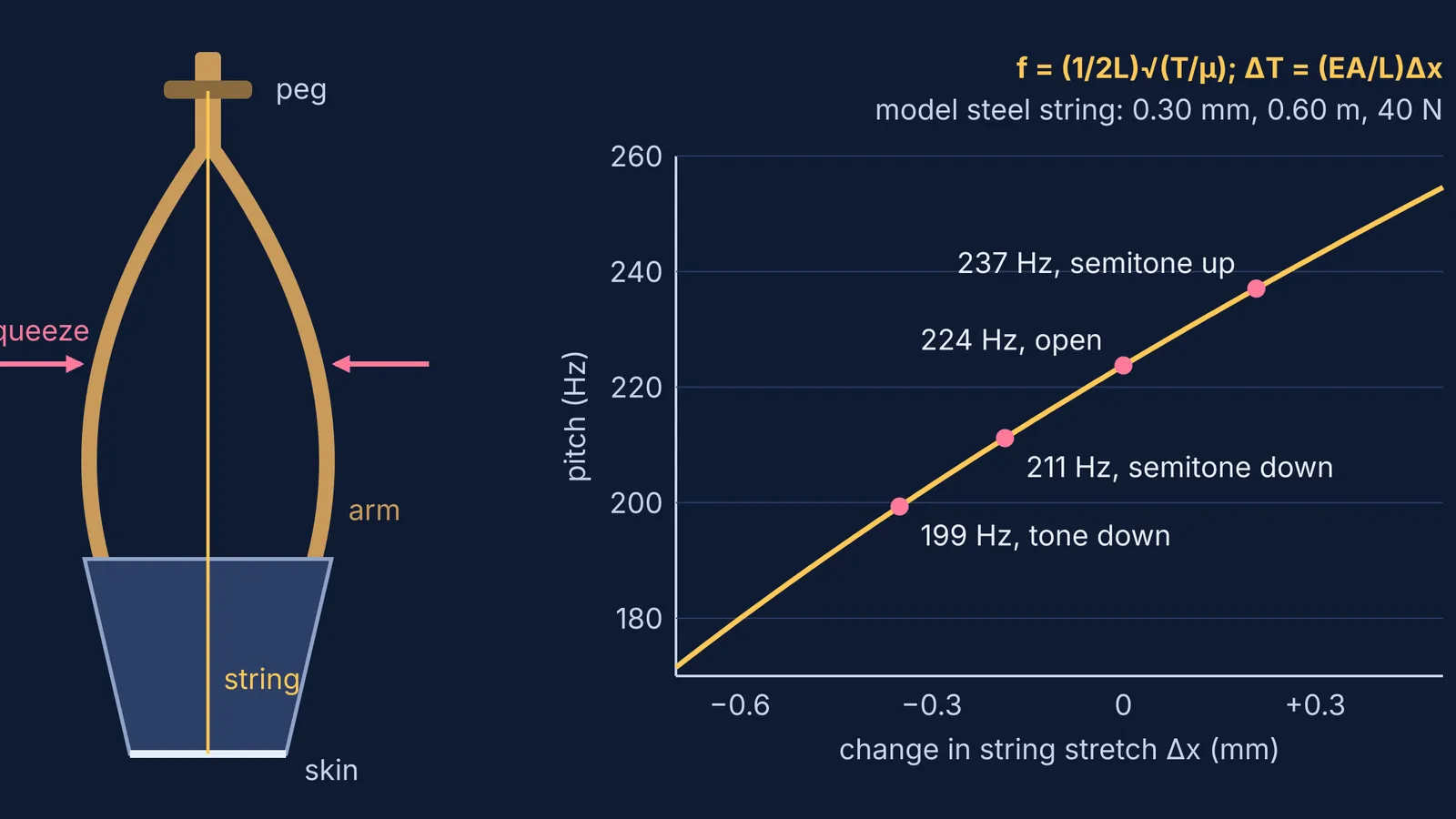
So the string runs from the middle of the skin, up between the two bamboo arms, to a peg where the arms join. The bamboo arms hold the skin and the peg apart. Anything that changes that distance changes how much the string is stretched, and so its tension. There is no fingerboard: the player never shortens the string, only changes its tension.
How does tension set the note of a string?
For a string of length L, tension T and mass per unit length μ, the lowest note is
f = (1/2L)√(T/μ)
The wave speed √(T/μ) is covered in how wave speed on a string changes with tension, and the role of μ in why thicker strings make lower notes. On the ektara, L and μ stay fixed, so f is proportional to √T.
A semitone is a frequency ratio of 2^(1/12). Since f ∝ √T, tension must change by the square of that ratio, which is 2^(1/6):
One semitone down: T × 2^(−1/6) = T × 0.891, a 10.9% cut.
Two semitones (a whole tone) down: T × 0.794, a 20.6% cut.
One semitone up: T × 1.122, a 12.2% rise.
These are big changes in tension for a small change in pitch. Yet the player makes them with a light squeeze. The next section shows why that works.
Worked example: how far must the string's end move?
Take an illustrative steel string 0.30 mm thick and 0.60 m long, tuned to 40 N. Real strings vary, so treat these as model values. Use density 7,850 kg/m³ and Young's modulus 200 GPa for steel.
Cross-section. A = π(0.15 × 10⁻³)² = 7.07 × 10⁻⁸ m².
Mass per unit length. μ = ρA = 7,850 × 7.07 × 10⁻⁸ = 5.55 × 10⁻⁴ kg/m.
Open note. f = (1/1.2)√(40/5.55 × 10⁻⁴) = 268.5/1.2 ≈ 224 Hz.
Stiffness of the wire. From Young's modulus, ΔT = (EA/L)Δx. Here EA/L = (200 × 10⁹ × 7.07 × 10⁻⁸)/0.60 ≈ 23,600 N/m, or 23.6 N per mm.
How much is the wire stretched now? 40 N / 23.6 N/mm ≈ 1.70 mm. The whole note depends on this 1.7 mm of stretch.
One semitone down. ΔT = 40 × (1 − 0.891) = 4.36 N, so Δx = 4.36/23.6 ≈ 0.185 mm. The note falls to about 211 Hz.
A whole tone down. ΔT ≈ 8.25 N, Δx ≈ 0.35 mm, and the note is about 199 Hz.
One semitone up. ΔT ≈ 4.90 N, Δx ≈ 0.21 mm, and the note is about 237 Hz.
Check units. N ÷ (N/mm) = mm. And a semitone is a 10.9% cut in tension, which is a 10.9% cut in the 1.70 mm stretch: 0.109 × 1.70 ≈ 0.185 mm. The two routes agree.
So the string's anchor needs to move only about a fifth of a millimetre for a semitone. The skin and the bamboo also give a little under the load, so the real movement at the player's hand is somewhat larger, but the 0.185 mm is the wire's share of it.
Does squeezing the neck raise or lower the pitch?
This depends on how the arms are shaped, and we could not settle it from a museum or specialist source. The Horniman entry and David Courtney's description of the gopichand both describe the pitch bending as the arms are squeezed, but neither says which way it goes. Some general descriptions say squeezing loosens the string, but we found none from an organological source, so here is the physics of both cases.
The string pulls the peg towards the skin, so the two arms are like thin columns under compression. What matters is the straight-line distance between the ends of each arm.
If the arms are straight or already curve inward, squeezing bends them more. A bent strip of fixed length has its ends closer together. The peg moves towards the skin, the string loosens and the pitch falls.
If the arms bow outward, squeezing straightens them. A straighter strip has its ends further apart. The peg moves away from the skin, the string tightens and the pitch rises.
Either way the effect is large for a small push. For a strip of length ℓ bent into a gentle half-sine curve with sideways bulge δ, the ends come closer by about π²δ²/(4ℓ). For an illustrative 0.45 m arm, a bulge of about 6 mm shortens it by about 0.19 mm. A few millimetres of squeeze at the hand becomes a fifth of a millimetre at the peg, which is exactly the size of movement a semitone needs. That gearing down is what makes fine control by hand possible.
How is this different from a sitar or a guitar?
On a sitar or guitar, you change the note mostly by pressing the string against a fret, which shortens the vibrating length L. The string's tension barely changes. Bending a guitar string sideways does raise the tension, which is the same physics as the ektara, but only as a small ornament. The ektara uses tension as its only control. The sitar adds strings that are never plucked but ring in sympathy, a different idea, explained in why a sitar has strings that are not played.
If you want to see how tension and wave speed set the note of a string, try it in the Simulation Lab, which has interactive simulations for ideas easier to see than read.
Quick checklist
The Baul ektara changes pitch by changing tension, not length.
f = (1/2L)√(T/μ), so f ∝ √T when L and μ are fixed.
A semitone needs a tension ratio of 2^(1/6): about 11% less for down, 12% more for up.
ΔT = (EA/L)Δx: a stiff steel wire needs only about 0.19 mm of anchor movement for a semitone in the model.
Whether squeezing raises or lowers the note depends on whether it bends the arms more or straightens them.
Bending a thin strip sideways moves its ends by an amount proportional to δ², which gives the player fine control.


