

On this page
If you look closely at a sitar, you will notice something unusual: beneath the main strings that the musician plucks, there is a whole second layer of smaller, thinner strings. These extra strings are never touched by the player's fingers. Yet, as the music begins, they ring out on their own, filling the room with a shimmering, ethereal hum.
These are called sympathetic strings, or *taraf* strings. They exist to harness a fundamental phenomenon in acoustics: resonance.
Why does a sitar have strings that are not played?
A standard sitar has 11 to 13 sympathetic strings running underneath the curved frets. They are not played because their job is to provide continuous harmonic background and natural sustain. Before a performance, the musician carefully tunes each of these strings to the specific notes of the *raga* (the melodic framework or scale) they are about to play.
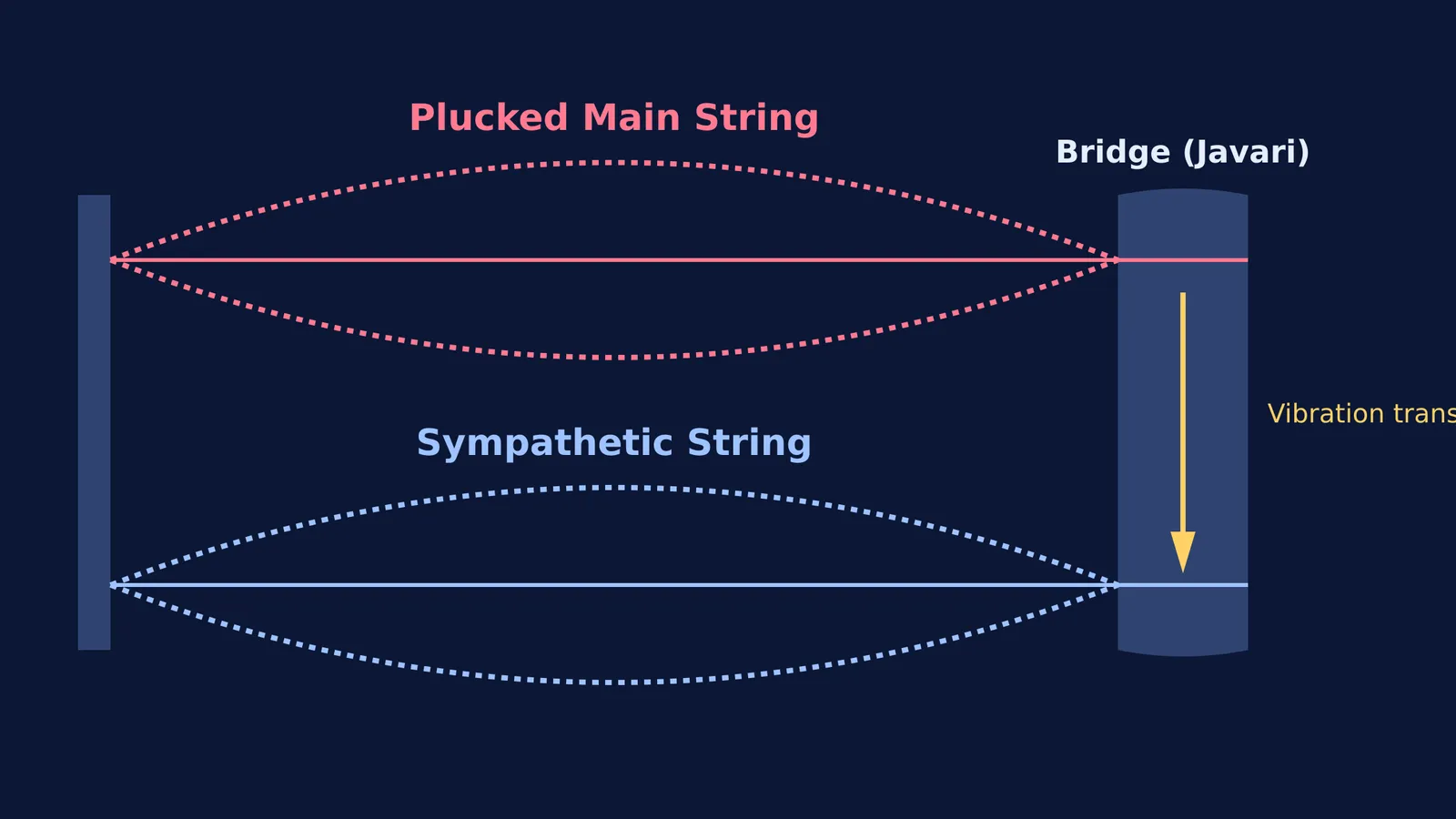
Because they are tuned to the exact notes of the song, these strings act as a physical memory of the music's key. When the player strikes a note on the main string, any sympathetic string tuned to that same frequency (or a strong harmonic) will automatically begin to vibrate. This transforms a single plucked note into a rich, full-bodied chord that surrounds the listener.
How does sympathetic resonance work?
To understand why an untouched string starts moving, you have to look at how energy travels. Every vibrating object has a natural frequency of vibration determined by its physical parameters. Resonance occurs when an object is exposed to external vibrations that match this frequency, making it remarkably easy to excite into motion.
When the musician plucks a main string, it sets the air and the wooden body of the sitar into motion. This energy travels down into the bridge. If the vibrations pushing through the bridge match the natural frequency of a sympathetic string, that string easily absorbs the energy and starts forming its own standing waves in strings and pipes.
If you struggle to picture how energy moves between objects of the same frequency, the Fermi Simulation Lab lets you watch a wave transfer its energy to a resonant system while leaving mismatched systems completely still. Interactive visualisations make it easier to see how phase alignment allows maximum power transfer between the driver and the resonator.
Why is the sitar's bridge curved?
The sitar's sympathetic resonance is especially loud and complex because of its bridge, known as the *javari*. Most stringed instruments, like a guitar or a violin, have a sharp, narrow bridge that holds the string at a single point. In contrast, the sitar's bridge is a wide, gently sloping piece of bone or horn.
As the sympathetic strings vibrate, they lightly graze this curved surface. This continuous grazing action breaks up the simple sine wave of the string, enriching the sound with dozens of high-frequency overtones. This gives the sitar its characteristic "buzzing" or "twanging" timbre, which is impossible to replicate with a conventional sharp bridge.
When several sympathetic strings are resonating at once, their complex waves overlap. Unlike the harsh beats in sound caused by out-of-tune frequencies, this precise overlapping creates a wall of harmonic support that sustains the music long after the main string has stopped vibrating.
How can you test resonance yourself?
Whether you play the sitar or just want to test resonance on a piano or guitar, the principle is the same:
Tune precisely: Two strings must share identical frequencies (or integer ratios like 2:1 for an octave) to transfer energy efficiently. If they are even slightly mismatched, they will not couple.
Open the strings: On a piano, hold down the sustain pedal to lift the dampers off the strings, leaving them free to vibrate without any friction holding them back.
Play the driving note: Strike a strong, loud note on the instrument to push maximum energy into the acoustic chamber.
Listen for the echo: Stop the original note abruptly by muting the string. You will hear the other strings that match that frequency continuing to ring in sympathy, proving that they absorbed the invisible acoustic energy.
The sitar simply builds this physics experiment directly into its design, turning natural resonance into an instrument's most defining feature. By embracing the science of acoustics, instrument makers centuries ago created a sound that continues to captivate listeners today.


