On this page
An atomic force microscope (AFM) can map a surface atom by atom without using light to form the image. Its sensor is a strip of silicon under half a millimetre long and only a couple of micrometres thick, fixed at one end like a diving board. A sharp tip on the free end touches the surface, the strip bends, and a laser reflected off it shows how far. Three ideas from Class 11 explain every number in it: bending of a beam, the optical lever, and equipartition of energy.
How does an atomic force microscope work?
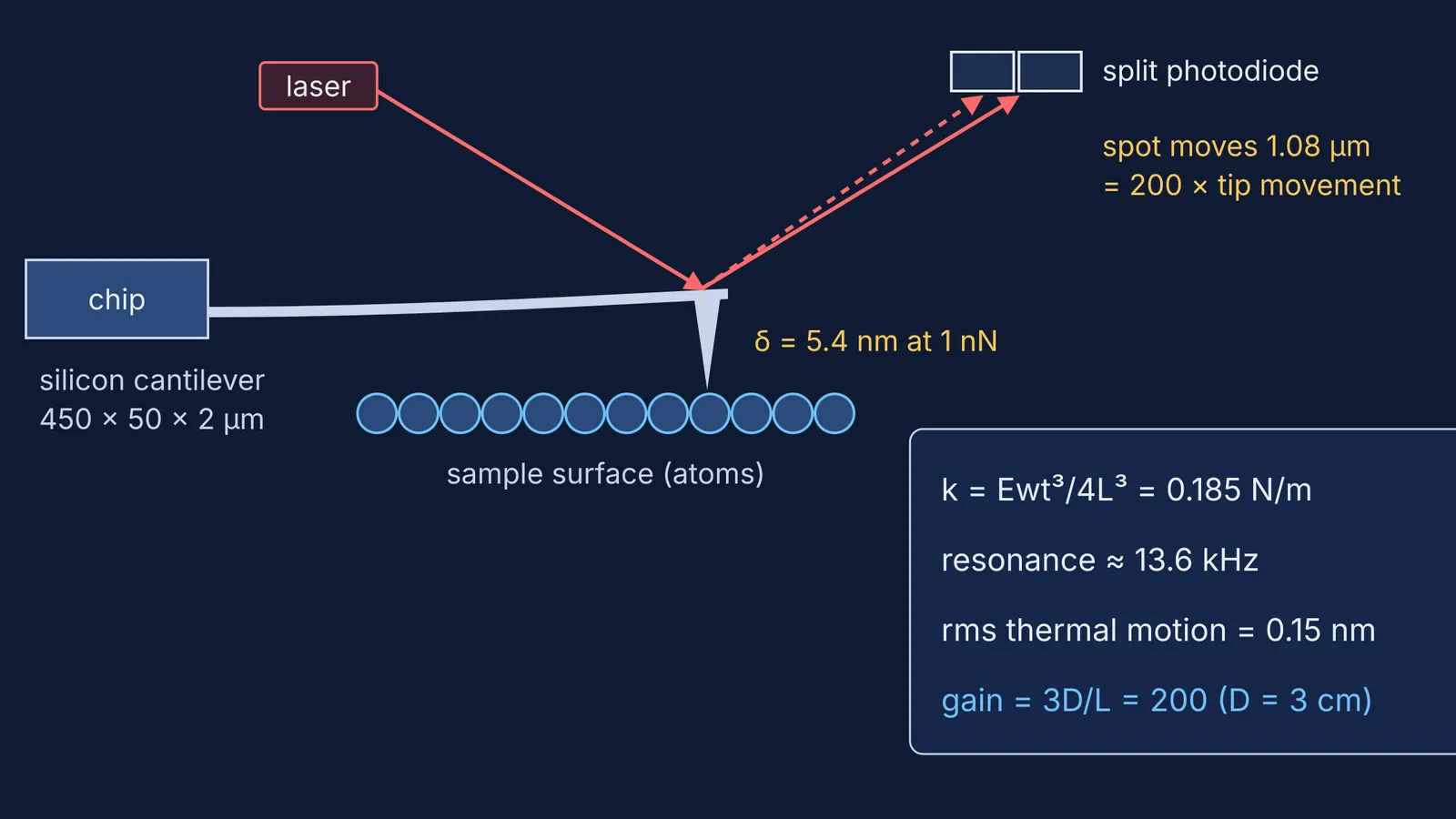
The cantilever is a tiny beam clamped at one end, with a sharp tip (radius of a few nanometres) underneath its free end.
The sample moves under the tip in a raster, line by line.
The force between tip and surface bends the cantilever. A bump pushes the tip up; a dip lets it down.
The optical lever is a laser spot reflected off the back of the cantilever onto a photodiode split into two halves. When the cantilever bends, the spot moves from one half towards the other.
The feedback loop raises or lowers the sample to keep the bend constant. The record of those height corrections, point by point, is the image.
So the cantilever is just a very soft spring, and the AFM is a spring balance for nanonewton forces.
How stiff is an AFM cantilever?
A rectangular cantilever of length L, width w and thickness t, made of a material with Young's modulus E, bends by δ = FL³/(3EI) under a force F at its free end, where I = wt³/12. So its spring constant is
k = F/δ = Ewt³/4L³
This is the same t³ dependence that makes a deep beam stiff in why beams have an I-shaped cross section, here used the other way round: a very thin beam is a very soft spring.
Take a real contact-mode probe. The NanoWorld CONTR data sheet gives nominal values L = 450 µm, w = 50 µm, t = 2 µm, force constant 0.2 N/m and resonance 13 kHz, for monolithic silicon. For silicon along the usual [110] direction, E ≈ 169 GPa (Hopcroft, Nix and Kenny, 2010), and ρ ≈ 2,330 kg/m³.
Spring constant. k = 169 × 10⁹ × 50 × 10⁻⁶ × (2 × 10⁻⁶)³ ÷ (4 × (450 × 10⁻⁶)³) = 0.185 N/m. The data sheet's 0.2 N/m agrees.
Bend under 1 nN. δ = F/k = 10⁻⁹ ÷ 0.185 = 5.4 × 10⁻⁹ m = 5.4 nm.
Units. Pa × m × m³ ÷ m³ = Pa × m = (N/m²) × m = N/m. Correct.
For scale, the cantilever's own mass is ρLwt = 2,330 × 450 × 10⁻⁶ × 50 × 10⁻⁶ × 2 × 10⁻⁶ ≈ 1.0 × 10⁻¹⁰ kg, so 1 nN is roughly its own weight.
The data sheet also gives a thickness range of 1.5–2.5 µm. Put those into the formula and k runs from 0.078 to 0.36 N/m, a factor of (2.5/1.5)³ = 4.6, which matches the sheet's quoted range of 0.07–0.4 N/m. That is why every real cantilever has to be calibrated: a small error in thickness becomes a large error in stiffness.
How does a laser turn a 5 nm bend into a signal?
For a point load at the end, the slope of the cantilever at its tip is θ = 3δ/2L.
End slope. θ = 3 × 5.4 × 10⁻⁹ ÷ (2 × 450 × 10⁻⁶) = 1.8 × 10⁻⁵ rad.
Reflected beam. A mirror turned through θ turns the reflected ray through 2θ = 3.6 × 10⁻⁵ rad.
Spot movement. With the photodiode an illustrative 3 cm away, the spot moves 2θ × D = 3.6 × 10⁻⁵ × 0.03 = 1.08 × 10⁻⁶ m, about 1.08 µm.
Gain. Spot movement ÷ tip movement = 2 × (3δ/2L) × D ÷ δ = 3D/L = 3 × 0.03 ÷ 450 × 10⁻⁶ = 200.
A longer lever arm D gives more gain, and a shorter cantilever also gives more gain for the same bend. A split photodiode can then detect a micrometre-sized shift of the spot easily. If you want more mirror-rotation and lever problems with each step explained, the Fermi Problem Library has a step-by-step solver that explains the reasoning.
What is the resonant frequency of an AFM cantilever?
The cantilever is also a spring-mass oscillator. For its first mode, it behaves roughly like a mass of about a quarter of its own mass on a spring of stiffness k.
Effective mass. m_eff ≈ 0.24 × 1.05 × 10⁻¹⁰ kg ≈ 2.5 × 10⁻¹¹ kg.
Frequency. f = (1/2π)√(k/m_eff) = (1/2π)√(0.185 ÷ 2.5 × 10⁻¹¹) ≈ 13.6 kHz.
The full beam theory gives f = (1.875²/2π)(t/L²)√(E/12ρ) = 13.6 kHz as well, close to the data sheet's 13 kHz.
In "tapping" mode the cantilever is driven near resonance and the change in its swing reveals the surface. Those probes are short and thick. The NanoWorld NCHR data sheet lists L = 125 µm, w = 30 µm, t = 4 µm, 42 N/m and 320 kHz; our formulas give k = 41.5 N/m and f = 352 kHz. The beam is 220 times stiffer and vibrates about 26 times faster.
What limits the smallest force an AFM can measure?
At room temperature the cantilever is never still. It is a single oscillator with potential energy ½kx², and the law of equipartition of energy gives that quadratic term an average of ½k_BT:
½k⟨x²⟩ = ½k_BT, so x_rms = √(k_BT/k).
Soft contact cantilever. x_rms = √(1.38 × 10⁻²³ × 300 ÷ 0.185) = 1.5 × 10⁻¹⁰ m = 0.15 nm.
As a force. k × x_rms = 0.185 × 1.5 × 10⁻¹⁰ ≈ 28 pN. Forces much smaller than this are buried in the thermal jiggle unless you average for a long time.
Stiff tapping cantilever. x_rms = √(1.38 × 10⁻²³ × 300 ÷ 41.5) = 0.010 nm.
This thermal motion is not just noise. Measuring x_rms and using k = k_BT/⟨x²⟩ is a standard way of calibrating a cantilever's stiffness.
Why is an AFM not limited by the wavelength of light?
An optical microscope cannot resolve details much smaller than about half the wavelength of light, a few hundred nanometres. The AFM does not form an image with light at all. The laser only measures how much the cantilever bends; the image comes from the force on a tip a few nanometres across. So an AFM is not an optical microscope, and its resolution is set by the sharpness of the tip and the noise in the bend.
Quick checklist
The AFM cantilever is a spring: k = Ewt³/4L³.
450 × 50 × 2 µm silicon: k ≈ 0.19 N/m, so 1 nN bends it about 5 nm.
k ∝ t³: thickness tolerance explains the wide spread in real k.
Optical lever: end slope 3δ/2L, reflected beam turns 2θ, gain 3D/L.
Resonance: f = (1/2π)√(k/m_eff), with m_eff about a quarter of the beam's mass.
Thermal limit: x_rms = √(k_BT/k), about 0.15 nm for the soft cantilever at 300 K.