

On this page
Most asteroids look like points of light even in large telescopes. Yet astronomers know the sizes and outlines of many of them to within a kilometre or two. The trick needs only Class 11 and 12 physics. When an asteroid passes in front of a star, the star blinks out for a few seconds. The length of that blink, multiplied by how fast the shadow moves, is a length across the asteroid.
Why is an asteroid's shadow the same size as the asteroid?
A shadow's shape depends on the light source. A large, nearby source such as the Sun gives a dark umbra and a fuzzy penumbra, which is how solar and lunar eclipses work; that case is covered in this eclipse shadow simulation.
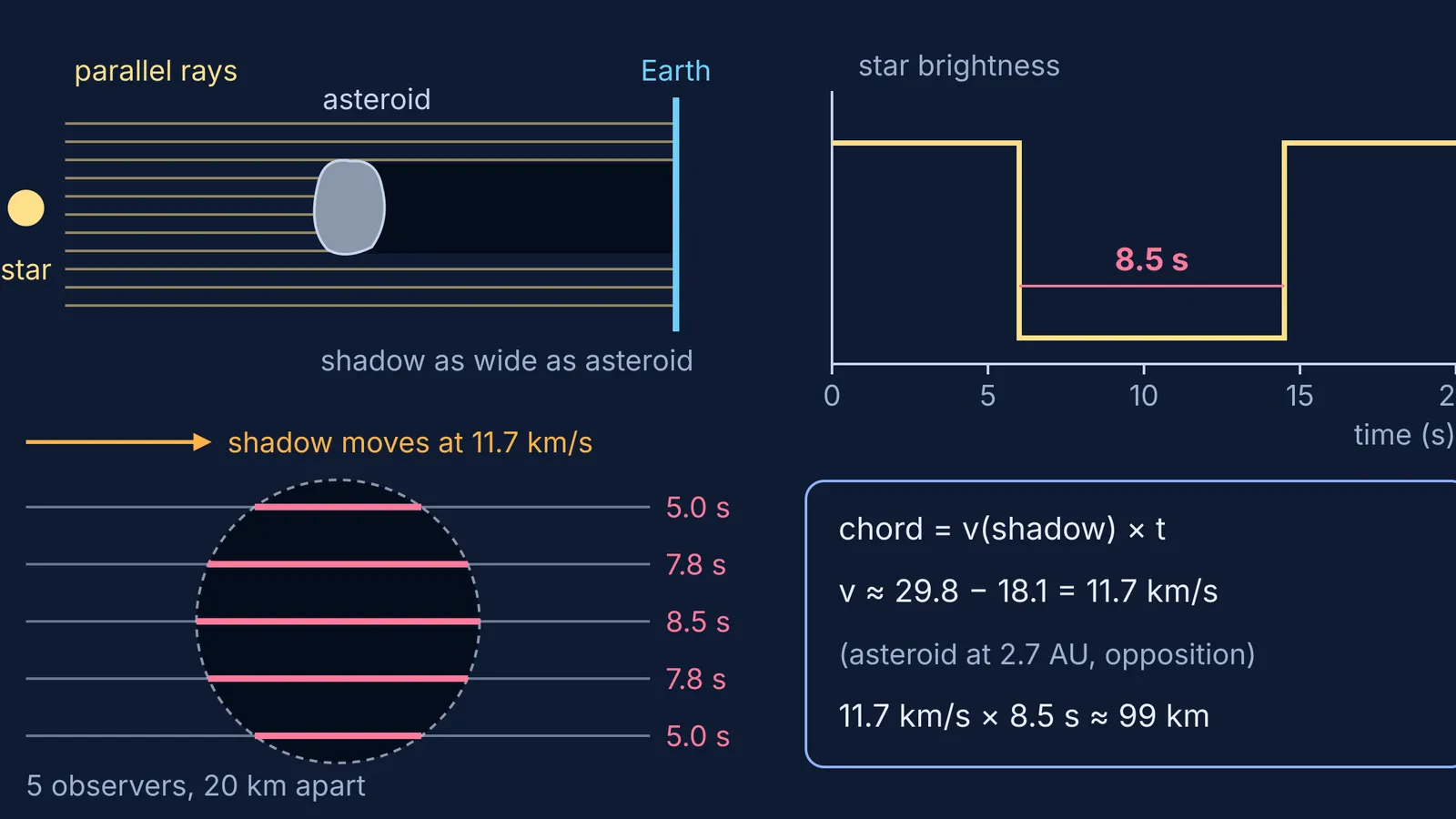
A star is different. It is so far away that its rays reach the solar system almost exactly parallel. Parallel rays make a shadow that neither grows nor shrinks with distance. So the asteroid's shadow, when it lands on Earth, is a copy of the asteroid's own outline, at full size. A 100 km asteroid throws a 100 km wide shadow.
This is also different from a transit, where a dark planet crosses a bright disc and dims it only slightly; see how transits of Mercury and Venus work. In an occultation the background source is a point, so it vanishes completely.
How fast does the shadow move across Earth?
Both Earth and the asteroid orbit the Sun. For a circular orbit, gravity supplies the centripetal force, so GMm/r² = mv²/r and v = √(GM/r). Speed falls as 1/√r.
Earth at 1 AU moves at about 29.8 km/s.
An asteroid on a circular orbit at 2.7 AU (the middle of the main belt) moves at 29.78/√2.7 = 18.1 km/s.
At opposition, the asteroid is on the far side of Earth from the Sun, and both move in the same direction. Light from the star is fixed, so the shadow's speed across Earth is the relative speed: 29.8 − 18.1 = 11.7 km/s.
This is the simple case. A real prediction also includes the tilt of the asteroid's orbit, its position away from opposition, and Earth's rotation, which adds up to about 0.47 km/s at the equator. Treat 11.7 km/s as the textbook number for this geometry, not a constant.
Worked example: from blink times to the asteroid's size
Five observers stand on a line across the predicted path, 20 km apart. Each records how long the star disappears: 5.0 s, 7.8 s, 8.5 s, 7.8 s and 5.0 s. The asteroid is at 2.7 AU, seen at opposition.
Shadow speed. v = 29.78 − 29.78/√2.7 = 29.78 − 18.12 = 11.66 km/s.
Central chord. Chord = v × t = 11.66 × 8.5 = 99.1 km.
The other chords. 11.66 × 7.8 = 90.9 km, and 11.66 × 5.0 = 58.3 km.
Check the shape. If the outline is a circle of radius R, a chord at distance y from the centre has half-length √(R² − y²). So R = √((c/2)² + y²). For the 90.9 km chord at 20 km: R = √(45.45² + 20²) = 49.7 km. For the 58.3 km chord at 40 km: R = √(29.15² + 40²) = 49.5 km. Central chord: R = 49.5 km.
Result. All three agree within 0.2 km, so the outline is close to a circle about 99 km across. A real, lumpy asteroid would give chords that do not fit one circle, and that mismatch is how its shape is mapped.
Precision. If each blink is timed to 0.1 s, each chord is fixed to 11.66 × 0.1 = 1.2 km.
Observers just outside the shadow, who see no blink, matter too: their misses limit how wide the asteroid can be.
Why can't a telescope simply photograph the asteroid?
At opposition, an asteroid at 2.7 AU is 2.7 − 1 = 1.7 AU from Earth, about 2.54 × 10⁸ km. Its angular size is 100 km ÷ 2.54 × 10⁸ km = 3.9 × 10⁻⁷ rad, or 0.081 arcseconds.
Turbulence in the air typically blurs a star to around 1 arcsecond from an ordinary site, more than ten times larger. Even a 10 m telescope with adaptive optics, working at 1.6 μm, has a diffraction limit of 1.22λ/D ≈ 0.04 arcseconds, so it would show this asteroid as only two or three resolution elements across. The occultation needs no image at all. It turns a size problem into a timing problem, and a stopwatch accurate to 0.1 s beats the optics.
What blurs the edge of the shadow?
In ray optics the shadow edge is perfectly sharp. Two things soften it.
The star's own size. Take a star 1 milliarcsecond across (an illustrative round value; real stars range widely). Seen from the asteroid at 1.7 AU, that angle spreads the edge over (1 × 10⁻³ ÷ 206,265) × 2.54 × 10⁸ km = 1.2 km. At 11.7 km/s that is a fade lasting about 0.1 s.
Diffraction. Light bends round the asteroid's limb. The edge is smeared over the Fresnel scale √(λd/2). For λ = 550 nm and d = 2.54 × 10¹¹ m, that is √(550 × 10⁻⁹ × 2.54 × 10¹¹ ÷ 2) = 264 m.
Both are small compared with a 99 km chord, which is why ray optics works for the size. Whether ray optics or diffraction wins in a given setup is the subject of the Fresnel distance.
What have real occultations found?
Amateur observers do much of this work. The International Occultation Timing Association explains how volunteers spread out across a predicted path, record disappearance and reappearance times, and report misses as well as hits, because misses fix the edges of the shadow.
On 29 July 2019, the near-Earth asteroid (3200) Phaethon passed in front of a 7.3-magnitude star over the southwestern United States. According to the campaign report by Dunham and colleagues, 6 stations saw the star vanish, and their chords agreed with the radar size of about 5.8 km.
An occultation can also reveal an atmosphere. An airless body makes the star snap off in a fraction of a second. On 9 June 1988, when Pluto occulted a star, the light faded gradually instead, because Pluto's thin atmosphere bent the starlight away bit by bit. The result is published by Elliot and colleagues in Icarus.
If orbital speeds, relative velocity or shadow geometry still feel shaky, the Concept Library explains each idea, and the Fermi Problem Library has a step-by-step solver that explains the reasoning for problems like the one above.
Quick checklist
A star is a point source at huge distance, so its rays are parallel and an asteroid's shadow is the asteroid's real size.
Orbital speed v = √(GM/r), so v ∝ 1/√r: 18.1 km/s at 2.7 AU.
At opposition, shadow speed = 29.8 − 18.1 ≈ 11.7 km/s.
Chord = shadow speed × blink time: 8.5 s gives 99 km.
Several chords from observers at known spacing map the outline; misses set the limits.
The edge blur from star size (about 1 km) and diffraction (about 0.26 km) is small next to the chord.
A sudden blink means no atmosphere; a gradual fade means one.


