

On this page
Ray optics treats light as straight lines, yet light is a wave that bends around edges. The Fresnel distance tells you how far the straight-line picture holds for a given opening.
What is the Fresnel distance?
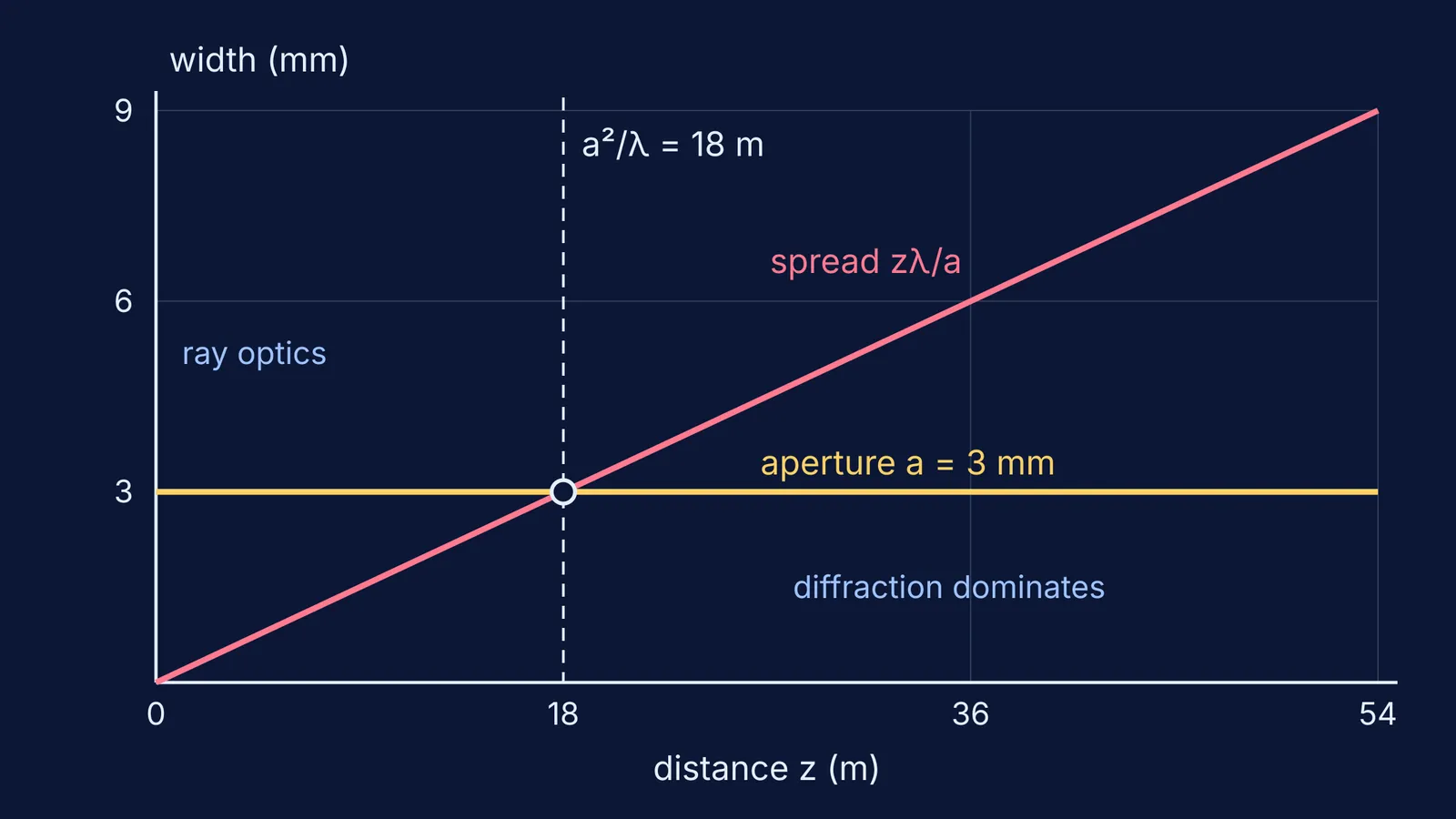
Start from single-slit diffraction. NCERT's current Wave Optics chapter states that a slit of width a gives a central maximum, with the intensity falling to zero at angles of about ±λ/a, ±2λ/a and so on (NCERT Class 12 Physics Part II, Chapter 10, 2026-27 reprint). So after travelling a distance z, light that came through an opening of width a has spread sideways by roughly zλ/a.
Ray optics says the beam simply keeps its width a. The two pictures agree only while the spread is small next to the aperture: zλ/a much less than a, which rearranges to z much less than a²/λ.
The Fresnel distance is z_F = a²/λ, the distance at which the diffraction spread zλ/a becomes as large as the aperture a itself.
Optics courses track the same idea with the Fresnel number N = a²/(λL), where a is the aperture size and L the distance from aperture to screen. Cornell's experimental optics lecture slides call N much greater than 1 the near field and N much less than 1 the far-field, or Fraunhofer, regime (Ivan Bazarov, Introduction to Diffraction, Cornell Physics P3330). The Fresnel distance is simply the L at which N = 1.
Why does ray optics work for large apertures?
Because z_F grows with the square of the aperture, while the wavelength of light is tiny. Using z_F = a²/λ from the argument above (NCERT Wave Optics chapter), doubling a makes z_F four times larger, and a ten times wider opening pushes z_F 100 times farther.
Worked numbers, each from z_F = a²/λ with a and λ in metres:
A 3 mm opening with 500 nm light: (3×10⁻³)² ÷ (5×10⁻⁷) = 18 m.
A 4 mm opening with 400 nm light: (4×10⁻³)² ÷ (4×10⁻⁷) = 40 m, the same answer as this worked practice solution.
A 5 cm lens with 550 nm light: (0.05)² ÷ (5.5×10⁻⁷) ≈ 4,500 m.
A 0.2 mm slit with 600 nm light: (2×10⁻⁴)² ÷ (6×10⁻⁷) ≈ 0.067 m, under 7 cm.
A 0.1 mm pinhole with 550 nm light: about 0.018 m, under 2 cm.
A 5 cm lens used over a metre or two on a school optical bench is more than 2,000 times inside its Fresnel distance, so the lens formula works there. Diffraction does not vanish, though. NCERT's Points to Ponder say "Diffraction phenomena define the limits of ray optics," and add that the limit of microscopes and telescopes in telling very close objects apart is set by the wavelength of light.
When does diffraction spreading start to matter?
Compare the distance z you care about with z_F, using the near-field and far-field regimes in the Cornell diffraction slides:
z much less than z_F: the shadow is sharp and ray optics is a good approximation.
z close to z_F: Fresnel diffraction. Edges blur, fringes appear, and the pattern changes shape as you move the screen.
z much more than z_F: Fraunhofer diffraction. The pattern keeps its shape and just grows, with a width of about zλ/a.
Take the 0.2 mm slit and 600 nm light from the list, with a screen 1 m away. Here z is about 15 times z_F, so you are deep in the far field. The first dark band sits about zλ/a = 1 × (6×10⁻⁷) ÷ (2×10⁻⁴) = 3×10⁻³ m, or 3 mm, from the centre. Our earlier post on single-slit diffraction problems and common errors works more of these.
How do you solve a Fresnel distance question?
A four-step check that fits most textbook questions, built on the θ ≈ λ/a result in the NCERT chapter:
Find a, the width of the opening the light passes through, and λ.
Convert both to metres before squaring: 3 mm is 3×10⁻³ m, so a² is 9×10⁻⁶ m². 500 nm is 5×10⁻⁷ m.
Compute z_F = a²/λ.
Compare with the distance in the question and name the regime: ray optics, Fresnel or Fraunhofer.
Treat z_F as an order-of-magnitude marker, not a sharp wall: some sources use the aperture's radius, some its full width (the Cornell slides use both). Also, the 2026-27 NCERT reprint has no separate subsection on the validity of ray optics (section 10.6 goes from the single slit to polarisation in 10.7), so check your current syllabus.
If the idea of a wavefront spreading from an opening still feels shaky, revisit Huygens principle and wavefronts, or read how Augustin Fresnel built his diffraction theory. The Fermi Concept Library covers every concept in physics with its own lesson and its place in the map. For practice, the Fermi Problem Library has worked problems with a step-by-step solver that explains the reasoning rather than printing an answer.


