

On this page
Every month the Moon passes between Earth and the Sun at new moon, and Earth sits between them at full moon. So why isn't every new moon a solar eclipse? You can answer this with a few NASA numbers and the same shadow model an eclipse simulation runs on screen. For the basic picture first, see why seasons and eclipses happen.
Why don't solar and lunar eclipses happen every month?
The Moon's orbit is tilted about 5 degrees to the plane of Earth's orbit, and NASA's eclipse explainer says this tilt is what prevents monthly solar and lunar eclipses. The NASA Moon fact sheet gives the exact inclination as 5.145 degrees and the mean Earth-Moon distance as 384,400 km.
At 384,400 km that tilt lets the Moon sit up to about 34,500 km above or below the plane of Earth's orbit (384,400 × sin 5.145°). Earth's whole shadow at that distance is only about 16,000 km across, so in most months the Moon passes over or under it.
How big are the umbra and penumbra?
The umbra is the dark inner part of a shadow, and the penumbra is the faint outer part, as NASA describes for lunar eclipses. Two zones appear because the Sun is a large source, not a point, the same idea as in shadows, mirrors and pinhole cameras.
Their sizes follow from similar triangles. You need the Sun's radius of 695,700 km and its mean distance of 149.6 million km from the NASA Sun fact sheet, and Earth's mean radius of 6,371 km from the NASA Earth fact sheet.
Worked example 1, Earth's shadow at the Moon:
The umbra narrows by (Sun radius − Earth radius) ÷ Sun distance per kilometre: about 0.0046.
Over 384,400 km it shrinks by about 1,770 km, so the umbra radius at the Moon is 6,371 − 1,770 ≈ 4,600 km.
The penumbra widens by (Sun radius + Earth radius) ÷ Sun distance, about 1,800 km over the same distance, giving a radius of about 8,175 km.
So Earth's umbra is about 9,200 km across at the Moon, roughly 2.6 Moon diameters (Moon fact sheet), and the penumbra about 16,350 km.
Worked example 2, the Moon's shadow at Earth. Repeat with the Moon's radius of 1,738 km: its umbra closes to a point about 373,700 km behind it. At mean distance the Moon is about 378,000 km from Earth's surface, so the umbra falls short. Near perigee (363,300 km from Earth's centre, per the Moon fact sheet) the umbra reaches the ground only about 157 km wide. That is why totality is seen along a narrow track, and why NASA's guide to eclipse types says an eclipse near the Moon's farthest point is annular, leaving a ring of Sun visible.
What decides a total or a partial eclipse?
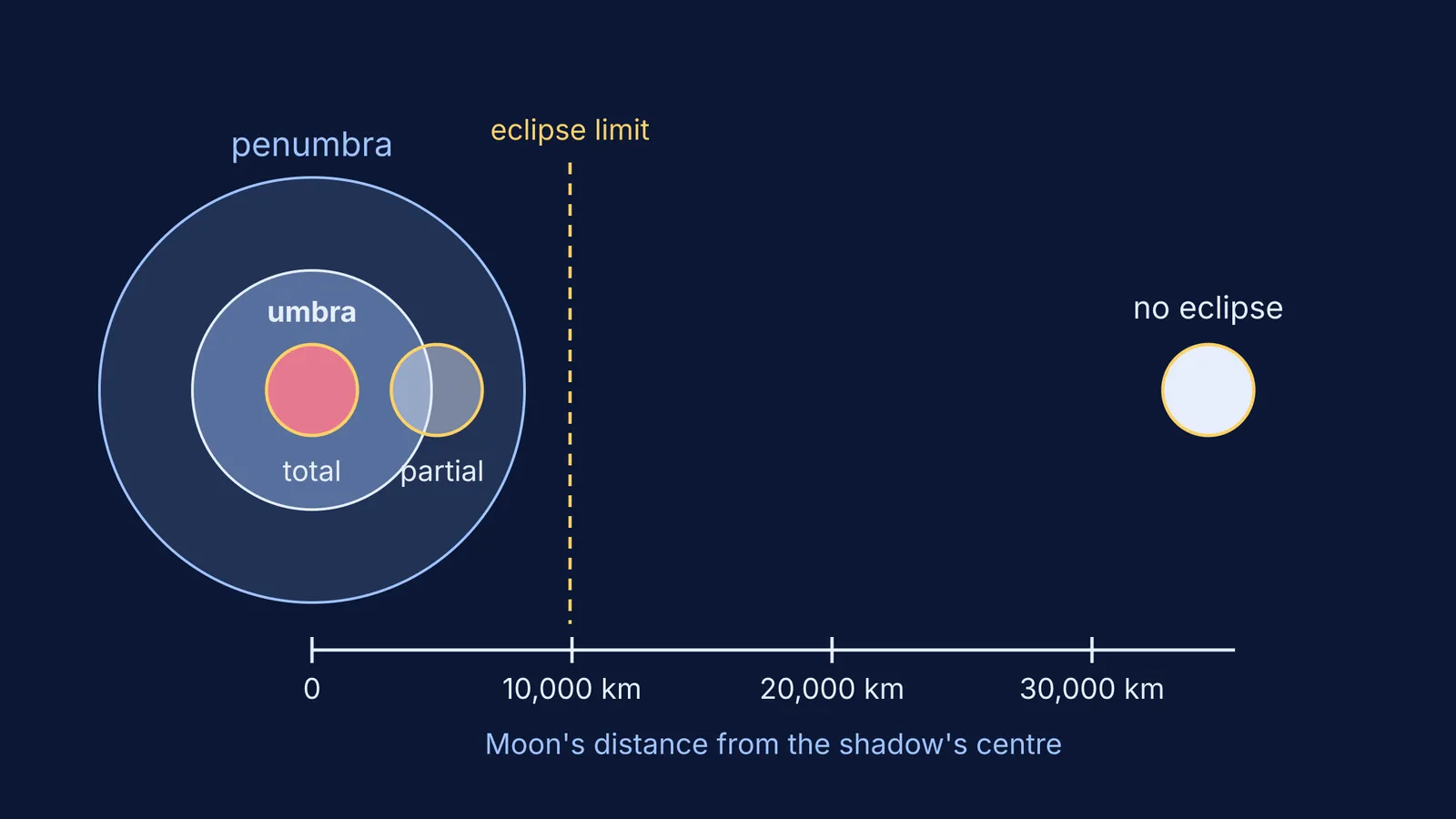
For a lunar eclipse, it depends on how far the Moon's centre passes from the shadow's centre. Use the radii above and the Moon's 1,738 km radius (Moon fact sheet):
Under about 2,860 km: the whole Moon fits inside the umbra, a total lunar eclipse.
About 2,860 to 6,340 km: part of the Moon is in the umbra, a partial eclipse.
About 6,340 to 9,910 km: only the penumbra touches it, a faint penumbral eclipse.
Beyond about 9,910 km: no eclipse, as in most months.
That 9,910 km limit is about 1.5 degrees off the plane of Earth's orbit, which the tilted Moon reaches about 17 degrees from a node (a point where the two orbits cross). NASA's lunar eclipse periodicity page gives the same rule: a full moon within about 17 degrees of a node gives a lunar eclipse (its footnote gives 15.3 to 17.1 degrees, because the orbits are not circles). Six fact-sheet numbers land close to NASA's figure.
How often do eclipse seasons come round?
Eclipses cluster in eclipse seasons, when the Sun is near a node. NASA's solar eclipse periodicity page says eclipse seasons are centred 173.3 days apart, and the Sun takes 34.5 days to cross each node's eclipse zone. A lunar month is 29.53 days (Moon fact sheet), so NASA notes every season brings at least one solar eclipse, and possibly two. In all, NASA counts four to seven eclipses a year.
How do you test this in an eclipse simulation?
Use a simulation or a spreadsheet, and predict before you press play:
Set the tilt to 0 and count a year of eclipses: you should get one every new and full moon.
Restore the fact-sheet tilt of 5.145 degrees, count again, and note how far apart the eclipses fall.
Move the Moon from perigee to apogee and watch total turn into annular.
Shift the Moon's path from the shadow's centre in 1,000 km steps and label each pass total, partial, penumbral or none.
The Fermi Simulation Lab collects interactive simulations for ideas that are easier to see than to read. If the geometry won't click, Fermi's AI tutor can draw the figure, run the simulation and check your understanding as it goes.
Before the next full moon, predict from its distance to a node whether you will see an eclipse.


