

On this page
Transits of Venus are rare enough that Edmond Halley, proposing in 1716 to use one to measure the Sun's distance, urged in the English translation NASA reproduces: "again and again, I recommend it to the curious strenuously to apply themselves to this observation" (Halley's paper, reproduced by NASA). Here is the geometry, and the school-level maths that checks it.
What is a transit of Mercury?
A transit is the passage of a planet across the disc of the Sun, which NASA says "may be thought of as a special kind of eclipse" (NASA Planetary Transits). Only Mercury and Venus, which orbit inside Earth, can transit as seen from here.
Mercury looks just 10 to 12 arcseconds across during a transit (NASA), against 1,919 arcseconds for the Sun (NASA Sun fact sheet): a sharp black dot under a hundredth of the Sun's width.
NASA lists the last transit of Mercury on 11 November 2019 and the next on 13 November 2032. Venus last transited on 6 June 2012; the next is on 11 December 2117 (NASA).
Why isn't there a transit every time Mercury passes the Sun?
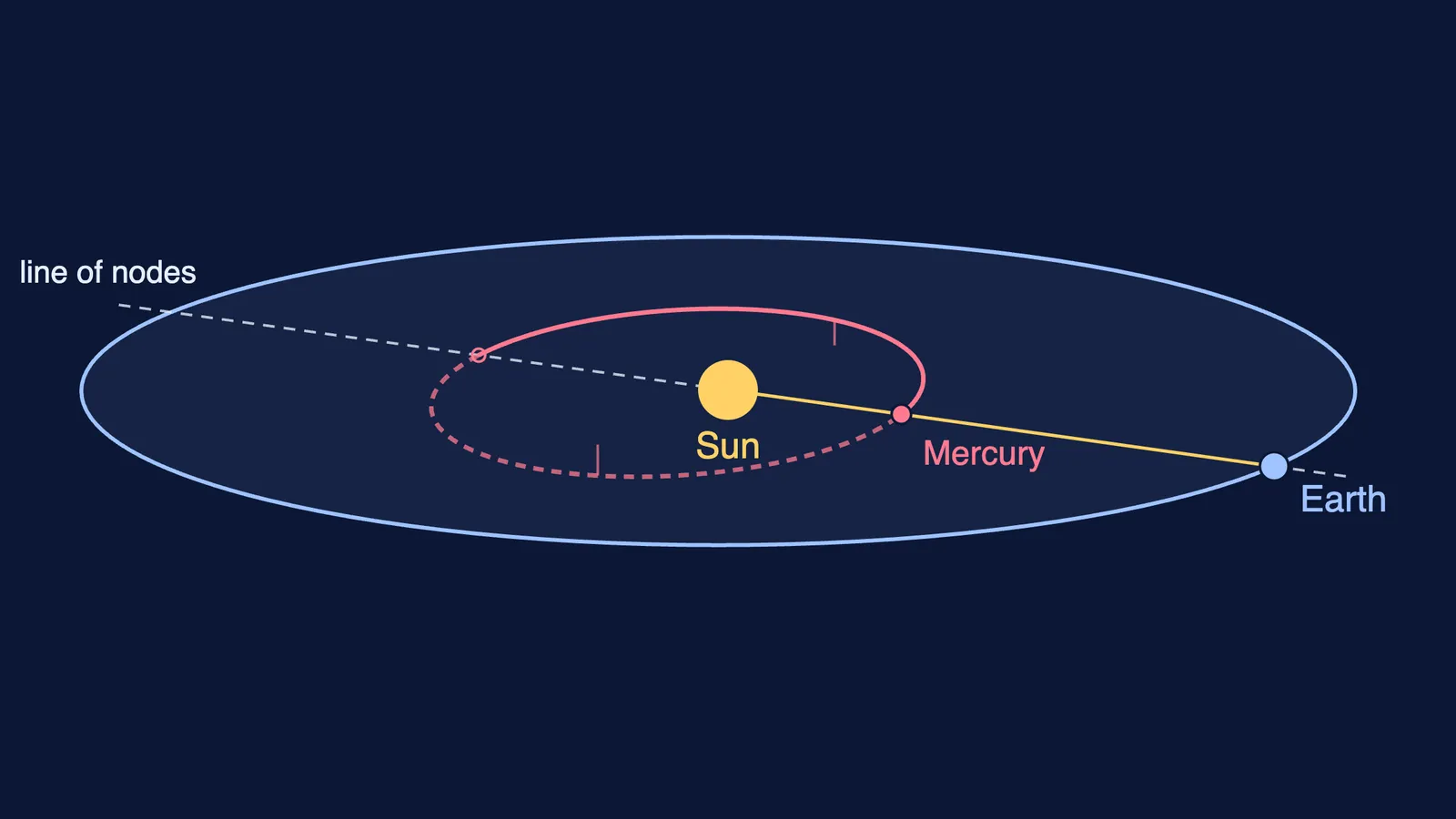
Mercury overtakes Earth every 115.88 days (NASA Mercury fact sheet). But its orbit is tilted 7.0 degrees to Earth's, and Venus's 3.39 degrees (NASA Venus fact sheet), so the planet usually passes just above or below the Sun.
Two tilted planes cross along the line of nodes. Earth lines up with Mercury's nodes each year, so transits of Mercury currently fall within several days of 8 May and 10 November; for Venus, early June and December (NASA).
How rare should transits be, by school maths?
You can estimate the rate from the NASA fact sheets (Mercury, Sun).
The Sun's radius looks about 0.27 degrees, so Mercury must appear within 0.27 degrees of its centre.
Mercury is 0.387 AU from the Sun and 0.613 AU from Earth, so its tilt seen from Earth shrinks by a factor of 0.387 / 0.613 = 0.63. Mercury must be within 0.27 / 0.63 = 0.42 degrees of the plane.
With a 7 degree tilt, that only happens within about 3.5 degrees of a node (sin u = sin 0.42 / sin 7).
Two nodes, each with a 7-degree window: 14 out of 360, about 1 conjunction in 26.
A century has 36,525 / 115.88 = 315 conjunctions, so about 12 transits.
NASA's average is 13 per century (NASA), close for a model that treats the orbit as a circle.
For Venus the angle is magnified instead, by 0.723 / 0.277 = 2.6, so Venus must pass within about 1.7 degrees of a node: roughly 1 conjunction in 52, with one conjunction every 583.92 days (NASA Venus fact sheet). Five of those (2,919.6 days) fall 2.4 days short of eight years, so Venus returns almost to the same spot eight years later, then misses for over a century: NASA lists gaps of 8, 121.5, 8 and 105.5 years (NASA).
How did transits of Venus measure the Sun's distance?
Kepler's third law gave planetary distances only relative to Earth's. Halley proposed timing a transit of Venus from far-apart places: each observer sees Venus cross a slightly different chord, and the difference in duration gives the solar parallax. He expected a difference of about 17 minutes between Hudson Bay and the East Indies, and named Madras and Pondicherry among possible sites (Halley, via NASA).
In 1769, 151 professional observations were made at 77 sites, including James Cook and Charles Green in Tahiti, while Le Gentil was clouded out at Pondicherry. Values derived from them put the solar parallax between 8.43 and 8.80 arcseconds, against 8.28 to 10.60 after 1761 (IMCCE, Paris Observatory).
To get kilometres, divide Earth's radius, 6,378 km (NASA Earth fact sheet), by the parallax in radians (1 arcsecond = 1/206,265 radian):
Halley's working guess of 12.5 arcseconds gives about 105 million km.
The 1769 range gives about 149.5 to 156 million km.
The astronomical unit is now fixed at exactly 149,597,870,700 metres by IAU 2012 Resolution B2 (Paris Observatory), which works out to a parallax of 8.794 arcseconds.
It is the same triangle as finding the distance to the Moon with parallax, with a far thinner angle.
How can you see the next transit of Mercury?
Check your city: NASA's transit visibility page explains how to work out, from your latitude and longitude, whether the Sun is up for each stage of a transit.
Protect your eyes: never look at the Sun directly, or through binoculars or a telescope, without a proper solar filter; project the image onto card instead.
Read the history: how Gassendi saw the first transit of Mercury in 1631.
Look further: read planet size from a transit dip around other stars.
If tilted orbits are hard to picture, the Fermi Simulation Lab has interactive simulations for ideas that are easier to see than to read. For parallax and orbit numericals like these, the Fermi Problem Library has a step-by-step solver that explains the reasoning.


