On this page
In 1627 Johannes Kepler published his Rudolphine Tables, built on his laws of planetary motion and Tycho Brahe's observations. In an *Admonitio* (a reminder to astronomers) issued with ephemerides in 1630, he warned that Mercury would pass in front of the Sun on 7 November 1631, and Venus a month later, according to this review of transit history by Danielle Briot and Jean Schneider of the Paris Observatory. Kepler died in 1630, so he never saw the test of his own prediction.
The man who did was Pierre Gassendi, a French scientist who was in Paris that week.
What did Gassendi see on 7 November 1631?
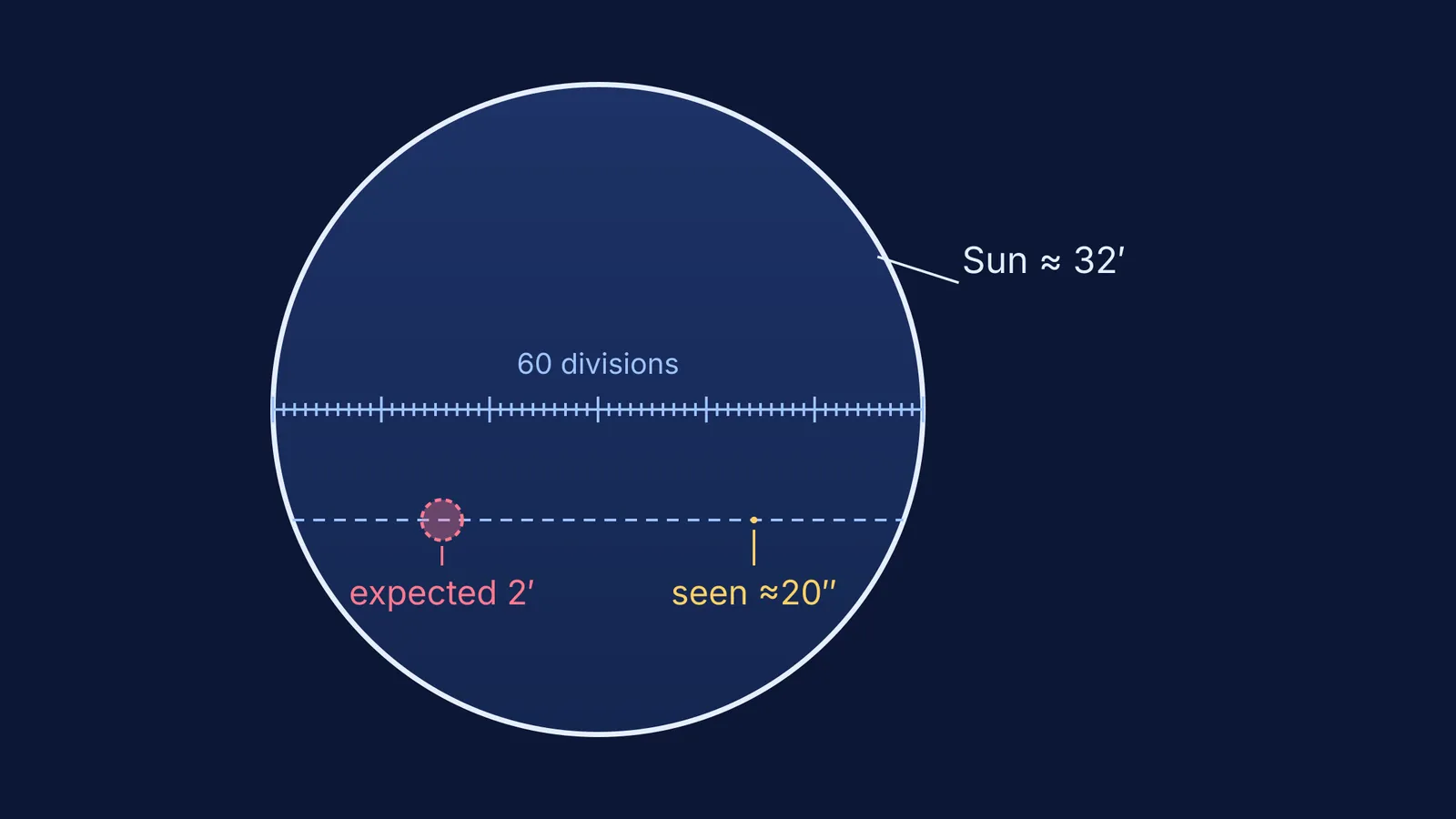
Kepler was unsure of the exact date, so he advised watching from 6 to 8 November, Briot and Schneider note. Gassendi prepared carefully. Sunlight passed through a Galilean telescope into a darkened room and formed an image of the Sun about 25 cm across on a sheet of paper. On the paper he drew a matching circle with its diameter divided into 60 equal parts. In another room, an assistant with a two-foot quadrant waited to measure the Sun's height in the sky whenever Gassendi stamped his foot.
After cloudy days, the Sun came out at about 9 AM on 7 November, with a black spot on the image, says the British Astronomical Association.
It was so small that Gassendi first took it for a sunspot. The dot moved much faster across the Sun, and along a different path, than a sunspot would, as this Cambridge University Press history of Mercury transits explains. Only a planet could do that. He wrote it all up in *Mercurius in sole visus* (1632).
Why was Mercury so much smaller than expected?
Naked-eye estimates suggested that Mercury, at its closest, should look roughly one tenth as wide as the Sun; in fact it is much closer to one hundredth, the Cambridge history notes. In a Tufts University lecture on Gassendi and the transit, Tufts philosopher of science George E. Smith puts it in numbers: Mercury was "around 20 arc seconds in diameter, and they expected it to be two minutes".
Observers using a camera obscura with no lens or telescope could not see Mercury at all. Briot and Schneider record that Johann Baptist Cysat in Innsbruck, Johannes Remus Quietanus in Rouffach and an unnamed Jesuit in Ingolstadt also saw it, but only Gassendi published his observations. A planet that tiny suggested the solar system was far larger than people had believed, as the British Astronomical Association account points out.
How good was Kepler's prediction?
In the same lecture, Smith explains that Kepler's tables put Mercury within about 15 arcminutes of where Gassendi found it. Tables by rival astronomers such as Longomontanus were off by more than four degrees. For Gassendi, this was strong evidence for Kepler's elliptical orbits, explained in our post on how Kepler found his three laws of planetary motion.
Worked example: what Gassendi actually had to spot
You can rebuild the problem with one ratio. Today the Sun looks about 1920 arcseconds across, and Mercury during a November transit about 10 arcseconds, according to The Sun Today's guide to Mercury transits. The size of a dot on a projected image is the image width multiplied by (the object's angle divided by the Sun's angle).
One of Gassendi's 60 divisions: 1920 / 60 = 32 arcseconds, which on a 25 cm image is 25 / 60, about 4.2 mm.
The expected Mercury, 120 arcseconds: 25 cm x 120 / 1920, about 1.6 cm, nearly four divisions wide.
The Mercury Smith describes, 20 arcseconds: 25 cm x 20 / 1920, about 2.6 mm, less than one division.
The real November disc, 10 arcseconds: about 1.3 mm, a pencil dot.
If an angle-and-ratio step like this trips you up, the Fermi Problem Library has worked problems with a step-by-step solver that explains the reasoning rather than printing an answer.
What can students learn from Gassendi's method?
Gassendi's morning is a model for testing any prediction, in a lab practical or a mock analysis:
Write the prediction down before you look, with a range (Kepler gave three days).
Prepare a scale in advance, like Gassendi's 60 divisions, so you can measure, not just notice.
When the result surprises you, list the other explanations (a sunspot) and find a test that separates them (speed and path).
Record times and positions as you go, not afterwards.
Compare the numbers with the prediction, and say how far off it was.
The same idea, a planet briefly blocking the Sun, was later used for Venus; read how Jeremiah Horrocks observed a transit of Venus. And to see why a sunspot moves differently from a planet, read about Galileo's sunspots and the Sun's rotation.
Orbits and angular sizes are easier to see than to read about, which is what the interactive simulations in the Fermi Simulation Lab are for.