On this page
In 1612, Galileo Galilei and his protégé Benedetto Castelli watched the Sun day after day and drew its dark spots. From those drawings Galileo argued that the spots are on the Sun, and the Sun spins. The geometry behind it fits on one page, so you can check it yourself.
What did Galileo see on the Sun in 1612?
According to the Galileo Project at Rice University, it was Castelli who developed the method of projecting the Sun's image through the telescope. Galileo set out his findings in three letters to the Augsburg banker Mark Welser, dated 4 May, 14 August and 1 December 1612, which the Accademia dei Lincei published in Rome in 1613 as the *Letters on Sunspots* (summary and dates). The book carried 38 engravings of the Sun, mostly from June and July 1612.
He was answering the Jesuit mathematician Christoph Scheiner, who, writing in January 1612 as "Apelles", had argued that the spots were small satellites circling close to the Sun (Rice). Galileo said they were on the surface or in the Sun's atmosphere, and looked most like clouds.
How did sunspots show the Sun rotates?
Galileo's case rests on three observations.
The spots all move together. They cross the disc in the same direction, as if carried along by something turning.
They thin out at the edge. A round spot near the centre turns into a thin sliver near the rim, just as a mark on a turning ball does.
They seem to slow down near the edge. A spot covers more of the disc each day near the centre than near the rim, just as a spot fixed to a turning sphere must.
The simplest explanation is that the Sun turns on its axis and carries the spots with it. Galileo put the period at about a lunar month (Letters on Sunspots). At the end of his third letter he also spoke favourably of Copernicus, the idea that the Earth and planets go round the Sun, in what some scholars read as his first endorsement of it (Rice). He pushed that argument further with the phases of Venus.
His drawings hold up. In a study in the Proceedings of the International Astronomical Union, Mikhail Vokhmyanin and Nadezhda Zolotova studied the 47 of Galileo's 1612 drawings that are openly available. They worked out when each drawing was made, which gave them the direction of the Sun's rotation axis. Unlike the spots Scheiner drew, none of Galileo's lies on the Sun's equator, which they say confirms the quality of his drawings.
How long does the Sun take to turn once?
The Sun rotates every 25 days at its equator and takes longer at higher latitudes, up to about 35 days near the poles, according to a NASA SOHO lesson. This is called differential rotation.
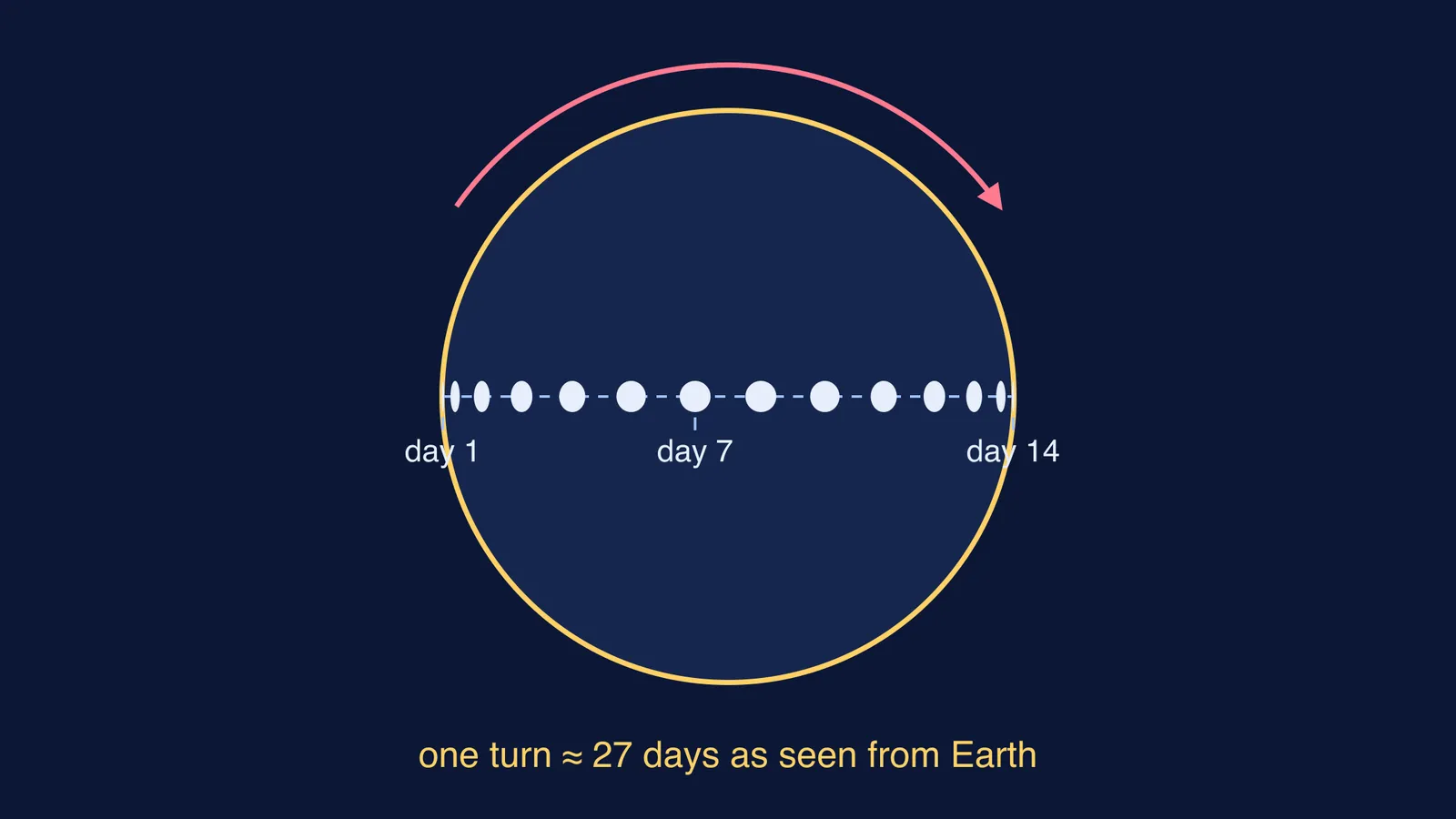
Seen from Earth, which is itself moving round the Sun, the spots take a little longer to come round. The astronomer Richard Carrington found that sunspots rotate every 27.28 days (SOHO). So a spot needs about two weeks to cross the visible face.
How can you work out the Sun's spin from two sketches?
Treat the Sun's disc as a circle of radius R and follow one spot near the equator.
Measure positions. On day 1 the spot is at the centre line. Two days later it sits 0.45 R from the centre.
Turn distance into angle. A spot at angle θ from the centre line appears at R sin θ. So sin θ = 0.45, and θ is about 26.7 degrees.
Find the daily turn. 26.7 degrees in 2 days is about 13.4 degrees a day.
Scale up to a full turn. 360 divided by 13.4 gives about 27 days, close to Carrington's 27.28 days.
Now see the slowing-down effect. Carrington's 27.28 days means 13.2 degrees a day as seen from Earth. At that rate a spot near the centre moves about 0.23 R in one day. Near the rim, between 72.6 and 85.8 degrees, it moves only about 0.04 R. Same turning speed, a fifth of the visible motion. The diagram at the top is drawn from these numbers.
If a turning sphere is hard to picture from a flat drawing, the Fermi Simulation Lab has interactive simulations for ideas that are easier to see than to read.
Can you watch sunspots safely today?
Yes, with care. NASA warns that viewing any part of the bright Sun through a camera lens, binoculars or a telescope without a special-purpose solar filter secured over the front will instantly cause severe eye injury. It advises seeking expert advice from an astronomer before using such a filter. A pinhole projector is a safe indirect method; our guide to watching a solar eclipse safely covers the setup.
Next, read how Heinrich Schwabe discovered the sunspot cycle.