

On this page
For over a thousand years, astronomers accepted the geocentric model of the universe. Claudius Ptolemy's system placed the Earth at the centre, with the Sun, Moon and planets orbiting it. This model predicted the paths of the planets well enough for early astronomers, but it had a fatal flaw. In late 1610, Galileo Galilei turned his telescope to Venus and saw something that shattered the old model completely.
What did Galileo see when he looked at Venus?
When you look at Venus with the naked eye, it appears as a bright, featureless point of light. But through a telescope, it has phases. Galileo observed that Venus changed its shape over time, moving through a full sequence from a thin crescent to a half disc, and then to a small, nearly full circle.
He also noticed that the planet's apparent size changed drastically. As a thin crescent, Venus looked large. When it was nearly full, it looked much smaller. These two observations together—a changing shape and a changing size—could not be explained by the astronomy of the day.
Why couldn't Ptolemy's model explain a full Venus?
To understand why this observation was so destructive to the old science, you have to look at the geometry. In Ptolemy's Earth-centred model, Venus orbited on a small circle (an epicycle) that was always positioned exactly between the Earth and the Sun. The model required this to explain why Venus never strays far from the Sun in the sky.
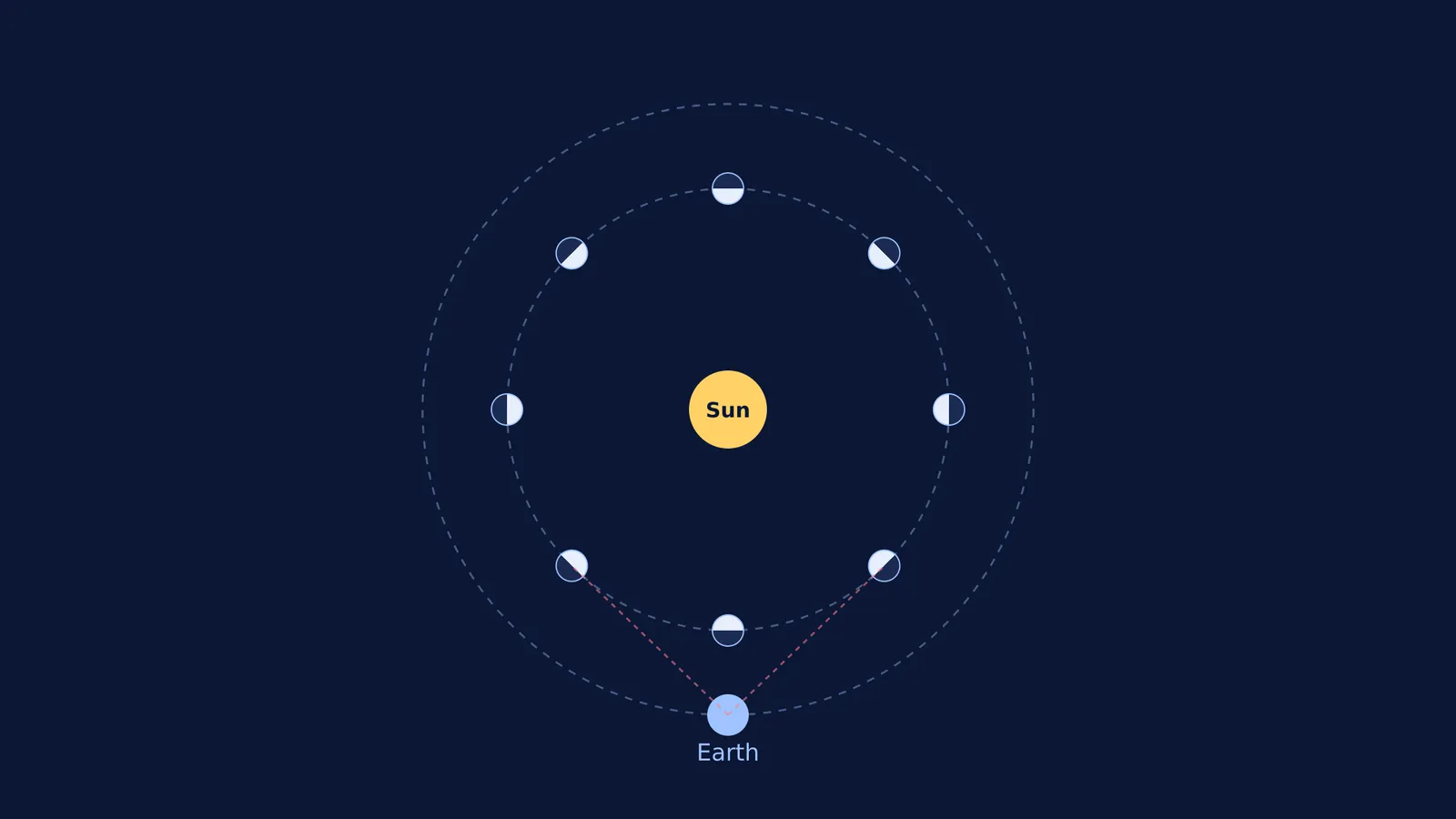
Because Venus was always trapped between us and the Sun, the side illuminated by sunlight would mostly face away from the Earth. An observer would only ever see a crescent or a "new" (dark) phase. A full phase is geometrically impossible in the Ptolemaic model because Venus could never pass to the far side of the Sun.
If you find it difficult to picture how the changing angles of sunlight create these shapes, the Simulation Lab lets you drag the planets through their orbits and see the phase change in real time. It is much easier to understand when you can watch the light shift as the orbit progresses.
Did the phases of Venus prove the heliocentric model?
In the 1540s, Nicolaus Copernicus proposed the heliocentric model, which placed the Sun at the centre of the solar system. In this model, Venus orbits the Sun, not the Earth.
Galileo's observations matched the Copernican model perfectly. When Venus is between the Earth and the Sun, we see its dark side (a new phase) and it appears large because it is close to us. When Venus moves to the far side of the Sun, the illuminated side faces us directly, creating a full phase. It appears smaller simply because it is much further away.
The observation of a full Venus proved that the planet must travel behind the Sun, dealing a fatal blow to the Ptolemaic system. However, it did not strictly prove the heliocentric model. The phases were also compatible with the Tychonic system, where the planets orbit the Sun, but the Sun itself orbits a stationary Earth. Nevertheless, it was definitive proof that Venus orbits the Sun.
What was the anagram Galileo sent to Kepler?
In the 17th century, scientists often used anagrams to stake a claim on a discovery before they had gathered enough data to publish it officially. This stopped rivals from stealing their work. In late 1610, Galileo sent a jumbled Latin sentence to his rival Johannes Kepler: *Haec immatura a me iam frustra leguntur o.y.* ("These are now too young to be read by me.")
Kepler tried to solve the puzzle himself. He incorrectly guessed a sentence that translated to "There is a red spot on Jupiter which rotates mathematically," accidentally predicting the Great Red Spot centuries before it was fully understood.
A few months later, Galileo revealed the real solution. The letters rearranged to form *Cynthiae figuras aemulatur mater amorum*, which translates to "The mother of love imitates the shapes of Cynthia." In classical poetry, the mother of love is Venus, and Cynthia is the Moon. Galileo was announcing that Venus has phases just like the Moon. Almost thirty years later, astronomers like Jeremiah Horrocks observed the transit of Venus, continuing to build the exact dimensions of the solar system.


