

On this page
Hold up a finger and look at it with one eye, then the other. It jumps against the wall behind it. That jump is parallax. Swap your eyes for two observers thousands of kilometres apart and you can measure the distance to the Moon.
What is the parallax method?
Parallax is the apparent shift of a nearby object against a far-away background when you view it from two places. In a school project described in Science in School, two observers photographed the Moon at the same moment, and the parallax angle was the Moon's apparent shift between the two images.
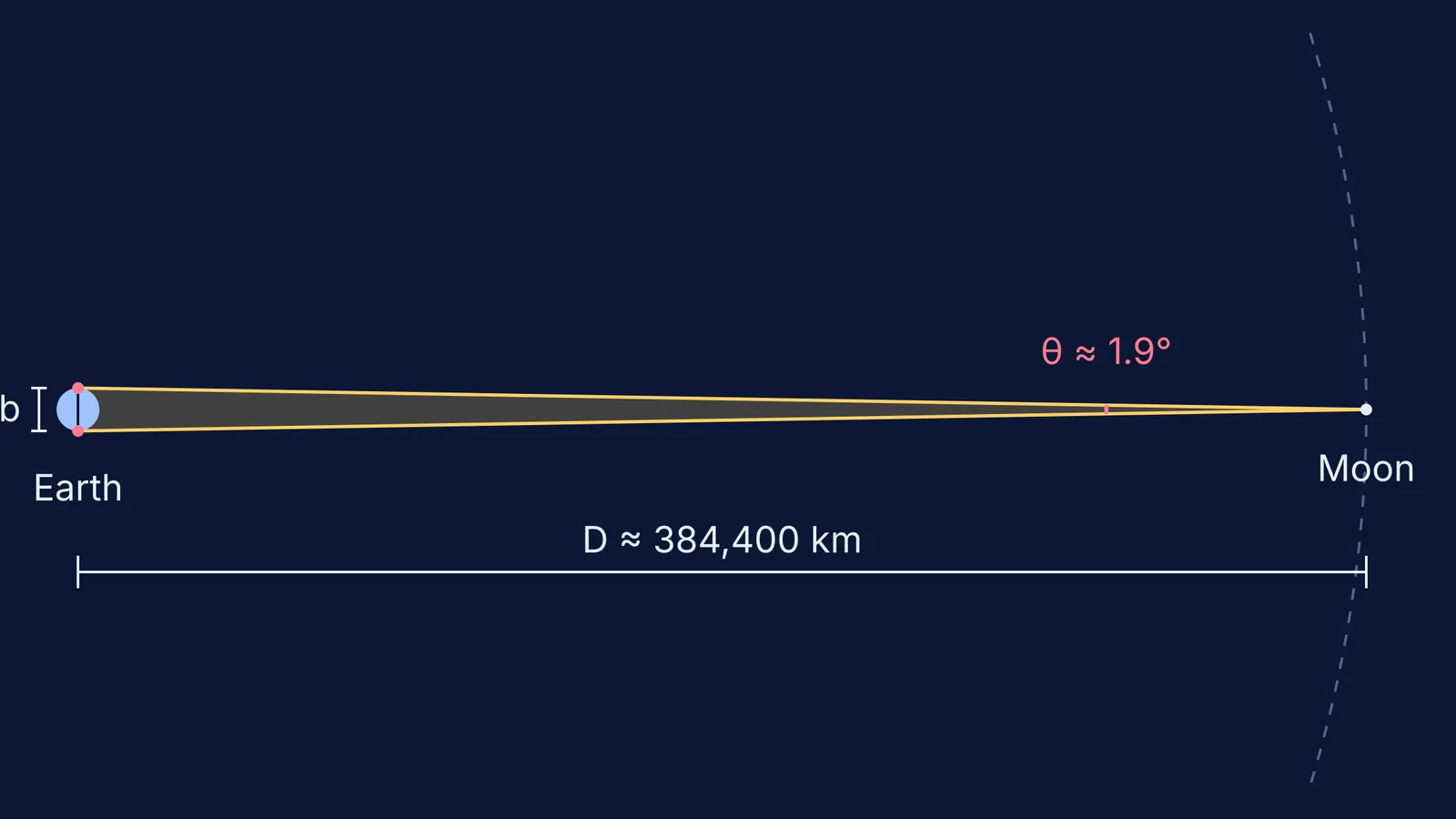
The straight-line distance between the observers is the baseline, b. The stars are so far away that they act as a fixed backdrop. So the Moon's shift against them is the angle θ at the tip of a long, thin triangle with the baseline as its short side.
How do you find the distance of the Moon using parallax?
Choose two observation points thousands of kilometres apart.
At one agreed moment, both photograph the Moon with stars in the frame.
Line up the two images using the stars and measure how far the Moon's centre has moved. That shift is θ.
Find b, the straight-line distance between the observers.
Convert θ to radians and divide: D = b/θ.
The formula comes from the definition of the radian. NCERT's Class 11 physics chapter Units and Measurement defines a plane angle as arc length divided by radius, dθ = ds/r. When θ is tiny, the baseline is almost an arc of a circle of radius D centred on the Moon, so θ ≈ b/D and D = b/θ. The same chapter gives 1° = π/180 rad.
What angle does Earth's diameter give?
Take the longest baseline Earth offers: two observers at opposite ends of a diameter. The NCERT Units and Measurement chapter gives Earth's diameter as 1.28 × 10^7 m, and NASA's Moon facts page gives the Moon's average distance as 384,400 km.
θ = b/D = (1.28 × 10^7 m) / (3.844 × 10^8 m) = 0.0333 rad
In degrees: 0.0333 × 180/π ≈ 1.91°, or about 1°54′
Run it backwards for the usual textbook question: given θ = 1°54′ (0.0333 rad) and b = 1.28 × 10^7 m, D ≈ 3.84 × 10^8 m.
Has anyone measured it with real photos?
Yes. In the project described in Science in School, observers in Cape Town and Italy's Aosta Valley photographed the Moon on 2 February 2015. Their baseline was 8,212 km and the parallax angle was 1.2°. The quick version:
θ = 1.2 × π/180 = 0.02094 rad
D = 8,212 km / 0.02094 ≈ 392,100 km
The authors, Davide Cenadelli and colleagues, then added the offset from the observers to Earth's centre and got 396,900 km. The true distance that night was 397,900 km, so they were 0.3% short. It wasn't 384,400 km because the Moon's distance changes over its orbit, as the lunar distance reference page shows. The 384,400 km figure is only the average.
When does D = b/θ give the wrong answer?
Degrees instead of radians. See the callout above.
A slanted baseline. What counts is the part of the baseline at right angles to the line of sight. Astrophotographer Anthony Ayiomamitis compared photos from Athens and Selsey (UK), about 2,370 km apart. His first estimate was 438,988 km, roughly 10% too high. Once he corrected so that the two sites lay on the same plane facing the Moon, he got 404,897 km, within 2.37%.
Photos taken at different times. The Moon moves against the stars, so a time gap adds a false shift.
Large angles. At 1.2°, θ and the exact 2 tan(θ/2) differ by under 0.01%. For angles of tens of degrees, use full trigonometry.
The same geometry measures star distances, using Earth's orbit as the baseline. Try it in how parallax measures star distances, in a simulation, and brush up on degrees, radians and arc length and when the small angle approximation is valid. If radians still feel shaky, the Fermi Concept Library gives every concept in physics and mathematics its own lesson and shows its place in the map.
How do we know 384,400 km is right?
The Apollo 11 astronauts left reflectors on the Moon in 1969. Observatories fire laser pulses at them and time the return, measuring the distance to within a few millimetres (NASA Goddard). The NCERT chapter gives the speed of light as exactly 299,792,458 m/s, so light takes about 2.56 s to cover the 2 × 384,400 km round trip.
If one of them trips you up, the Fermi Problem Library has worked problems with a step-by-step solver that explains the reasoning rather than printing an answer.


