

On this page
In almost every introductory physics class, there comes a moment when a complicated equation is magically simplified by crossing out sin θ and replacing it with just θ. We use it to derive the period of a swinging mass, to trace light rays through thin lenses, and to find the bright and dark fringes in a double-slit experiment. It feels like a convenient loophole that makes the mathematics significantly easier to solve.
But accepting this rule blindly creates a dangerous habit of trusting formulas over physical reality. If you never test the boundary of the rule, you will not know when your model stops describing the real world. Instead of simply asking when the rule applies, the best way to understand the small-angle approximation is to sit down, run the numbers, and compute the exact error yourself at different degrees.
When is small angle approximation valid?
The short answer is that sin θ ≈ θ is generally considered valid up to 14° if you need your calculation to stay within a 1% margin of error, according to the standard mathematical error tables on Wikipedia.
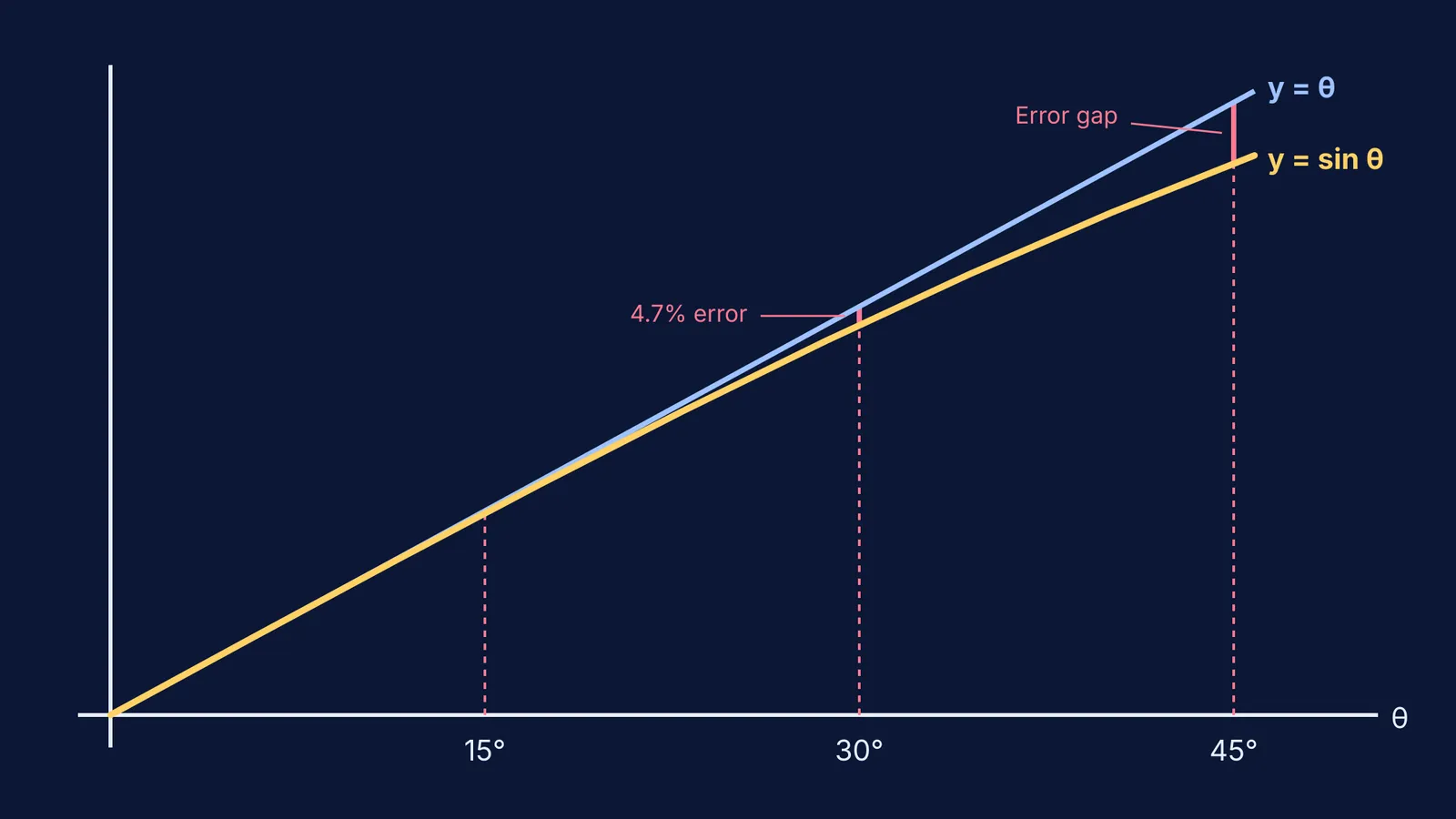
The approximation works because the sine curve and the straight line representing y = x are almost completely identical near the origin. If you look at a graph of both functions, they overlap perfectly at first. However, as the angle increases, the straight line continues diagonally upwards while the sine curve inevitably bends back down towards zero. Because the approximation formula relies entirely on angles measured in radians rather than degrees, the mathematical divergence starts slowly and then accelerates rapidly.
By the time you reach 30°, the gap between the straight line and the curve becomes visually and mathematically obvious. This is exactly why using the approximation for wide-swinging objects or steep physical trajectories gives answers that simply do not match laboratory experiments.
How do you compute the error yourself?
Testing the mathematical limit is a highly effective active learning technique. To find the exact error, you cannot use degrees directly in your calculations. You must first convert your chosen angle to radians by multiplying it by π/180. Then, you compare the exact value of sin θ to the raw numerical value of θ itself. The relative error is the difference between the two, divided by the exact value, and then expressed as a percentage.
Here is what happens when you calculate the relative errors at three common test points, verifying the thresholds listed in standard reference tables:
At 5°: The angle converts to roughly 0.08727 radians. The exact sine of 5° is 0.08716. The difference is microscopic, resulting in a relative error of just 0.13%. At this tiny scale, the approximation is practically flawless and completely safe to use.
At 15°: The angle is 0.26180 radians, and the exact sine is 0.25882. The relative error jumps to 1.1%. For most classroom physics and engineering problems, this is the accepted cutoff point for accuracy.
At 30°: The angle is 0.52360 radians, but the sine is exactly 0.5. The gap widens significantly, resulting in a relative error of 4.7%.
If you ever find yourself uncertain about whether a mathematical shortcut is safe to take, Fermi's AI tutor can help you test it. Most learning tools answer questions. Fermi teaches — it holds a line of reasoning across a whole session, notices where a student is stuck, and decides whether to explain, ask, or show. It works through the boundary conditions with you, writing the error calculations on a board and checking your understanding as it goes.
Why does it matter in physics?
Relying on an approximation when it is no longer valid does not just make your final number slightly messy; it completely hides the actual physics of the system.
Consider the classic example of a swinging mass. If you are calculating the simple pendulum string tension at any angle, the small-angle approximation is the only thing that allows us to treat the motion as simple harmonic. In simple harmonic motion, the period of the swing is perfectly regular regardless of the amplitude. However, once the pendulum swings past a small angle, the period actually begins to depend heavily on the amplitude of the swing. The simple approximation masks this beautiful, complex reality.
Similarly, if you are looking at the equation of trajectory of a projectile, substituting angles loosely can completely change the predicted landing point and maximum height. The mathematics must always reflect the physical boundaries of the real-world system.
A practical script to test approximations
The next time a textbook introduces a new mathematical approximation like cos θ ≈ 1 - θ²/2 or tan θ ≈ θ, do not just memorise the rule. Sit down with a calculator and run a quick boundary check for yourself:
Pick a small starting value and convert it to radians.
Compute both sides of the approximation using your calculator.
Calculate the percentage difference between the two results.
Double the test angle and repeat the calculation until the error crosses your chosen threshold.
This simple habit shifts you from passively reading equations to actively testing their limits. You will stop seeing physics as a set of arbitrary rules to be memorised, and start seeing it as a series of deliberate, measured simplifications.


