On this page
Most planets outside our solar system are too far away to see directly. Instead, astronomers look for a star that blinks. When a planet passes in front of its star—an event called a transit—it blocks a tiny fraction of the star's light.
By measuring the dip in the exoplanet transit light curve, you can calculate the planet's size.
What is an exoplanet transit light curve?
A light curve is simply a graph showing a star's brightness over time. Normally, a star's light is steady and reads as a baseline relative brightness of 1.0. But if a planet's orbit is aligned perfectly with our line of sight, the planet will cross the star's face once per orbit.
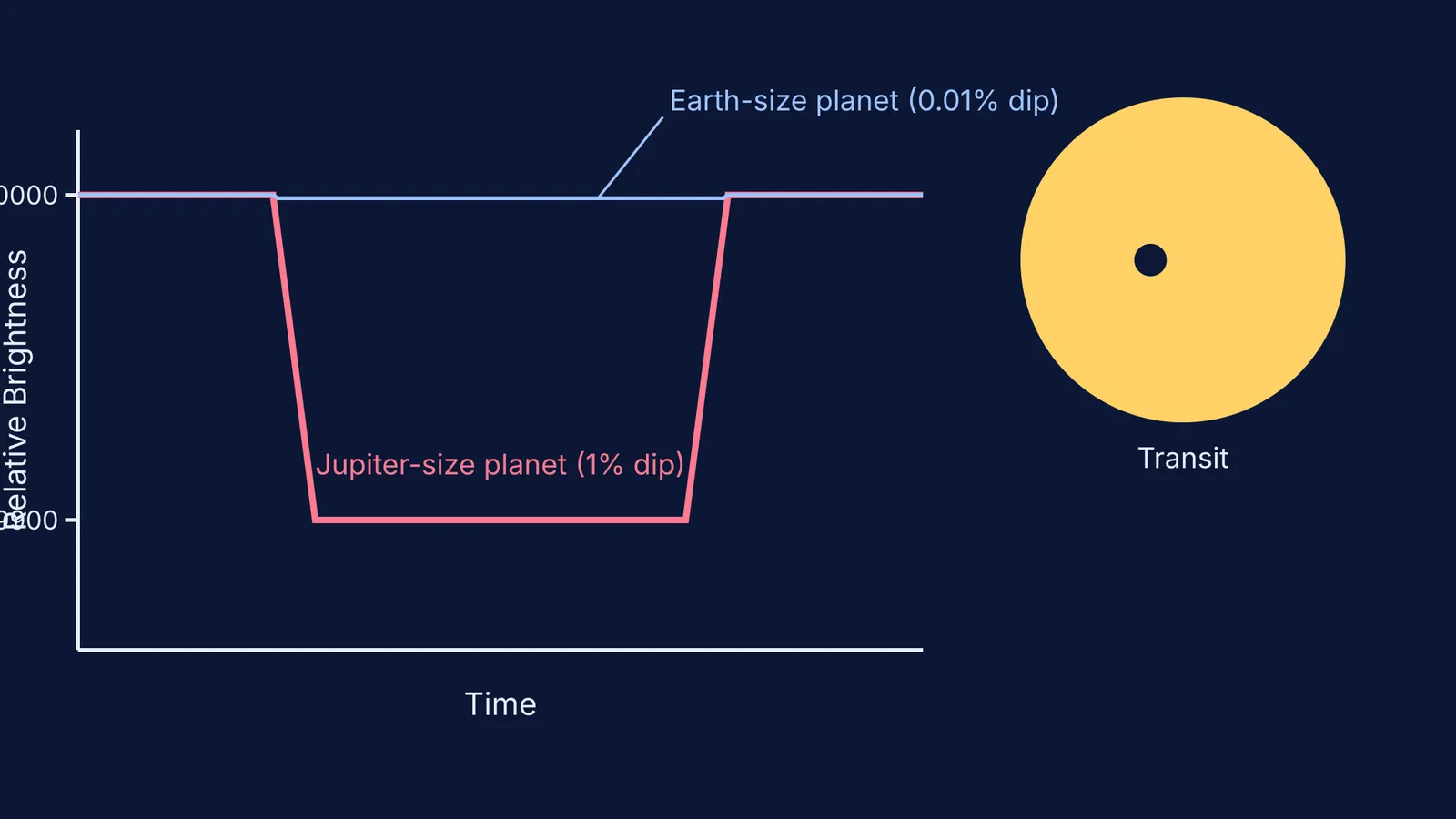
During this transit, the star's brightness drops, stays flat while the planet moves across the disk, and then rises back to normal. This creates a distinctive U-shape or bucket shape on the graph. The depth of this dip tells you exactly how much area the planet covers.
If you are Understanding planetary orbits with a gravity simulation, you know that larger orbits take more time. This is why the time between the dips tells astronomers the length of the planet's year, while the depth of the dip tells them the planet's physical size.
How do you find planet size from the transit dip?
The amount of light blocked depends entirely on the ratio of the planet's area to the star's area. Because planets and stars are roughly spherical, their cross-sections look like circles from our perspective.
The formula for the transit depth is the square of the ratio of their radii, according to the Open University:
Transit Depth = (Planet Radius / Star Radius)²
This means if you know the star's size and you measure the percentage dip in the light curve, you can directly read the planet's radius. (Once you have the radius, you might use other methods to Find the density of Earth from g and its radius, which tells you if the new world is a rocky terrestrial planet or a gas giant).
How much does a star dim when Earth or Jupiter transits?
To picture what telescopes are looking for, we can look at the baseline numbers from the Open University for our own solar system's planets crossing a Sun-like star:
Jupiter-size planets cause a 1% dip. A gas giant like Jupiter has a radius about 1/10th that of the Sun. Squaring 1/10 gives 1/100, meaning it blocks 1% of the star's light. A 1% dip is relatively deep and can often be detected by telescopes on the ground.
Earth-size planets cause a 0.01% dip. Earth has a radius about 1/100th that of the Sun. Squaring 1/100 gives 1/10,000, or 0.01%. This signal is so faint that measuring it usually requires space-based telescopes to avoid the blurring effect of our atmosphere.
A worked example: Calculating a planet's radius
If you are solving an exoplanet problem in your physics homework, you will usually follow these steps to find the planet's size based on the Open University's method.
Step 1: Identify the transit depth from the light curve. Look at the graph. If the normal relative brightness is 1.000, and it drops to 0.990 during the transit, the change is 0.01. This means the transit depth is 1%.
Step 2: Find the radius of the star. You cannot find the planet's size without knowing the star's size first. Usually, this is given to you based on the star's spectral type. Let us assume the star is exactly the size of our Sun, which has a radius of about 700,000 km.
Step 3: Apply the transit depth formula. The formula links the light blocked to the areas: Transit Depth = (Planet Radius / Star Radius)²
Plug in the 0.01 transit depth we found in Step 1: 0.01 = (Planet Radius / Star Radius)²
Step 4: Take the square root of both sides. To isolate the radius ratio, take the square root of 0.01, which is 0.1. 0.1 = Planet Radius / Star Radius
Step 5: Multiply by the star's radius. Multiply the ratio (0.1) by the Sun's radius (700,000 km). Planet Radius = 0.1 × 700,000 km = 70,000 km.
A radius of 70,000 km is exactly the size of Jupiter. By simply measuring a 1% drop in light, you have proven that a gas giant is orbiting a distant star.
One detail you might notice in real light curves is that the bottom of the dip is rarely perfectly flat. Stars are slightly darker near their edges than at their centres, an effect called limb darkening. Because of this, the light curve is slightly rounded. Astronomers use the exact shape of the ingress (the initial drop) and egress (the rise) to understand exactly how the planet crosses the star.
How to test this yourself
Visualising how a small sphere blocks light from a large sphere is one of those ideas that are easier to see than to read about. If you want to experiment with how changing the planet's radius alters the bucket shape of the light curve, you can set up a system in the Fermi Simulation Lab and watch the graph update in real time.
If you get stuck trying to calculate the exact radius of an exoplanet from a messy real-world light curve, Fermi's AI tutor can walk you through the math step by step, checking your understanding of the radius squared formula as you go.