On this page
Chapter 1 of the Class 10 Science textbook, Chemical Reactions and Equations, covers balancing, reaction types, energy changes and redox. Every statement below was checked against the NCERT Class 10 Science chapter 1 PDF (Reprint 2026-27).
How do you answer assertion-reason questions?
Judge each line on its own: true or false? Only when both are true, ask whether R is the direct reason for A or just a true fact beside it.
Use these keys for Q1 to Q6:
(A) Both A and R are true and R is the correct explanation of A.
(B) Both A and R are true but R is NOT the correct explanation of A.
(C) A is true but R is false.
(D) A is false but R is true.
For the full method, with worked examples, read our guide to solving assertion-reason questions in CBSE papers.
Assertion-reason questions on chemical reactions
Q1 (easy). Assertion (A): A wall whitewashed with slaked lime gets a shiny finish two to three days later. Reason (R): Calcium hydroxide reacts slowly with carbon dioxide in the air to form a thin layer of calcium carbonate.
Answer: (A). Both are true and R is the cause. NCERT explains the shine by exactly this reaction: Ca(OH)2 + CO2 → CaCO3 + H2O.
Trap: thinking the wall shines because the water dries off.
Q2 (easy). Assertion (A): To balance oxygen in Fe + H2O → Fe3O4 + H2, you may rewrite water as H2O4. Reason (R): While balancing an equation, the formulae of the substances must not be changed.
Answer: (D). A is false: you put a coefficient in front, 4 H2O, and never touch the formula. R is true, and it is the rule that A breaks.
Trap: treating a formula as just a count of atoms that you can adjust.
Q3 (medium). Assertion (A): The decomposition of silver chloride in sunlight is an endothermic reaction. Reason (R): Silver chloride turns grey when it is left in sunlight.
Answer: (B). Both are true, but R is only an observation. It is endothermic because it absorbs light energy to break the reactant down; the grey colour only shows that silver has formed.
Trap: choosing (A) because both lines are about the same experiment.
Q4 (medium). Assertion (A): When an iron nail is kept in copper sulphate solution, the blue colour of the solution fades. Reason (R): Iron is less reactive than copper.
Answer: (C). A is true. R is false: iron is more reactive than copper, which is why it can displace copper from copper sulphate and form iron sulphate. A less reactive metal could not do this.
Trap: reading "displaced" the wrong way round.
Q5 (medium). Assertion (A): The reaction between sodium sulphate and barium chloride solutions is a double displacement reaction. Reason (R): A white precipitate forms when the two solutions are mixed.
Answer: (B). Both are true, but R is not the reason. It is a double displacement reaction because the reactants exchange ions: Ba2+ joins SO4 2− and Na+ stays with Cl−. The precipitate makes it a precipitation reaction, which is a separate label.
Trap: thinking every reaction that forms a precipitate is defined by it.
Q6 (hard). Assertion (A): In ZnO + C → Zn + CO, carbon is the substance that gets reduced. Reason (R): A substance that loses oxygen during a reaction is reduced.
Answer: (D). A is false: carbon gains oxygen to become CO, so carbon is oxidised. Zinc oxide loses oxygen and is reduced. R is the correct definition.
Trap: calling whatever ends up "on its own" reduced.
Statement I and Statement II questions
Use these keys for Q7 to Q10:
(A) Both statements are correct.
(B) Both statements are incorrect.
(C) Statement I is correct, Statement II is incorrect.
(D) Statement I is incorrect, Statement II is correct.
Q7 (medium). Statement I: Respiration is an exothermic process. Statement II: The decomposition of vegetable matter into compost is an endothermic reaction.
Answer: (C). Statement I is correct: glucose combines with oxygen in our cells and releases energy. Statement II is wrong: NCERT lists composting as an exothermic reaction.
Trap: seeing "decomposition" and assuming energy must be absorbed.
Q8 (medium). Statement I: The brown fumes given off when lead nitrate is heated are nitrogen dioxide. Statement II: When ferrous sulphate crystals are heated, they lose water and then decompose into ferric oxide, sulphur dioxide and sulphur trioxide.
Answer: (A). Both are correct. Lead nitrate gives lead oxide, NO2 and oxygen; ferrous sulphate changes colour as it loses water, then gives Fe2O3, SO2 and SO3.
Trap: mixing up which product is the coloured gas.
Q9 (hard). Statement I: In MnO2 + 4HCl → MnCl2 + 2H2O + Cl2, manganese dioxide is oxidised. Statement II: In the same reaction, HCl is reduced to Cl2.
Answer: (B). Both are wrong. MnO2 loses oxygen, so it is reduced. HCl loses hydrogen to become Cl2, so it is oxidised.
Trap: checking only oxygen and forgetting the hydrogen rule.
Q10 (hard). Statement I: Mg + O2 → MgO is a balanced equation, because only magnesium and oxygen appear on both sides. Statement II: When natural gas burns, the balanced equation needs two molecules of oxygen for every molecule of methane.
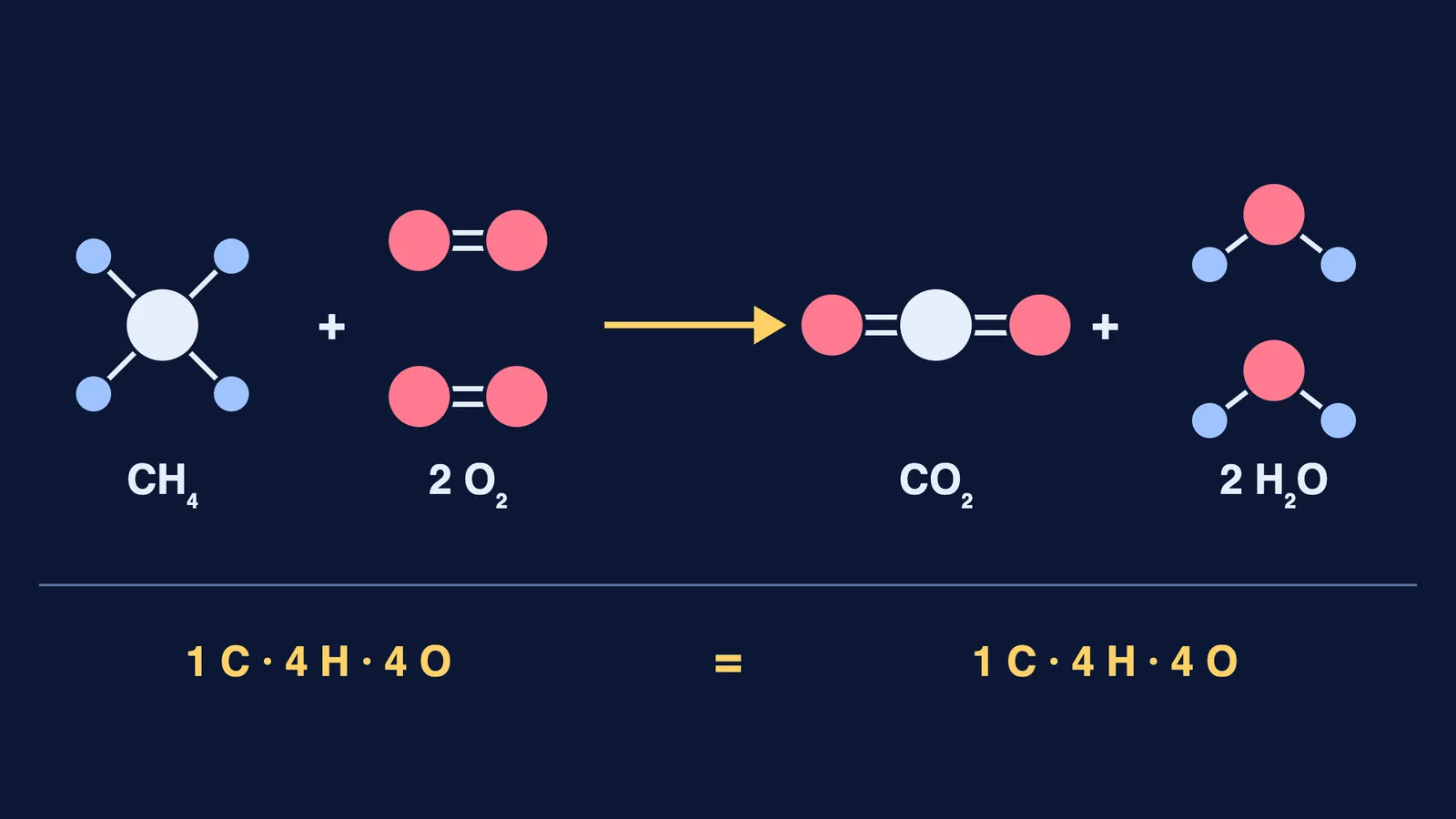
Answer: (D). Statement I is wrong: it has two oxygen atoms on the left and one on the right, so it is only a skeletal equation (balanced, it is 2Mg + O2 → 2MgO). Statement II is correct: CH4 + 2O2 → CO2 + 2H2O has 1 C, 4 H and 4 O on each side.
Trap: checking which elements appear instead of counting atoms.
How should you use this set?
Try all ten without the textbook. Write T or F next to every line before you pick a key.
For each miss, note what went wrong: the assertion, the reason, or the link between them.
Redo your misses three days later, then practise the balancing steps in our Class 10 guide to balancing chemical equations.
For spotting "true but not the reason" pairs in any subject, see our assertion-reason question strategy. If oxidation and reduction still feel like a guessing game, the Fermi Concept Library gives every concept in chemistry its own lesson and its place in the map.