

On this page
A tube well in the Bengal delta can give clear, good-tasting water that still carries arsenic above the drinking-water limit. Removing it is harder than it sounds, because groundwater arsenic comes in two oxidation states that behave like two different substances. One is a neutral molecule that iron hydroxide holds weakly; the other is an anion that it grabs. That is why arsenic treatment starts by oxidising the water. This post explains the chemistry. It is not a guide to treating your own water: if you live in an affected area, get your well tested and follow your public health engineering department or local health authority.
Where does the arsenic in Bengal's groundwater come from?
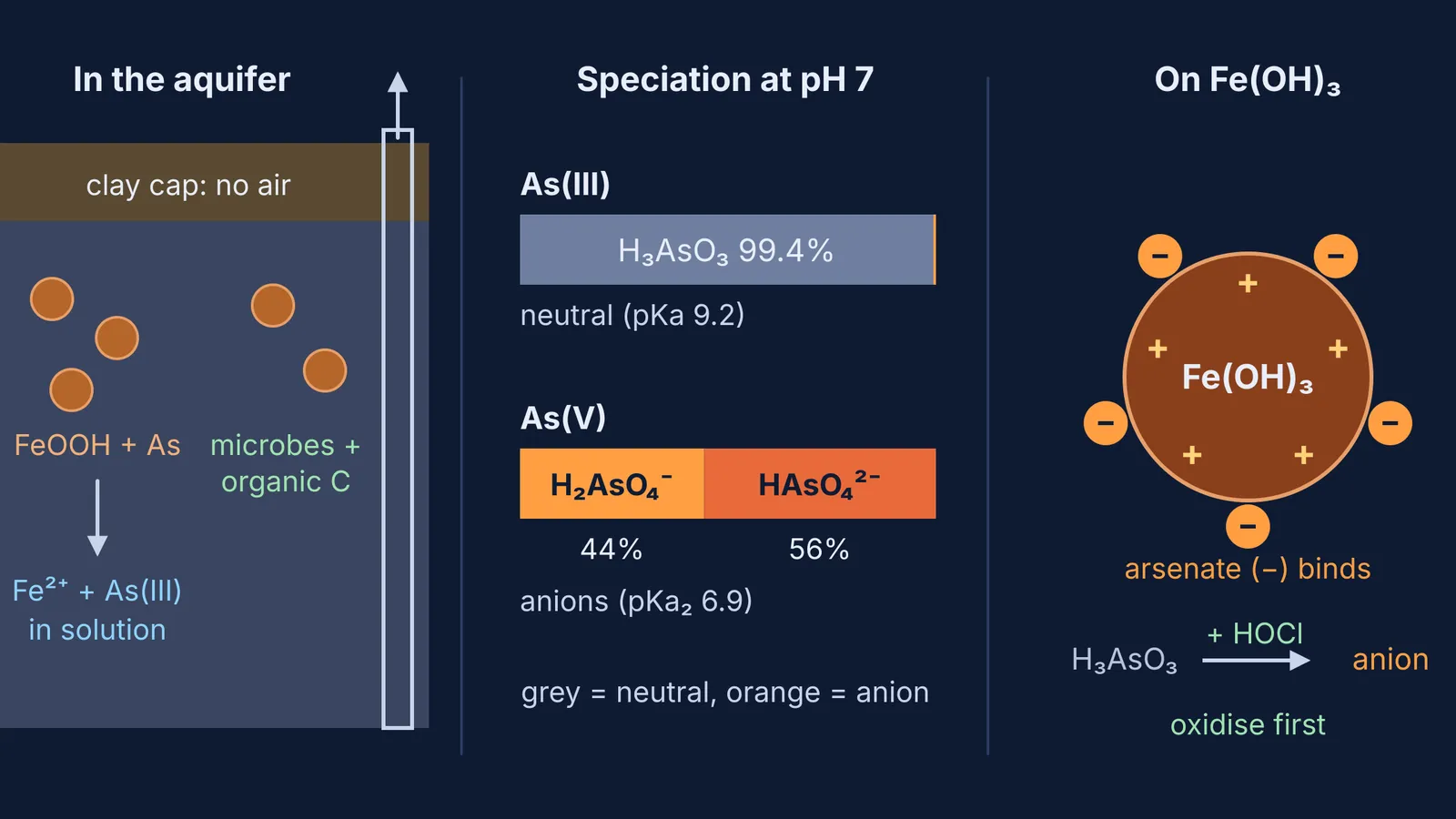
The arsenic is natural and comes from the sediments themselves. The widely cited review of arsenic in natural waters00018-5) by Pauline Smedley and David Kinniburgh of the British Geological Survey describes the affected aquifers as shallow (less than about 100 to 150 m), young sands, silts and clays laid down by the Ganges, Brahmaputra and Meghna. A clay cap keeps air out, and buried organic matter keeps the water strongly reducing.
Microbes feeding on that organic matter use iron(III) oxides as their electron acceptor, much as you use oxygen. The oxide is reduced to soluble Fe²⁺, and arsenic that was stuck to its surface comes off. The review lists several processes that probably act together: reductive dissolution of the iron oxides, desorption as their surfaces change, and reduction of arsenic from +5 to +3. The details are still debated, but the overall picture is redox chemistry.
Tube wells were promoted for decades as a safer alternative to polluted surface water, and they did cut water-borne disease. The arsenic was unforeseen; the review notes that health problems were first identified in West Bengal in the 1980s. Its distribution is patchy, and the review notes that deep wells in Bangladesh (below about 150 to 200 m) almost always have low arsenic.
Why do As(III) and As(V) behave so differently?
Arsenic is in Group 15 and shows the +3 and +5 states you learn for phosphorus. In water they are oxyacids:
Arsenite, As(III): arsenous acid, H₃AsO₃, pKa about 9.2.
Arsenate, As(V): arsenic acid, H₃AsO₄, pKa values about 2.2, 6.9 and 11.5.
Tables differ by 0.1 to 0.2 units; 6.9 and 9.2 match the Smedley and Kinniburgh review. Delta groundwater is close to pH 7, where arsenite is almost all uncharged H₃AsO₃ and arsenate is almost all anions, H₂AsO₄⁻ and HAsO₄²⁻. Wells usually carry both: the review reports that arsenite is typically 50 to 60% of the total.
Worked example: speciation, balancing and oxidant demand
Problem. A well at pH 7.0 has 100 µg/L of arsenic, all As(III), and 3.0 mg/L of Fe²⁺. (a) What fraction of each arsenic form is charged? (b) Balance the oxidation of arsenite by hypochlorous acid. (c) How much chlorine do the arsenic and the iron each need?
Step 1. Arsenite. For a weak acid, [A⁻]/[HA] = 10^(pH − pKa) = 10^(7.0 − 9.2) = 0.0063. The ionised fraction is 0.0063 ÷ 1.0063 ≈ 0.6%, so 99.4% is neutral.
Step 2. Arsenate. [HAsO₄²⁻]/[H₂AsO₄⁻] = 10^(7.0 − 6.9) = 1.26, so about 56% HAsO₄²⁻ and 44% H₂AsO₄⁻. The neutral acid is negligible: [H₃AsO₄]/[H₂AsO₄⁻] = 10^(2.2 − 7.0) ≈ 1.6 × 10⁻⁵.
Step 3. Balance. H₃AsO₃ + HOCl → H₂AsO₄⁻ + Cl⁻ + 2H⁺
Arsenic goes from +3 to +5 (loses 2 electrons) and chlorine from +1 to −1 (gains 2). Atoms: As 1 = 1; Cl 1 = 1; O 4 = 4; H 4 = 2 + 2. Charge: 0 on the left, −1 − 1 + 2 = 0 on the right.
Step 4. Chlorine for the arsenic. 100 µg/L ÷ 74.92 g/mol = 1.33 × 10⁻⁶ mol/L. One Cl₂ gives one HOCl (Cl₂ + H₂O → HOCl + HCl), so this needs 1.33 × 10⁻⁶ × 70.90 g/mol = 0.095 mg/L of Cl₂.
Step 5. Chlorine for the iron. 2Fe²⁺ + Cl₂ → 2Fe³⁺ + 2Cl⁻. Iron is 3.0 ÷ 55.85 = 0.0537 mmol/L, needing half that in Cl₂: 0.0269 mmol/L, or 1.9 mg/L.
Answer. The iron uses about 20 times more oxidant than the arsenic. But the Fe³⁺ it forms precipitates as iron(III) hydroxide, which is what then removes the arsenate. These are exam numbers, not doses: real water has other substances that use up oxidant, so treatment plants test rather than calculate.
Why does iron hydroxide remove arsenate better than arsenite?
Freshly precipitated iron(III) hydroxide (the poorly crystalline form is called ferrihydrite) has a positive surface below its point of zero charge, usually quoted as about pH 8 (reported values run from roughly 7.5 to 8.5). It is the same surface you meet as the positive sol in Class 12: see why ferric hydroxide sol is positively charged. At pH 7 it attracts anions, and arsenate then bonds directly to surface iron through Fe–O–As links.
Arsenite does bind to iron oxides too, so "neutral molecules don't stick" is an oversimplification. The difference shows in real groundwater, where silicate and phosphate compete for the same sites. A study by Roberts and colleagues (2004), designed around Bangladesh groundwater, found that even without silicate or phosphate, taking 500 µg/L arsenic below 50 µg/L needed about 2.0 to 2.5 mg/L of iron for As(V) but 30 to 40 mg/L for As(III). With silicate and phosphate added, both needed more iron. Hence the rule: oxidise first, then let the iron hydroxide form and remove it.
Why not just let air oxidise the arsenic?
Because it is slow. Smedley and Kinniburgh cite half-lives of several months to a year for oxidation of arsenite by dissolved oxygen in seawater, and note that As(V)/As(III) ratios in samples can stay unchanged for days or weeks. Chlorine and permanganate work far faster; permanganate also oxidises iron, as in what KMnO₄ does to well water. One helpful twist from the Roberts study: when Fe²⁺ is oxidised by air, some As(III) is oxidised along with it.
What is the limit for arsenic in drinking water?
The World Health Organization's guideline is 10 µg/L, and its arsenic fact sheet calls it provisional because removing arsenic to lower levels is practically difficult. India's IS 10500:2012 set an acceptable limit of 0.01 mg/L and originally allowed 0.05 mg/L where no other source existed. The Jal Jeevan Mission's guidelines for arsenic- and fluoride-affected areas state that BIS removed that relaxation by an amendment in June 2015, so 0.01 mg/L now applies.
WHO links long-term exposure to inorganic arsenic in drinking water with skin changes, some cancers and other chronic diseases. Risk depends on concentration and years of exposure, and only testing tells you where a well stands. To practise speciation sums like the one above, the Fermi Problem Library has a step-by-step solver that explains the reasoning. For how arsenic was first detected, see the Marsh test.
Quick checklist
Bengal arsenic is natural: microbes reduce iron(III) oxides in organic-rich sediment, releasing the arsenic on them.
As(III), H₃AsO₃ (pKa about 9.2), is about 99.4% neutral at pH 7.
As(V), H₃AsO₄ (pKa about 2.2, 6.9, 11.5), is essentially all anions at pH 7.
Fe(OH)₃ is positive below about pH 8 and binds arsenate far better in real groundwater.
H₃AsO₃ + HOCl → H₂AsO₄⁻ + Cl⁻ + 2H⁺: 2 electrons, 1 : 1 with chlorine.
Air oxidises As(III) slowly; chlorine or permanganate is fast.
Limit: 10 µg/L. Test wells and follow local health authority advice.


