

On this page
In many parts of India, a spoonful of potassium permanganate, "lal dawa", goes into the well after a flood, or when the water smells of rotten eggs or leaves orange stains on buckets. The water turns pink, then brown flakes settle, and the water looks and smells better. The chemistry behind that is the neutral-medium permanganate reaction from your Class 12 d-block chapter. It is very good at removing dissolved iron and hydrogen sulphide. It is not a dependable way to kill germs, which is why wells are disinfected with chlorine compounds such as bleaching powder. This post explains what the reaction does and what it does not do. It is not a guide to treating drinking water: for that, follow your local health authority.
What happens when KMnO₄ goes into well water?
Well water is close to neutral, so permanganate does not go all the way to Mn²⁺ as it does in a titration flask. It stops at manganese dioxide, a brown solid:
MnO₄⁻ + 2H₂O + 3e⁻ → MnO₂ + 4OH⁻
Manganese goes from +7 to +4, so each permanganate ion takes 3 electrons. The lab version of this half-equation, with iodide and thiosulphate, is in KMnO₄ in neutral or alkaline medium: products and n-factors. Here the electrons come from what is dissolved in the well.
Why does well water turn orange and smell of rotten eggs?
Deep groundwater has very little dissolved oxygen, so iron can stay in solution as colourless Fe²⁺. When you draw the water and it meets air, Fe²⁺ is oxidised to Fe³⁺, which comes out as orange-brown Fe(OH)₃. That is the stain on the bucket. Groundwater can also carry Mn²⁺, which leaves dark stains, and H₂S, made by bacteria that reduce sulphate, which gives the rotten-egg smell.
Permanganate oxidises all three quickly. For iron, in neutral water, the classic reaction is (US EPA guidance manual, chapter 5):
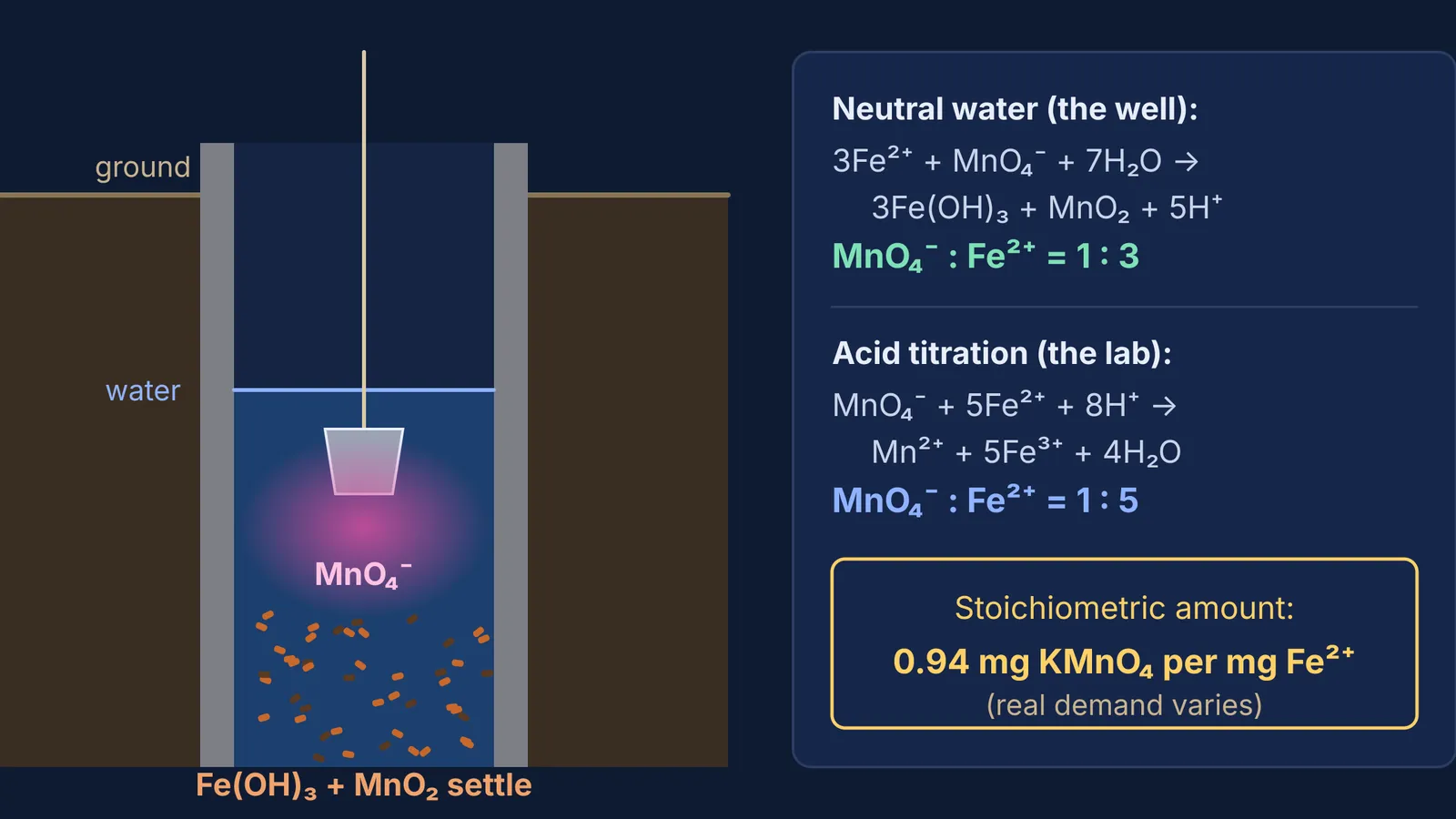
3Fe²⁺ + MnO₄⁻ + 7H₂O → 3Fe(OH)₃ + MnO₂ + 5H⁺
For manganese, the same source gives:
3Mn²⁺ + 2MnO₄⁻ + 2H₂O → 5MnO₂ + 4H⁺
For hydrogen sulphide, written to sulphur:
3H₂S + 2MnO₄⁻ → 3S + 2MnO₂ + 2H₂O + 2OH⁻
In every case the products are solids. They settle to the bottom of the well or can be filtered out, and the water left above is clearer and smells less.
How much KMnO₄ does dissolved iron use up? A worked example
Problem: Well water contains 1.5 mg L⁻¹ of Fe²⁺. What mass of KMnO₄ does the iron in 10 000 L of water use up in neutral solution? Compare this with the ratio in an acid titration.
Step 1. Count electrons. Fe²⁺ → Fe³⁺ loses 1 electron. MnO₄⁻ → MnO₂ gains 3. So one MnO₄⁻ handles three Fe²⁺.
Step 2. Check the equation balances. In 3Fe²⁺ + MnO₄⁻ + 7H₂O → 3Fe(OH)₃ + MnO₂ + 5H⁺:
Fe: 3 = 3. Mn: 1 = 1.
O: 4 + 7 = 11 on the left; 9 + 2 = 11 on the right.
H: 14 on the left; 9 + 5 = 14 on the right.
Charge: 3(+2) − 1 = +5 on the left; +5 on the right.
Step 3. Find the mass ratio. KMnO₄ has M = 158.0 g mol⁻¹ and Fe has 55.85 g mol⁻¹. One mole of KMnO₄ per three moles of Fe gives:
158.0 ÷ (3 × 55.85) = 0.94 mg of KMnO₄ per mg of Fe²⁺
Step 4. Scale up. 1.5 mg L⁻¹ × 0.943 = 1.41 mg L⁻¹ of KMnO₄. For 10 000 L that is 1.41 × 10 000 = 14 100 mg, about 14 g.
Step 5. Compare the acid titration. In acid, MnO₄⁻ + 5Fe²⁺ + 8H⁺ → Mn²⁺ + 5Fe³⁺ + 4H₂O, so one MnO₄⁻ takes five Fe²⁺. The ratio becomes 158.0 ÷ (5 × 55.85) = 0.57 mg per mg, and the same iron would use only about 8.5 g. That 1 : 5 ratio is the one in the KMnO₄ and Mohr's salt titration.
The 0.94 mg per mg figure is the stoichiometric value, and the EPA manual quotes the same number. Treat it as an exam calculation, not a dose. In a real well, organic matter, H₂S and Mn²⁺ also use up permanganate, while the EPA manual notes that MnO₂ already present can speed the reaction and lower the amount needed. Treatment plants set their dose by testing the water, not from this equation alone.
Why does the water stay pink, and is pink water safe to drink?
While there is still Fe²⁺, Mn²⁺ or H₂S in the water, each drop of permanganate is used up and the purple colour vanishes. When they run out, the next bit of permanganate has nothing to react with, so a faint pink stays. This is the same idea as the end point in a titration, explained in why KMnO₄ is its own indicator.
So pink water means unreacted oxidant is left over. Water treatment avoids leaving a permanganate residual for exactly this reason (US EPA guidance manual, chapter 5). Pink or brownish water should not be drunk.
Manganese is the other catch. Every gram of KMnO₄ carries 54.94 ÷ 158.0 = 0.35 g of manganese. In the worked example, 1.41 mg L⁻¹ of KMnO₄ brings 0.49 mg L⁻¹ of manganese into the well. WHO's provisional guideline for total manganese in drinking water is 0.08 mg L⁻¹ (WHO manganese fact sheet). If that manganese stayed in the water as fine MnO₂ particles, it would be about six times the guideline. It is safe only because MnO₂ is a solid that settles or is filtered out.
Does KMnO₄ disinfect a well?
Not reliably. The EPA manual describes permanganate as a useful oxidant but "a poor disinfectant", and says it is not considered a primary disinfectant (US EPA guidance manual, chapter 5). At amounts that keep water fit to drink, it cannot be counted on to kill the bacteria and viruses that floodwater carries into a well.
Chlorine does that job. Guidance for emergencies uses chlorine compounds such as calcium hypochlorite, bleaching powder or liquid bleach, and stresses cleaning the well first, because chlorine does not work well in muddy water, and then checking the residual chlorine (WHO technical note on cleaning and disinfecting wells). A measurable chlorine residual is a check that permanganate cannot give you. For how bleaching powder is made, see preparation of bleaching powder from chlorine and slaked lime.
Chlorine handling is hazardous, and dose, contact time and safety steps depend on the well. After a flood, follow your local health authority or public health engineering department rather than dosing a well yourself.
If you want to see how electron counts set these ratios, the Fermi Concept Library covers redox and n-factors, each with its own lesson.
Quick checklist
Neutral water: MnO₄⁻ + 2H₂O + 3e⁻ → MnO₂ + 4OH⁻, brown MnO₂.
Iron: 3Fe²⁺ + MnO₄⁻ + 7H₂O → 3Fe(OH)₃ + MnO₂ + 5H⁺, ratio 1 : 3.
Stoichiometric amount: 0.94 mg KMnO₄ per mg Fe²⁺; in acid it is 0.57 because the ratio is 1 : 5.
Lasting pink means excess oxidant; do not drink pink water.
Each mg of KMnO₄ adds 0.35 mg of Mn, so the MnO₂ must settle or be filtered.
KMnO₄ removes iron, manganese and H₂S; chlorine disinfects. Follow local health guidance.


