On this page
If you are doing the permanganate titration for your Class 12 chemistry practical, you will notice there is no phenolphthalein or methyl orange. The titrant does the job itself. Here is why, what the flask should look like drop by drop, and how to read the burette.
Why is KMnO4 called a self indicator?
A titrant can serve as its own indicator when its oxidised and reduced forms differ strongly in colour, as the redox titrations chapter of Harvey's Analytical Chemistry 2.1 on LibreTexts/09%3A_Titrimetric_Methods/9.04%3A_Redox_Titrations) explains. Permanganate is the classic case: the chapter says the intensely purple MnO₄⁻ ion serves as its own indicator because its reduced form, Mn²⁺, is almost colourless.
In acid, each permanganate ion takes five electrons and becomes Mn²⁺. The two reactions in the school practical are:
With oxalic acid: 2MnO₄⁻ + 5C₂O₄²⁻ + 16H⁺ → 2Mn²⁺ + 10CO₂ + 8H₂O
With Mohr's salt: MnO₄⁻ + 5Fe²⁺ + 8H⁺ → Mn²⁺ + 5Fe³⁺ + 4H₂O
While reducing agent remains, every purple drop becomes near-colourless Mn²⁺. Once it is used up, the next drop's colour stays. In Harvey's words, "The first drop of excess MnO₄⁻ produces a permanent tinge of purple, signaling the end point."
The colour is strong enough that no other indicator is usually needed, as titrations.info's guide to permanganate titration notes; with dilute titrant, around 0.01 M, the same guide says a blank test or an indicator may be needed. For why the ion is purple at all, read why KMnO4 is purple when manganese has no d electrons.
What colour change do you see at the end point?
Before you read on, predict. Write down the colour of the flask at the start, in the middle and at the end.
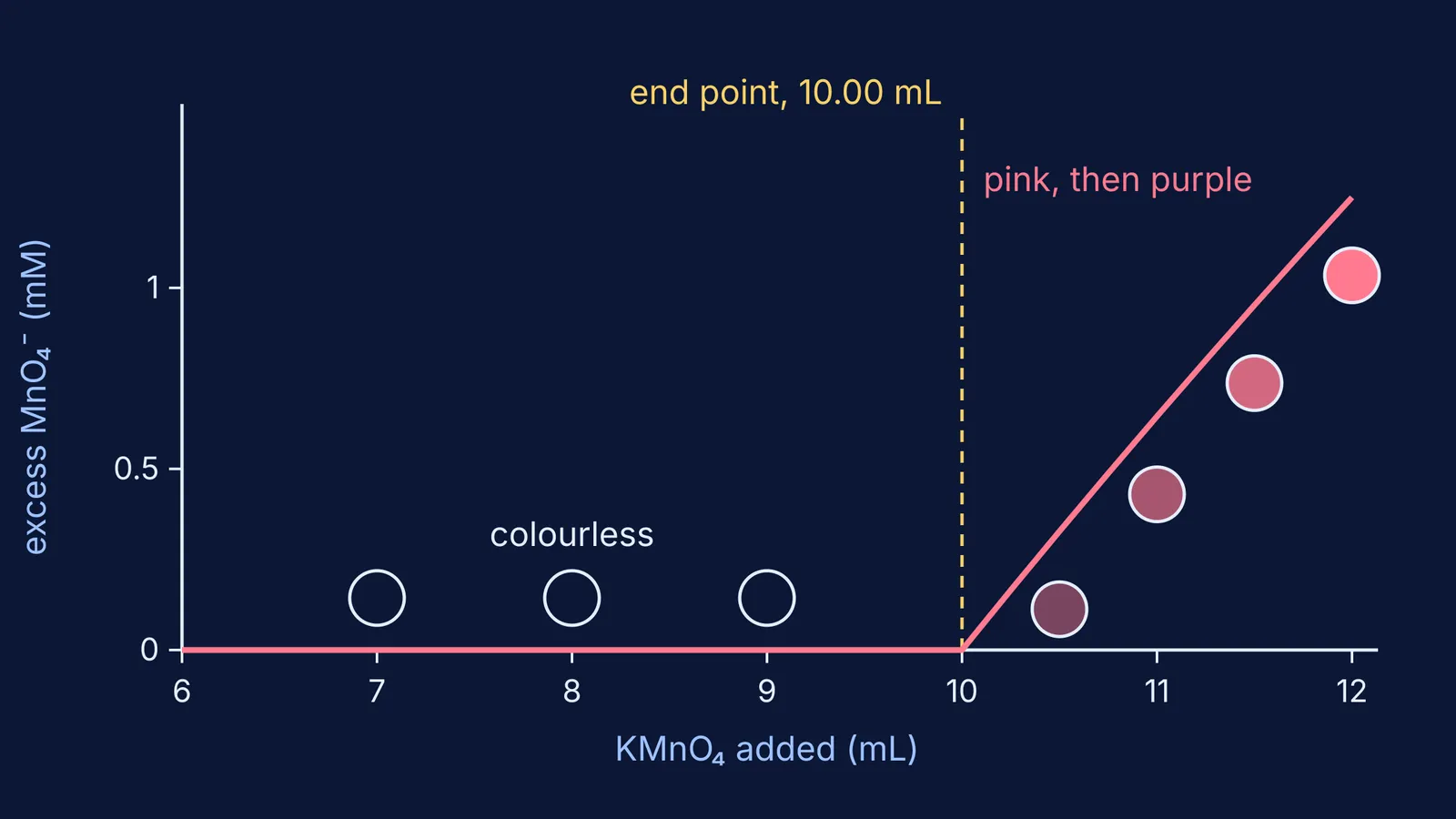
The flask starts colourless or almost colourless (oxalic acid or Mohr's salt in dilute sulphuric acid) and finishes pale pink, not purple, because one extra drop is spread through the whole flask. The titrations.info hydrogen peroxide method says to titrate until a faint pink colour persists for 30 seconds.
With warm oxalic acid:
First drops: the purple lingers before it fades. The titrations.info standardisation method heats the oxalate to about 70 °C and notes that the first portions decolourise slowly; follow the temperature in your own lab manual.
Middle: drops vanish almost on contact. The same source explains that the reaction is catalysed by Mn²⁺, so it speeds up as the product builds; this is called autocatalysis.
Near the end: a pink swirl spreads and takes longer to fade. Switch to one drop at a time and swirl after each.
End point: a pale pink that lasts about 30 seconds.
With Mohr's salt you do not heat, and the drops decolourise quickly at room temperature. Both practicals use dilute sulphuric acid; our post on why dilute sulphuric acid is used in KMnO4 titration, not HCl explains why.
How do you read the burette with KMnO4?
Permanganate is too dark to see the bottom of the meniscus, so titrations.info advises reading the top of the liquid instead. Read the initial and final levels the same way, at eye level, and the difference is your titre.
Worked example: run the titration on paper first
Take this example set-up: 10.0 mL of 0.05 M oxalic acid plus 10 mL of dilute sulphuric acid in the flask, and 0.02 M KMnO4 in the burette.
Oxalic acid in the flask: 0.05 × 10.0 = 0.50 mmol.
From the 2 : 5 ratio in the oxalate equation on titrations.info, KMnO4 needed: 0.50 × 2 ÷ 5 = 0.20 mmol.
Volume of KMnO4: 0.20 ÷ 0.02 = 10.0 mL.
Now predict the flask. At 5 mL: colourless. At 9.9 mL: each drop leaves a slowly fading pink cloud. At 10.0 mL: the first pink that lasts.
Suppose one drop from your burette is about 0.05 mL (count the drops in 1 mL of your own burette to check). One drop past the end point leaves 0.001 mmol of permanganate in about 30 mL, roughly 0.03 mM. That tiny excess is the faint pink you want; the diagram at the top of this post shows how the excess builds after it. One extra drop changes a 10 mL titre by about 0.5%; an extra 1 mL changes it by 10%, which is why the last millilitre goes drop by drop.
A sample reading: initial 0.50 mL, final 10.55 mL, both at the top of the liquid. Titre: 10.05 mL, one drop over. Repeat until two titres agree.
For chemistry ideas that are easier to see than to read, the Fermi Simulation Lab has interactive simulations. Fermi's AI tutor can also work through a titration problem like this one alongside you, checking your understanding as it goes.
A checklist for practical day
Read the top of the liquid, every time.
Warm oxalic acid as your manual says; do not heat Mohr's salt.
Expect slow fading at first with oxalic acid; do not rush.
Stop at the faint pink that persists for 30 seconds.
For the full procedure and calculation, see titrating oxalic acid with KMnO4: the Class 12 practical.