

On this page
In an anechoic chamber every wall, the ceiling and the floor are covered in long, pointed wedges of foam or glass fibre, and you stand on a wire mesh above the floor wedges. Speak, and nothing comes back. Engineers test loudspeakers, microphones and phones in these rooms. For a physics student the chamber matters for two reasons: the wedge length is set by the wavelength of sound, and it is one of the few places where the inverse-square law for sound shows up in a measurement.
Why are anechoic chamber wedges shaped like long points?
Sound reflects whenever it meets a sudden change in the medium it travels through. A flat slab of foam glued to a wall is a sudden change: air on one side, dense porous material on the other. Part of the wave bounces off the surface before it ever gets into the foam.
A wedge removes the sudden change. Near the tip, a thin slice across the wall is almost all air with a little foam. Deeper in, the slice is more and more foam. So the wave meets a gradual change from air to absorber, and most of it keeps going forward into the material, where friction between the moving air and the fibres turns its energy into heat. Sound that does reflect off one face is sent into the next wedge, not back into the room.
A change spread over a distance comparable to the wavelength reflects very little; a change much shorter than the wavelength looks sudden. For why bare walls send sound back in an ordinary room, see why an empty room echoes and how to fix it.
How long must the wedges be to absorb low notes?
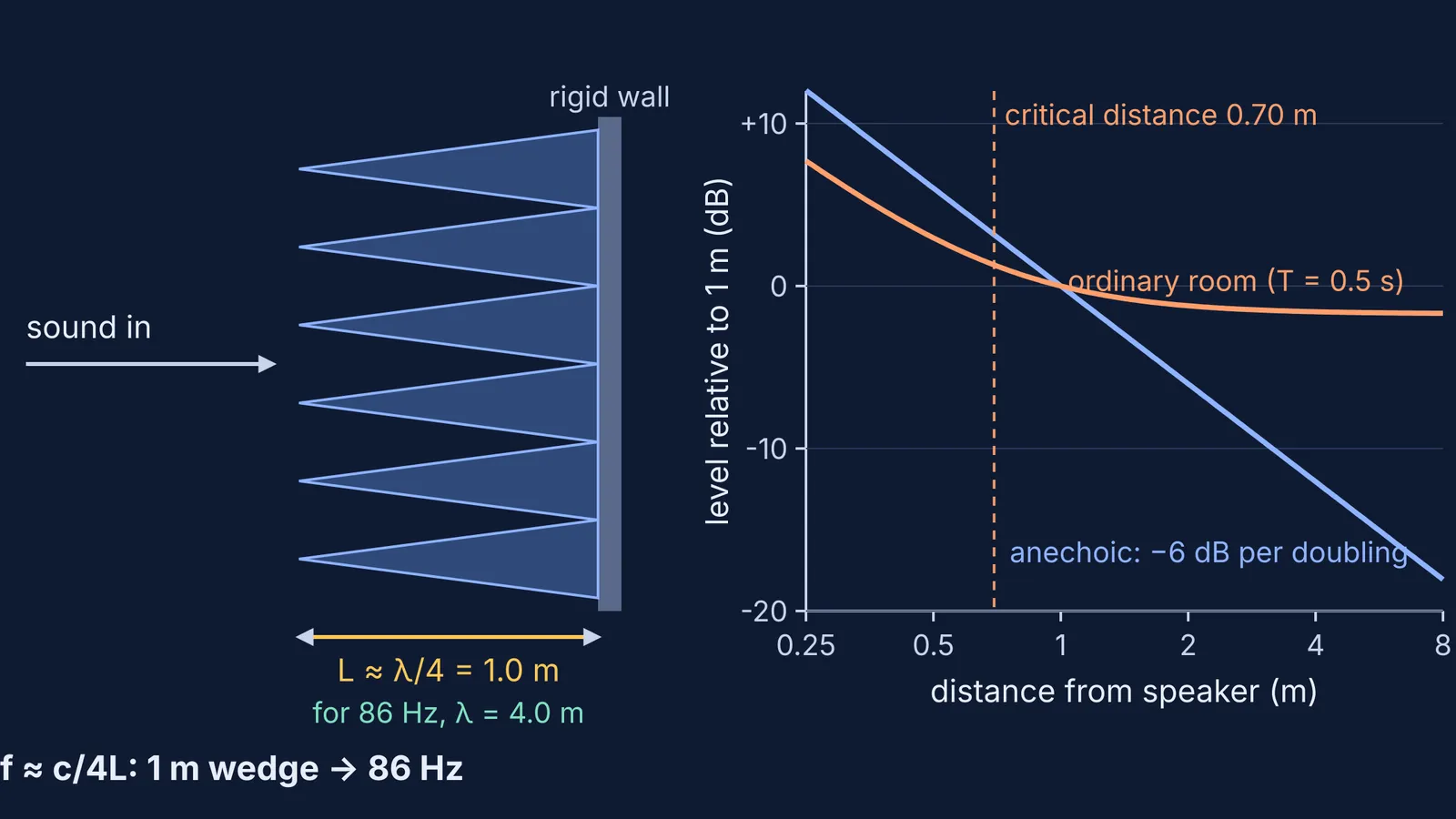
Low frequencies have long wavelengths, so a short wedge looks like a sudden wall to them. The working rule comes from the wartime Harvard study by Leo Beranek and Harvey Sleeper, who designed the first large wedge-lined chambers. Their report on the design and construction of anechoic sound chambers states that the lowest frequency at which good absorption is obtained is the one for which the wedge length, measured from the tip to the rigid backing wall, is about one quarter of a wavelength. The same report defines the cut-off frequency as the frequency at which the pressure reflection rises to 10%, which means 99% of the sound energy is absorbed.
As a formula, with c the speed of sound and L the wedge length:
f(cut-off) ≈ c / 4L
Taking c = 343 m/s (air at about 20 °C):
0.25 m wedges: about 343 Hz
0.5 m wedges: about 172 Hz
1.0 m wedges: about 86 Hz
1.5 m wedges: about 57 Hz
This is a rule of thumb: absorption falls away gradually below the cut-off, not suddenly. The same report measured a 25-inch (0.635 m) wedge with a cut-off of 150 Hz and a 15-inch (0.381 m) wedge at about 250 Hz. The rule gives 135 Hz and 225 Hz for those lengths, so real wedges land within about 10% of it, a little on the high side.
What does 99% absorption mean for the echo?
Absorption coefficients are about energy, and energy goes as the square of pressure amplitude. If 99% of the energy is absorbed, 1% is reflected, so the reflected pressure amplitude is √0.01 = 0.10 of the incident amplitude. In decibels, 10 log₁₀(0.01) = −20 dB: the echo is 20 dB quieter than the incoming sound.
Why does an ordinary room hide the inverse-square law?
For a small source radiating equally in all directions, intensity falls as 1/r², which is a drop of 6 dB each time the distance doubles. That rule is worked in how much the sound level drops when you double the distance. In a room you also hear sound that has bounced off the walls many times. This reverberant sound is roughly the same everywhere, so it does not fall with distance.
The standard room-acoustics formula adds the two parts:
level at distance r = source term + 10 log₁₀(1/4πr² + 4/R)
The first term is direct sound. The second is reverberant sound, with R the room constant, R = A/(1 − ᾱ), where A is the total absorption and ᾱ is the average absorption coefficient of the surfaces. The distance at which the two parts are equal is the critical distance, r(c) = √(R/16π). Beyond it, the room is louder than the source's direct sound.
A works out from the reverberation time using Sabine's formula, T = 0.161V/A, which has its own story in how Wallace Sabine found the formula for reverberation time.
How do you size the wedges and compare a chamber with a room?
Question. A chamber must test speakers down to 86 Hz. How long should its wedges be? Then compare the level drop from 1 m to 4 m in the chamber and in a 5 m × 4 m × 3 m room with a reverberation time of 0.5 s.
Wavelength at 86 Hz. λ = c/f = 343/86 = 3.99 m, about 4.0 m.
Wedge length. L ≈ λ/4 = 1.0 m.
Chamber drop from 1 m to 4 m. Distance ×4 means intensity ÷16. Drop = 20 log₁₀(4) = 12.0 dB.
Room absorption. V = 5 × 4 × 3 = 60 m³. A = 0.161 × 60 / 0.5 = 19.3 m².
Room constant. Surface S = 2(20 + 15 + 12) = 94 m², so ᾱ = 19.3/94 = 0.21. R = 19.3/(1 − 0.21) = 24.3 m².
Critical distance. r(c) = √(24.3/16π) = 0.70 m.
Room drop from 1 m to 4 m. At 1 m: 1/4π + 4/24.3 = 0.0796 + 0.1645 = 0.244. At 4 m: 1/(4π × 16) + 0.1645 = 0.0050 + 0.1645 = 0.170. Drop = 10 log₁₀(0.244/0.170) = 1.6 dB.
Answer. 1.0 m wedges. The chamber shows the full 12 dB drop; the room shows only 1.6 dB, because at 1 m you are already past the 0.70 m critical distance and reverberation dominates.
Two cautions: the 6 dB per doubling holds only in the far field of the source, and the critical distance formula assumes a source radiating equally in all directions.
To see how wavelength and distance shape a wave, try the Simulation Lab, interactive simulations for ideas easier to see than read.
Why do low-frequency chambers need such long wedges?
Below the cut-off, reflections return and every measurement needs corrections, so a chamber for bass speakers needs very deep wedges and a large shell. Beranek and Sleeper estimated that absorbing down to 40 Hz would need a total wedge depth of about 94 inches (2.39 m); the c/4L rule gives 36 Hz for that length.
Quick checklist
Wedges work by a gradual change from air to absorber, not just by being soft.
Cut-off rule of thumb: f ≈ c/4L; a 1 m wedge absorbs above about 86 Hz.
Cut-off is where 99% of the energy is absorbed: reflection amplitude 0.10, or −20 dB.
In free field, level falls 6 dB per doubling of distance.
In a room, beyond r(c) = √(R/16π) the reverberant sound takes over and the level barely falls.
A, R and ᾱ come from Sabine's T = 0.161V/A.


