On this page
In 1895 Harvard asked a young physicist, Wallace Clement Sabine, to fix the lecture room in its new Fogg Art Museum. He spent about two years experimenting on that one room, and what he found became the first quantitative rule for reverberation, as he describes in his Collected Papers on Acoustics.
What was wrong with Harvard's Fogg lecture room?
The room opened in 1895, and it was impossible for the audience to understand anyone speaking in it, according to the Linda Hall Library. Sabine wrote that Sanders Theatre was "by far the best auditorium in Cambridge", and that the Fogg room "was modeled after Sanders Theatre, and it was the worst" (Sabine, Collected Papers). Sanders was wood and the Fogg room plaster on tile, but Sabine noted that wood-lined Sayles Hall in Providence was bad too.
The trouble was reverberation: a spoken word stayed audible for about five and a half seconds, while a speaker said twelve or fifteen more syllables.
How did Sabine measure reverberation with seat cushions?
Sabine sounded an organ pipe, stopped it, and used an electrical chronograph to time how long he could still hear it. A gas-flame instrument had given readings too erratic to interpret; his ear proved surprisingly accurate (Sabine, Collected Papers).
In the empty room the sound stayed audible for 5.62 seconds.
Two months of repeat tests ranged from 5.45 to 5.62 seconds and averaged 5.57.
With Sanders Theatre's cushions on all 436 seats, the time fell to 2.03 seconds.
With every cushion from a theatre seating nearly 1,500 people spread over seats, aisles, platform and rear wall, it fell to 1.14 seconds.
The cushions became a measuring stick for rugs, curtains and even people. Sabine then expressed results in square metres of open window, a more permanent unit than cushions. In those units the Fogg room's walls, ceiling, floor, windows and chairs added up to 75.5. The modern unit, the sabin, is the absorbing capacity of an open window one foot square (Linda Hall Library).
Felt fixed to particular walls finally left the room, in Sabine's words, "not excellent, but entirely serviceable."
What is the Sabine reverberation time formula?
Sabine noticed that for any one room, the duration of the sound multiplied by the total absorption stayed constant. Across rooms, the largest nearly 150 times bigger than the smallest, that constant was proportional to the room's volume (Sabine, Collected Papers). In his later analysis he adopted an average constant of 0.164 for metric units.
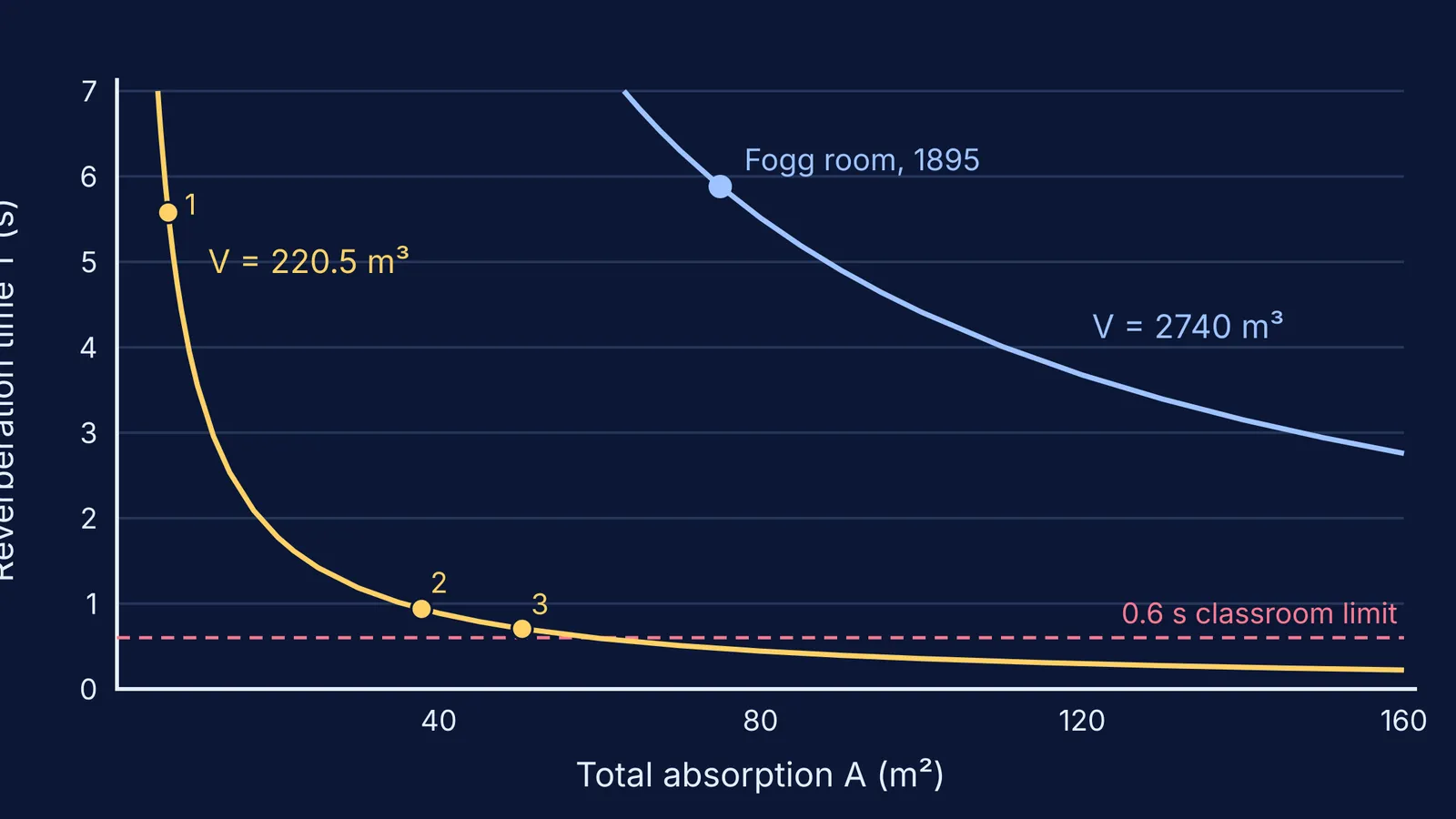
In modern form, the Sabine formula is T = 0.161 V / A, with T in seconds, V the room volume in cubic metres and A the total absorption in square metres (sengpielaudio).
Reverberation time, written RT60, is the time it takes the sound level to fall by 60 dB after the source stops (sengpielaudio).
You find A by adding each surface's area times its absorption coefficient α, from 0 for a perfect reflector to 1 for an open window.
Worked example: can you fix an echoey classroom on paper?
Take an empty classroom 9 m long, 7 m wide and 3.5 m high, with a tiled concrete floor, smooth plaster walls and ceiling, and 12 m² of windows. Absorption coefficients at 500 Hz from sengpielaudio's table: concrete or tile 0.015, smooth plaster 0.02, window glass 0.18, acoustic tiles 0.52.
Volume: V = 9 × 7 × 3.5 = 220.5 m³, so 0.161V = 35.5.
As built: floor 63 × 0.015 = 0.95; ceiling 63 × 0.02 = 1.26; walls (112 m² minus 12 m² of glass) 100 × 0.02 = 2.00; glass 12 × 0.18 = 2.16. A = 6.37 m², so T = 35.5 / 6.37 ≈ 5.6 s, close to Sabine's Fogg room.
Replace the plaster ceiling with acoustic tiles, 63 × 0.52 = 32.76. Now A = 37.87 m² and T ≈ 0.94 s.
Also tile 25 m² of the back wall's plaster (+13.0, −0.5). Now A = 50.37 m² and T ≈ 0.70 s.
For comparison, the classroom standard ANSI/ASA S12.60 asks for no more than 0.6 seconds in classrooms smaller than 283 m³, averaged over the 500, 1,000 and 2,000 Hz bands (Acoustics Today). Step 4 is close, and students and furniture add more absorption. Coefficients also change with pitch (window glass is 0.35 at 125 Hz but 0.04 at 4,000 Hz in the same table), so real designs repeat the sum at several frequencies.
If sound bouncing around a room is hard to picture, the Fermi Simulation Lab has interactive simulations for ideas that are easier to see than to read. For numericals like this, the Fermi Problem Library has a step-by-step solver that explains the reasoning rather than printing an answer.
What else shapes the sound you hear?
See why an empty room echoes and how to fix it, why distant trains sound clearer at night and why your recorded voice sounds strange.