

On this page
Have you ever walked into a new house before the moving truck arrives, clapped your hands, and heard the sound ring out for seconds? An unfurnished room feels loud and bright, but the moment you bring in a sofa, a rug, and some heavy curtains, the space goes quiet.
The difference lies in how materials handle acoustic energy. Understanding how sound waves bounce around a room—and how to stop them—is the foundation of architectural acoustics.
Why does an empty room echo so much?
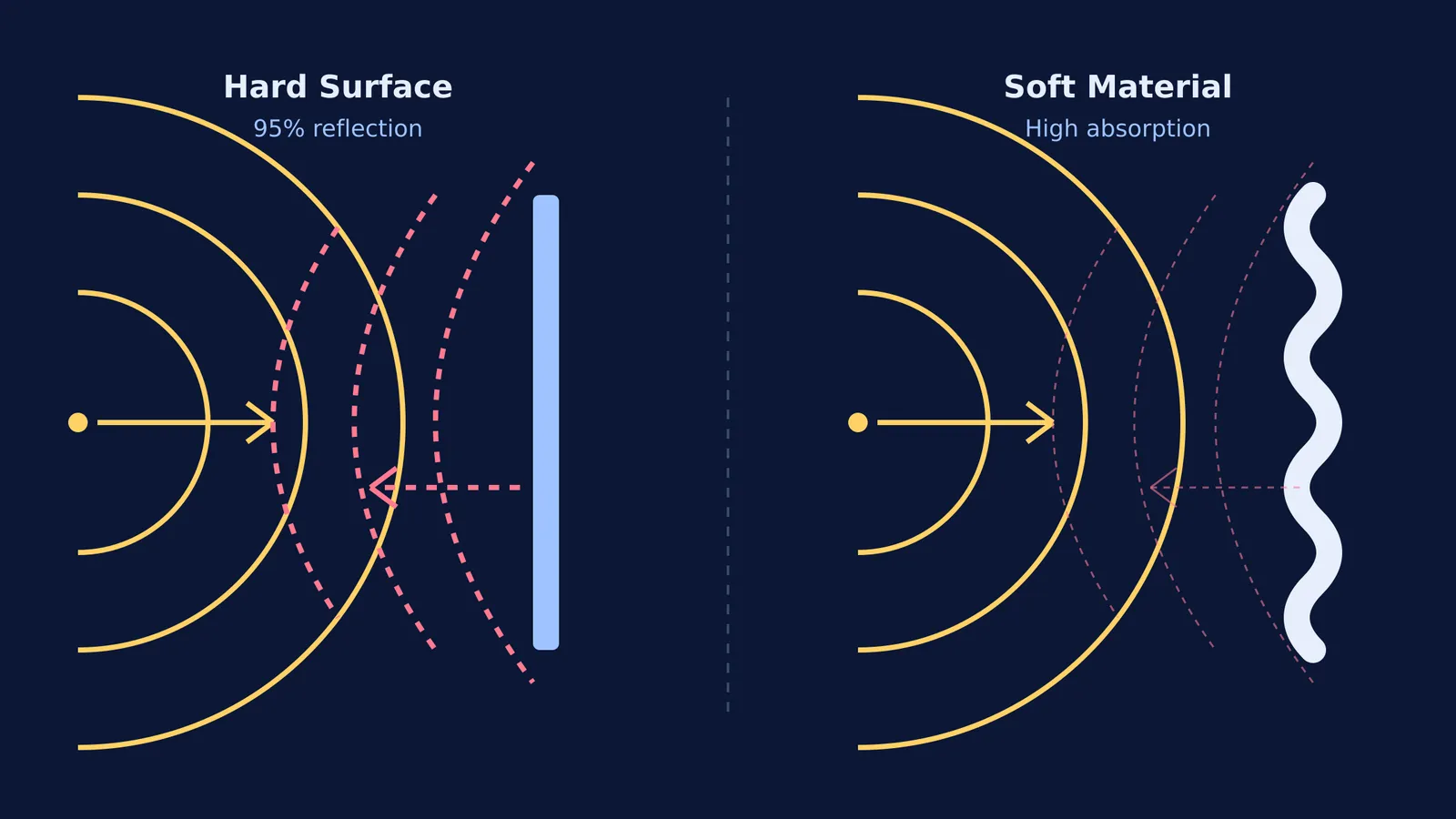
Sound is a mechanical wave that travels through the air as regions of high and low pressure. When these waves hit a boundary, they can be absorbed, transmitted, or reflected, following the rules of how waves behave at fixed boundaries.
In an empty room, the boundaries are usually hard, flat, and parallel. Standard drywall (gypsum board) over wooden studs is highly reflective at conversational frequencies. Bare drywall absorbs only about 5% of mid-frequency sound energy, reflecting the remaining 95% back into the room (Commercial Acoustics).
When you speak, the sound waves strike a wall, bounce to the opposite wall, and continue to ricochet around the enclosed space. Because there are no irregular objects to scatter the waves and no soft materials to convert the acoustic energy into tiny amounts of heat, the sound persists long after you stop speaking. This dense collection of rapid, overlapping reflections is called reverberation, and it is the main reason an empty room feels so loud.
How did the cushion experiment lead to the Sabine equation?
The science of measuring these echoes began in 1895 at Harvard University. The newly built Fogg Art Museum had a lecture hall with an echo so severe that a single spoken word would reverberate for about 5.5 seconds, making professors impossible to understand (Acentech).
Wallace Clement Sabine, a 27-year-old physics assistant, was asked to fix it. Working between midnight and 5:00 AM to avoid streetcar noise, he brought in hundreds of cloth-covered seat cushions from a nearby theatre. Using an organ pipe and a stopwatch, he measured how the echo shortened as he added more cushions.
His work led to the Sabine formula, which connects a room's echo to its dimensions and materials:
RT60 = 0.161 × (V / A)
Here, RT60 is the reverberation time—the time it takes for sound to decay by 60 decibels. The volume of the room (V) is in cubic metres, and A is the total absorption of the room in metric Sabins. The formula shows that a larger volume increases the echo, while adding absorptive materials reduces it.
If you are struggling to picture how wave intensity decays, the Fermi Simulation Lab lets you watch wavefronts bounce off different surfaces and see how the energy drops with each reflection.
What is a good reverberation time?
You do not want a completely silent room. A space with zero reverberation feels unnatural and unnerving. However, a room with too much echo makes studying exhausting because the brain has to work harder to separate new words from the lingering sound of previous ones, which strains the limits of human hearing.
For learning environments, the standard is strict. The 1999 Guidelines for Community Noise by the World Health Organization (WHO) recommend a reverberation time of 0.6 seconds for a standard classroom (WHO). At this level, speech is crisp and easy to follow, but the room still feels alive. In contrast, concert halls are designed for longer reverberation times to make music sound warm and full.
How can you reduce echo in a study space?
If your home study space is too "live," you can apply the principles of the Sabine formula to lower the RT60.
Here is a practical checklist to calm a noisy room:
Break up parallel walls: If two bare walls face each other directly, they create a "flutter echo." Place a bookshelf on one wall. The uneven spines of the books act as a diffuser, scattering the sound rather than reflecting it straight back.
Add a thick rug: A carpet on a concrete or tile floor is highly effective at absorbing high-frequency clicks and hisses, pulling down the overall reverberation time.
Hang heavy curtains: Windows are perfectly flat and highly reflective. Covering them with thick, pleated fabric adds significant absorption area (A) to the Sabine equation.
Use soft furnishings: A fabric-covered armchair or a canvas pinboard absorbs far more acoustic energy than a wooden chair or a bare desk.
By mixing diffusers (like bookshelves) and absorbers (like rugs), you can turn a harsh, ringing box into a quiet, focused environment. When you do not have to fight the echo to hear yourself think, the physics on the page becomes much easier to master. If you are starting a new topic and feel overwhelmed, Fermi's AI tutor can work out what you already know and build a plan for the session, so you sit down to a clear next step.


