

On this page
Whether you are stepping back from a loud concert speaker or calculating wave propagation for a physics exam, you have likely noticed that sound fades quickly as you move away. But exactly how much quieter does it get? The answer relies on a fundamental principle of physics known as the inverse square law.
What is the sound level drop when distance from source doubles?
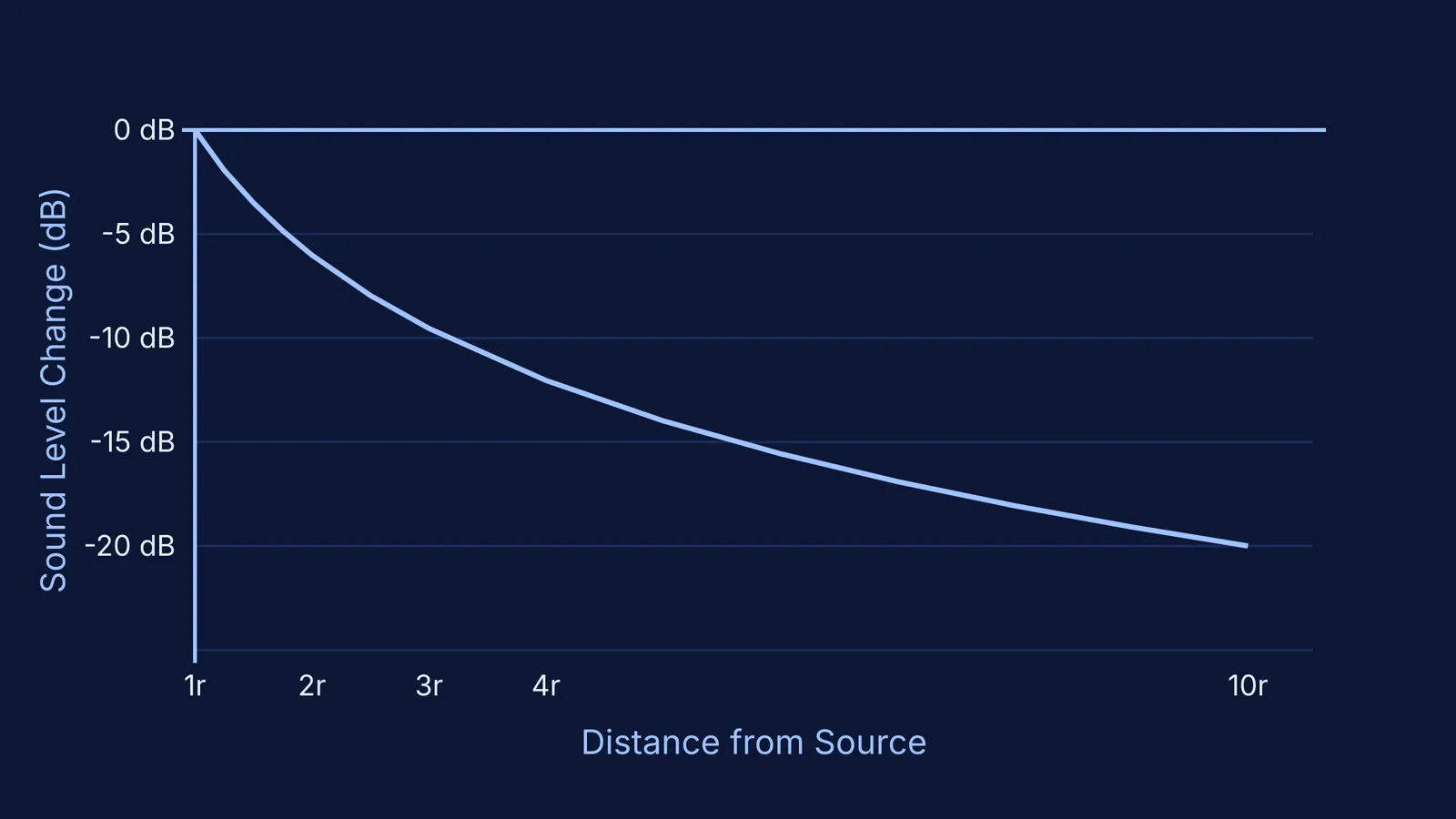
When you double your distance from a sound source, the sound intensity drops to one-fourth of its initial value, which translates to a decrease of approximately 6 dB (OpenStax).
Sound intensity is physically measured in watts per square metre. However, human hearing perceives loudness on a logarithmic scale measured in decibels (dB). Because the decibel scale compresses huge changes in physical energy into smaller, more manageable numbers, a drop to 25% of the original intensity is recorded as a simple subtraction of 6 decibels.
Why does sound intensity decrease with distance?
Sound travels outward from a point source as an expanding spherical wave. As the sound wave expands outward, its total energy is spread over a much larger surface area.
The surface area of a sphere is defined by the formula 4πr², where r represents your distance from the source. Because the acoustic energy must cover an area that grows with the square of the radius, the intensity (I) is inversely proportional to the square of the distance (1/r²). This physical behaviour is identical to the rules governing the intensity of an EM wave radiating in an open space.
If you find it tricky to jump between expanding wave geometries, intensity fractions, and logarithmic decibel scales, the Fermi Concept Library has a lesson on the inverse square law and its place in the physics map.
How much does sound drop at 3x or 10x the distance?
The mathematics of the inverse square law allows you to predict the sound level at any new distance (OpenStax). Every time you multiply your distance by a factor, the intensity falls by the square of that factor.
Tripling the distance (3x): The acoustic intensity drops to one-ninth (1/9) of its original value. On the logarithmic decibel scale, a drop to 1/9th results in a sound level decrease of roughly 9.5 dB.
Quadrupling the distance (4x): The intensity drops to one-sixteenth (1/16). Because 4x is equivalent to two consecutive doublings, you simply subtract 6 dB twice, resulting in a total drop of 12 dB.
Ten times the distance (10x): Moving ten times further away drops the intensity to exactly 1/100th of its initial value. A factor of 1/100 corresponds directly to a 20 dB reduction in sound level.
How to calculate the decibel drop for your exam?
If you are preparing for competitive exams like JEE or NEET, you will often need to calculate the exact sound level drop for arbitrary distances (OpenStax). Memorising the 6 dB rule is helpful, but you must know how to prove it. Here is a reliable three-step framework you can use for any distance change problem.
Find the distance ratio: Divide the new distance by the old distance (r₂ / r₁). Let us call this factor "k".
Calculate the intensity ratio: Because intensity follows the inverse square law, the new intensity will be 1/k² of the original. For example, if your distance ratio is 5, your intensity ratio is 1/25.
Apply the decibel formula: The change in sound level (ΔL) is given by the formula ΔL = 10 log₁₀(I₂ / I₁). Plug in your intensity ratio to find the exact drop in decibels. Remember the logarithm rule: log(1/x) is the same as -log(x).
Let us look at a worked example. Suppose a loud generator produces a sound level of 90 dB at a distance of 10 metres. What is the sound level at 100 metres?
First, find the distance ratio, which is 100 / 10 = 10. Second, square this ratio to get 100, meaning the new intensity is 1/100th of the original. Finally, apply the decibel formula: 10 log₁₀(1/100) = -20 dB. Subtracting 20 dB from the original 90 dB gives a final sound level of 70 dB.
How can distance improve your study environment?
For students and parents setting up a home study space, understanding this physical law provides a practical advantage (OpenStax). Distance is the cheapest and most effective form of soundproofing available.
If distracting noise from a television in the living room is measuring 70 dB at a distance of 2 metres, simply moving the study desk to 4 metres away will drop the noise to 64 dB. Pushing the desk to 8 metres drops it further to 58 dB, which is close to the level of a quiet conversation. Whenever possible, physically moving away from a noise source provides a mathematically guaranteed drop in distraction.
By mastering the relationship between distance and intensity, you can confidently solve inverse square law problems in your physics syllabus while also building a quieter, more focused environment for your daily studies.


