

On this page
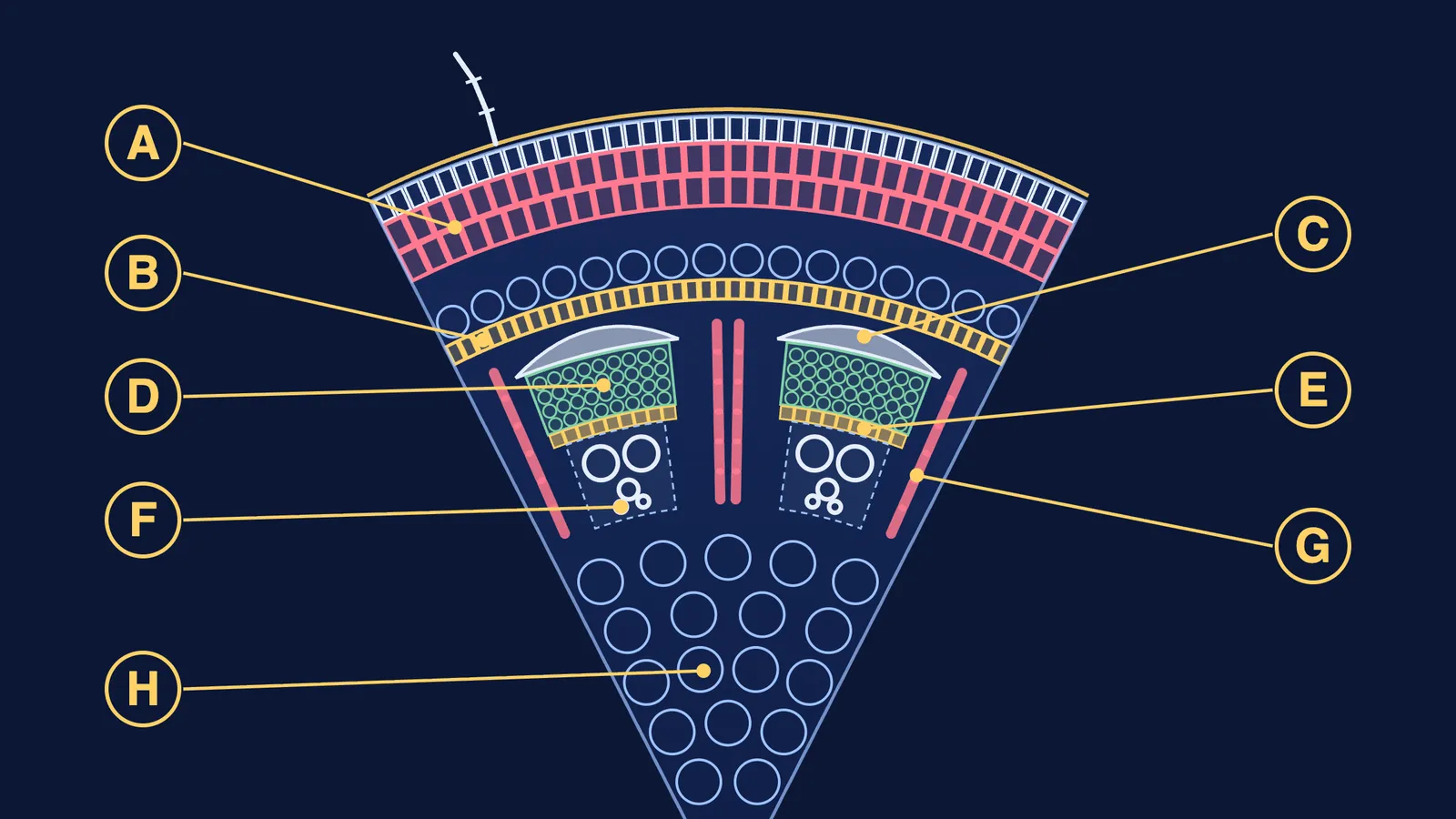
The schematic above is a wedge from the transverse section of a young dicot stem, cuticle to pith, with eight tissues lettered A to H. Q1 to Q6 use the letters; Q7 to Q14 describe the chapter's other figures in words.
What does this plant anatomy diagram set cover?
The NEET (UG)-2026 syllabus places plant tissues and anatomy in Biology Unit 2, Structural Organisation in Animals and Plants. Under the NEET (UG)-2026 information bulletin, Biology carries 90 of 180 questions, with +4 for each correct answer and −1 for each wrong one.
All 14 questions are original, not predictions, and every answer traces to NCERT Class 11 Biology, Chapter 6, Reprint 2026-27. New to the chapter? Start with how to prepare Anatomy of Flowering Plants for NEET.
How do you work out a lettered plant section?
Find the surface first: the cuticle marks the outer edge.
Walk inward, naming each layer before you check the letters.
Inside a bundle, ask which tissue faces the centre; that settles xylem versus phloem.
A thin band squeezed between two tissues is usually cambium.
Which tissues are A to H in the stem sector?
Q1. Which letter marks the innermost layer of the cortex? (1) A (2) B (3) C (4) G
Q2. Match each letter with its description. List-I: A, C, G, H. List-II: (i) Semi-lunar sclerenchyma patches over the phloem (ii) A few layers of collenchyma just under the epidermis (iii) Central rounded parenchyma, large spaces (iv) Radial parenchyma between bundles (1) A-ii, C-i, G-iv, H-iii (2) A-i, C-ii, G-iv, H-iii (3) A-ii, C-iv, G-i, H-iii (4) A-iii, C-i, G-iv, H-ii
Q3. Statement I: F faces H, so the protoxylem of this bundle is endarch. Statement II: D lies on the inner side of the xylem. (1) I right, II right (2) I right, II wrong (3) I wrong, II right (4) I wrong, II wrong
Q4. Which letters lie within one vascular bundle? (1) C, D, E (2) B, C, D (3) D, E, F (4) E, F, H
Q5. In a monocot stem, the layer at the position of A would be: (1) Collenchymatous (2) Replaced by mesophyll (3) Made of bulliform cells (4) Sclerenchymatous
Q6. Without E, the bundles would be: (1) Radial (2) Exarch (3) Open (4) Closed
How do you tackle root, leaf and stomata figures given in words?
Two-statement items: sketch the figure, judge each statement alone, then pick the code.
Q7. Figure of a stoma with bean-shaped guard cells beside one with dumb-bell shaped ones. Statement I: Guard cell walls facing the pore are thin, and those away from it are thick. Statement II: Grasses have dumb-bell shaped guard cells. (1) I right, II right (2) I right, II wrong (3) I wrong, II right (4) I wrong, II wrong
Matching items: fix your surest row, drop codes that disagree, check one more row.
Q8. Primary dicot root, T.S.: pair each part with its NCERT role. List-I: P. Conjunctive tissue Q. Pericycle R. Endodermis S. Stele. List-II: (i) All tissues inside the endodermis (ii) Parenchyma between xylem and phloem (iii) Lateral roots start here (iv) Barrel-shaped cells, no intercellular spaces (1) P-ii, Q-iii, R-iv, S-i (2) P-iii, Q-ii, R-iv, S-i (3) P-ii, Q-iv, R-iii, S-i (4) P-i, Q-iii, R-iv, S-ii
Single-correct items: options often differ by one word; read each to the end.
Q9. A root T.S. shows four xylem patches alternating with four phloem patches and a small pith. What develops here later? (1) A cambium ring between xylem and phloem (2) Bulliform cells (3) A sclerenchymatous hypodermis (4) Water-containing cavities in the bundles
Q10. A stem T.S. shows a sclerenchymatous hypodermis and scattered bundles, edge ones smaller. What lies inside each bundle? (1) Water-containing cavities (2) A strip of cambium (3) Phloem parenchyma (4) A semi-lunar pericycle cap
Q11. Vertical section of a dorsiventral leaf. Statement I: The palisade parenchyma lies on the adaxial side, below the upper epidermis. Statement II: The upper epidermis generally has more stomata than the lower. (1) I right, II right (2) I right, II wrong (3) I wrong, II right (4) I wrong, II wrong
Q12. In the same section, where are large spaces and air cavities? (1) Between palisade cells (2) Inside the bundle sheath (3) Among spongy parenchyma cells (4) In the adaxial epidermis
Q13. Isobilateral grass leaf: match each feature with its NCERT description. List-I: P. Bulliform cells when turgid Q. Bulliform cells when flaccid R. Mesophyll S. Bundles other than main veins. List-II: (i) Leaf curls inward, cutting water loss (ii) Leaf surface stays exposed (iii) Not split into palisade and spongy layers (iv) Nearly similar in size (1) P-ii, Q-i, R-iii, S-iv (2) P-i, Q-ii, R-iii, S-iv (3) P-ii, Q-i, R-iv, S-iii (4) P-iv, Q-i, R-iii, S-ii
Q14. An outer layer has no cuticle, and many cells grow out as single-celled hairs. Which organ, and what do the hairs do? (1) Stem; cut transpiration (2) Root; absorb water and minerals (3) Leaf; photosynthesise (4) Stem; secrete wax
Answer key for the lettered diagram
A hypodermis (collenchyma), B endodermis, C pericycle, D phloem, E cambium, F protoxylem, G medullary ray, H pith.
Which answers are right, and why?
(2). The endodermis ends the cortex.
(1). As NCERT describes the dicot stem.
(2). Protoxylem towards the pith is endarch; phloem sits outside the xylem.
(3). D, E and F (its protoxylem) lie in the bundle; C sits outside.
(4). The monocot stem has a sclerenchymatous hypodermis.
(4). No cambium, no secondary tissue: closed.
(3). It is the reverse: walls towards the pore are thickened.
(1). NCERT's sunflower root account.
(1). Two to four patches and a small pith: a dicot root, where a cambium ring forms later.
(1). Monocot stem: its bundles carry water-containing cavities.
(2). The abaxial surface usually carries more stomata.
(3). Spongy parenchyma is loosely arranged.
(1). Flaccid bulliform cells curl the leaf inward.
(2). Roots lack a cuticle; root hairs absorb.
Missed a figure? Sketch it again unaided, add your own letters, then try the statement and match-the-list set and the practice questions with worked solutions.
Stem sector solid, but leaf sections still blurry? Fermi's AI tutor works out what you already know and builds a plan for the session.


