

On this page
Ammonium perchlorate (AP, NH₄ClO₄) is the oxidiser in most solid rocket motors, including India's. Its chlorine sits at +7, the highest oxidation state chlorine can reach. Chlorine is cheap as common salt, where it sits at −1. Getting from −1 to +7 means taking 8 electrons away from every chlorine atom, and the classic way to do that is with electricity. That makes AP a clean Faraday's-law problem. This post counts those electrons; what happens when AP burns is a separate oxygen-balance question we do not repeat here.
ISRO makes its own AP at the Ammonium Perchlorate Experimental Plant in Aluva, which the post on Vasant Gowariker and India's first solid rocket propellants mentions. ISRO's public purchase notices from VSSC seek sodium chlorate and ammonium chloride for that plant. Those are the two raw materials of the textbook route below, but we have not found a public ISRO description of its process, so read what follows as general chemistry, not a plant description.
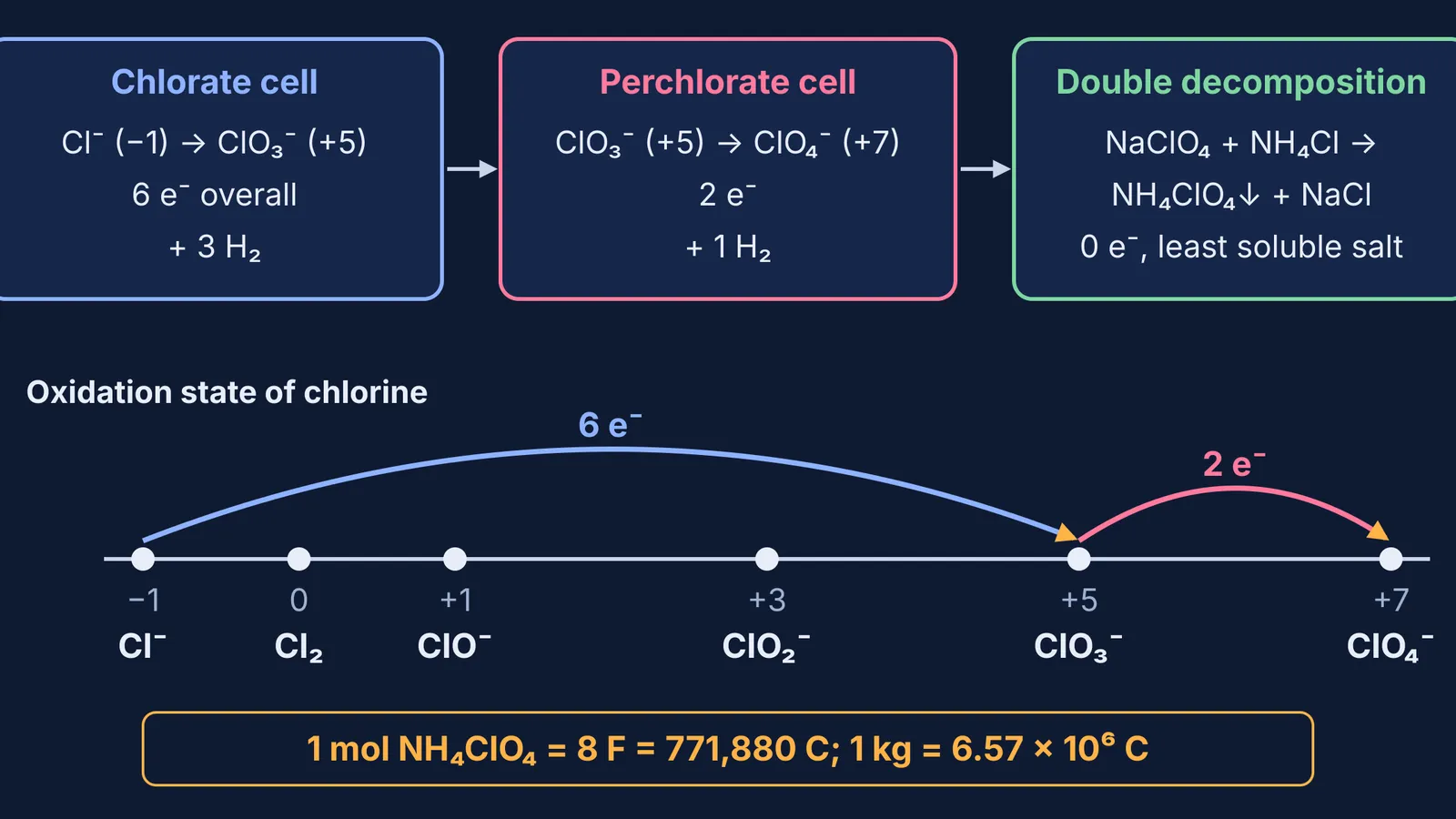
What are the oxidation states of chlorine from chloride to perchlorate?
Chlorine walks up a ladder of oxoanions:
Cl⁻, chloride: −1
Cl₂: 0
ClO⁻, hypochlorite: +1
ClO₂⁻, chlorite: +3
ClO₃⁻, chlorate: +5
ClO₄⁻, perchlorate: +7
From chloride to perchlorate is a change of 8, so each perchlorate ion made from salt costs 8 moles of electrons per mole, which is 8 faradays. Industry does it in two electrolytic jumps, −1 to +5 and then +5 to +7, followed by one step with no electrons at all.
How does electrolysing brine give sodium chlorate?
In a chlorate cell, brine is electrolysed without a separator, so the products of the two electrodes are allowed to mix.
Anode: 2Cl⁻ → Cl₂ + 2e⁻
Cathode: 2H₂O + 2e⁻ → H₂ + 2OH⁻
The chlorine meets the hydroxide and does exactly what you learned in chlorine with cold and hot NaOH: Cl₂ + 2OH⁻ → Cl⁻ + OCl⁻ + H₂O. Then, in the bulk solution, hypochlorous acid and hypochlorite react to give chlorate:
2HOCl + OCl⁻ → ClO₃⁻ + 2Cl⁻ + 2H⁺
Check: Cl 3 = 3, O 3 = 3, H 2 = 2, charge −1 = −1. In oxidation states, three chlorines at +1 become one at +5 and two at −1. Each of those three hypochlorites needed one Cl₂, which needed 2 electrons, so each chlorate costs 6 electrons in total. Adding everything up gives the overall equation:
NaCl + 3H₂O → NaClO₃ + 3H₂
Check: Na 1, Cl 1, H 6, O 3 on each side. Chlorine goes −1 → +5: 6 electrons. Note that 6 is an overall count. No single electrode step hands over 6 electrons; most of the chemistry after the anode happens in solution.
How does chlorate become perchlorate?
The second jump is a direct anodic oxidation at an inert anode. Wikipedia's sodium perchlorate page names platinum as an example.
Anode: ClO₃⁻ + H₂O → ClO₄⁻ + 2H⁺ + 2e⁻
Cathode: 2H₂O + 2e⁻ → H₂ + 2OH⁻
Overall: NaClO₃ + H₂O → NaClO₄ + H₂
Chlorine goes +5 → +7: 2 electrons. Check the anode half: charge −1 on the left, −1 + 2 − 2 = −1 on the right.
You may know a chemical route too. Heating potassium chlorate without a catalyst gives 4KClO₃ → 3KClO₄ + KCl, a disproportionation. It wastes a quarter of the chlorine as chloride. Electrolysis turns all of it into perchlorate, because the electrons are taken by the anode instead.
Why does ammonium perchlorate crystallise out?
The last step moves no electrons:
NaClO₄ + NH₄Cl → NH₄ClO₄ + NaCl
Check the oxidation states: N stays −3, Cl in perchlorate stays +7, Cl in chloride stays −1. This is a double decomposition, and it works because of solubility. Sodium perchlorate is very soluble, about 210 g per 100 mL of water at 25 °C. Ammonium perchlorate dissolves only about 20.9 g per 100 mL at 20 °C and 11.6 g at 0 °C (Wikipedia, ammonium perchlorate). NaCl and NH₄Cl both dissolve more than AP. So AP is the least soluble of the four salts, and its solubility falls steeply as the solution cools, while that of NaCl hardly changes. That is the principle of fractional crystallisation, the same idea used to make KNO₃ from NaNO₃ and KCl. Ammonium perchlorate can also be made by neutralising perchloric acid with ammonia.
Now add the three steps. The NaCl formed in the last step is the same salt the first step needs, so on paper sodium chloride is only a carrier. The net change is:
NH₄Cl + 4H₂O → NH₄ClO₄ + 4H₂
Check: N 1, H 12, Cl 1, O 4 on each side, and chlorine goes −1 → +7. With standard enthalpies of formation (approximately −295.8 kJ mol⁻¹ for AP, −314.4 for NH₄Cl and −285.8 for liquid water), ΔH ≈ +1162 kJ per mole of AP. That energy is supplied by the electricity.
Worked example: charge and hydrogen per kilogram of AP
Find the charge needed to make 1 kg of AP from salt, how it splits between the two cells, and how much hydrogen forms.
Moles of AP. M(NH₄ClO₄) = 117.49 g mol⁻¹, so n = 1000 ÷ 117.49 = 8.51 mol.
Faradays per mole. 6 (chlorate step) + 2 (perchlorate step) = 8 F, which is 8 × 96,485 = 771,880 C per mole.
Total charge. 8.51 × 771,880 = 6.57 × 10⁶ C per kg, or about 1,825 ampere-hours.
Split between the cells. The chlorate step carries 6/8 of it, 4.93 × 10⁶ C. The perchlorate step carries 2/8, 1.64 × 10⁶ C. If you start from bought-in sodium chlorate, only the last 2 F per mole are passed on site.
Current efficiency. Real cells waste some current on side reactions. If, as an exam question might assume, only 90% of the charge in the perchlorate step does useful work, that step needs 1.64 × 10⁶ ÷ 0.90 = 1.83 × 10⁶ C. See current efficiency in electrolysis for the method.
Hydrogen. 3 mol H₂ from the first step plus 1 from the second gives 4 mol H₂ per mol AP. For 1 kg: 4 × 8.51 = 34.0 mol, which is 34.0 × 2.016 = 68.6 g of H₂, about 773 L at STP (0 °C, 1 bar, 22.7 L mol⁻¹).
Compare aluminium, which needs 1.07 × 10⁷ C per kg. AP needs less charge per kilogram even though each formula unit takes 8 electrons against aluminium's 3, because AP's molar mass (117.49) is more than four times aluminium's (26.98).
For more electrolysis problems that chain several steps, the Fermi Problem Library has a step-by-step solver that explains the reasoning at each stage.
Quick checklist
Chlorine climbs −1 (Cl⁻) → +5 (ClO₃⁻) → +7 (ClO₄⁻): 6 e⁻ then 2 e⁻.
Chlorate cell overall: NaCl + 3H₂O → NaClO₃ + 3H₂; the 6 is an overall count.
Perchlorate cell: NaClO₃ + H₂O → NaClO₄ + H₂.
NaClO₄ + NH₄Cl → NH₄ClO₄ + NaCl works because AP is the least soluble salt.
1 mol AP = 8 F = 771,880 C; 1 kg = 6.57 × 10⁶ C and 68.6 g H₂.


