

On this page
Green hydrogen made with solar power still has to reach the place that uses it, and hydrogen is an awkward gas to move. That is why so much of India's green hydrogen talk is really about green ammonia. In 2025 the Solar Energy Corporation of India (SECI) ran its first green ammonia auction under the National Green Hydrogen Mission. According to the PIB release on the auction, it found a price of ₹55.75 per kg for 75,000 tonnes a year supplied to Paradeep Phosphates in Odisha, the first of 13 auctions under a tender totalling 7.24 lakh tonnes a year on 10-year fixed-price contracts. That ammonia is for fertiliser. But the same molecule is also how many projects plan to carry hydrogen over long distances, and the reasons are all Class 11 chemistry.
Why not just liquefy hydrogen and ship it?
A gas can be liquefied by pressure alone only below its critical temperature. Above it, no amount of squeezing gives a liquid.
Hydrogen: critical temperature about 33 K, which is about −240 °C (NIST data for hydrogen). To get a liquid at normal pressure you must cool it to its boiling point, −253 °C, and keep it that cold for the whole voyage. Heat leaks in, so some of the cargo keeps boiling off.
Ammonia: critical temperature about 405 K, which is about 132 °C (NIST data for ammonia). It boils at −33 °C, and at 20 °C a pressure of about 8.6 bar is enough to keep it liquid. That is the same kind of job as storing LPG in a steel tank.
Why does ammonia liquefy so much more easily than hydrogen?
The answer is intermolecular forces. H₂ is a tiny nonpolar molecule with only two electrons, so the only attraction between molecules is a weak London force. Molecules escape the liquid at very low temperatures.
NH₃ molecules are polar, and each one can hydrogen bond to its neighbours through the N–H bonds and the lone pair on nitrogen. These attractions hold the liquid together up to −33 °C at 1 atm. The same hydrogen bonding explains why ammonia boils 55 degrees higher than phosphine, even though PH₃ is the heavier molecule.
Does liquid ammonia really hold more hydrogen than liquid hydrogen?
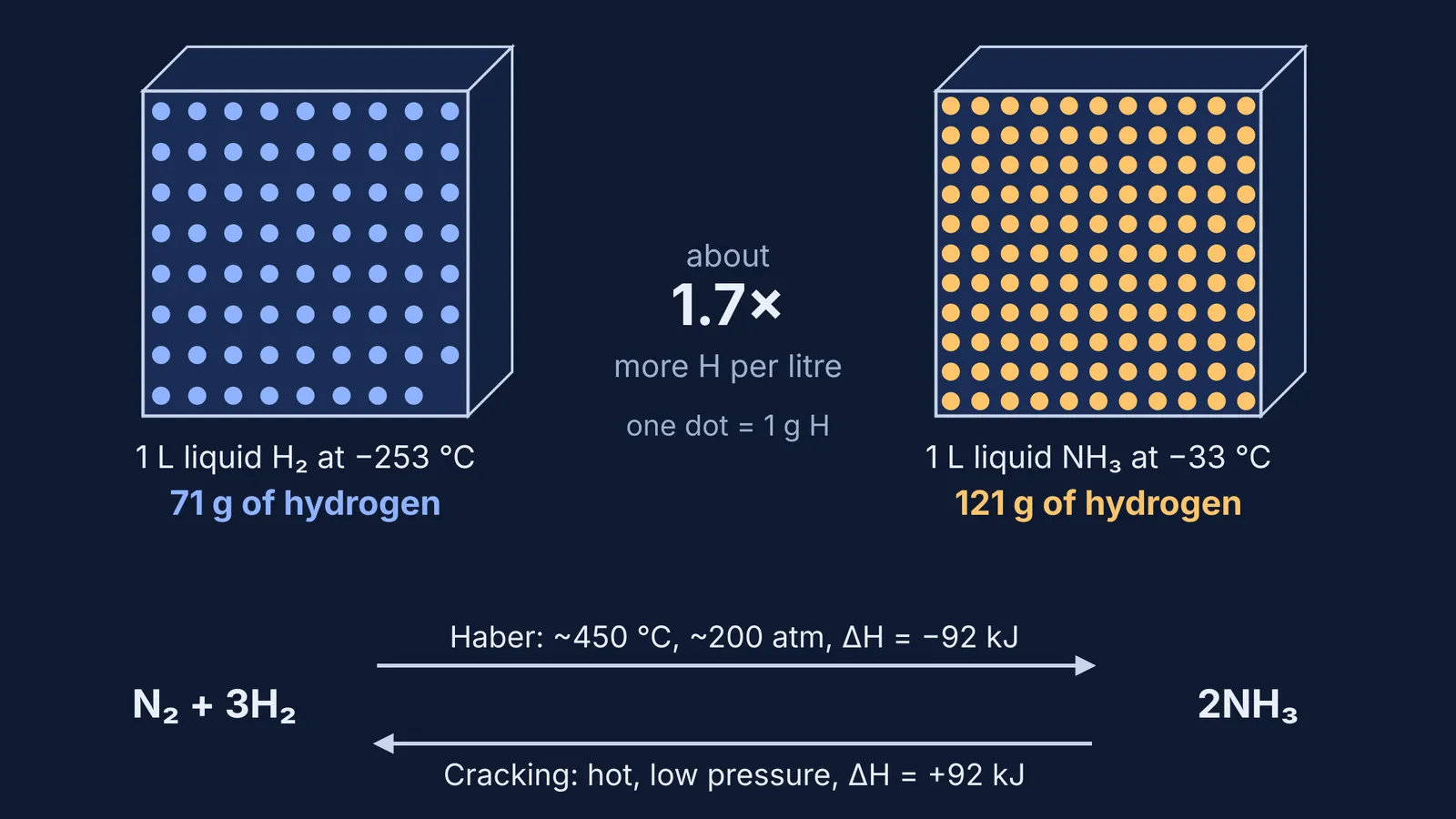
Yes, per litre, which surprises most people. Liquid hydrogen is extremely light: about 0.0708 g/mL at −253 °C, because the weak forces leave the molecules loosely packed. In liquid ammonia, each nitrogen atom pulls three hydrogen atoms in close, and hydrogen bonds pack the molecules tightly, giving about 0.682 g/mL at −33 °C. Densities are from the NIST fluid property tables and are approximate.
The density of liquid ammonia changes with temperature, so always say which one you mean. At 20 °C under its own vapour pressure it is about 0.61 g/mL.
Worked example: how much hydrogen does ammonia carry, and what does it cost to get it back?
Use H = 1.008 and N = 14.007, so the molar mass of NH₃ is 17.031 g/mol.
Part (a): mass percentage of hydrogen.
Mass of H in one mole of NH₃ = 3 × 1.008 = 3.024 g.
Mass percentage = 3.024 ÷ 17.031 × 100 = 17.8%.
To carry 1 kg of hydrogen you need 1 ÷ 0.178 = about 5.63 kg of ammonia.
Part (b): hydrogen per litre.
One litre of liquid NH₃ at −33 °C has a mass of about 682 g.
Hydrogen in it = 682 × 0.178 = about 121 g.
One litre of liquid H₂ at −253 °C holds about 71 g, all of it hydrogen.
Ratio = 121 ÷ 71 = about 1.7. Ammonia carries about 1.7 times more hydrogen per litre.
Even pressurised ammonia at 20 °C (0.61 g/mL) holds about 108 g of hydrogen per litre, still about 1.5 times more than liquid hydrogen.
Part (c): the energy needed to crack it.
Cracking is the Haber reaction run backwards: 2NH₃ → N₂ + 3H₂.
By Hess's law, ΔH = −2 × ΔfH(NH₃) = −2 × (−45.9) = +92 kJ per 2 mol NH₃, which releases 3 mol H₂.
Per mole of H₂: 92 ÷ 3 = about 30.7 kJ.
Compare with the lower heating value of hydrogen, the heat released when H₂ burns to water vapour, 241.8 kJ/mol: 30.7 ÷ 241.8 = about 12.7%.
Per kilogram of hydrogen delivered (about 496 mol): 496 × 30.7 kJ = about 15 MJ, or 4.2 kWh of heat, before any losses in the real equipment.
So about an eighth of the hydrogen's energy has to be put back in as heat. If you use the higher heating value (285.8 kJ/mol, liquid water) instead, the figure is about 10.7%. Use one or the other consistently.
What conditions does an ammonia cracker need?
Look at the reaction with Le Chatelier's principle. Cracking is endothermic, so high temperature pushes it forward. It turns 2 mol of gas into 4 mol (Δn = +2), so low pressure helps too. That is the exact opposite of what the synthesis wants, as explained in why the Haber process uses 450 °C and 200 atm.
At 1 bar the equilibrium lies far to the cracking side. A rough calculation with standard 298 K data (treating ΔH and ΔS as constant) gives about 94% of the ammonia cracked at 300 °C and about 98% at 400 °C. Equilibrium is not the problem; speed is. Breaking N–H bonds is slow without a catalyst. A 2023 review in Molecules reports ruthenium catalysts reaching near-complete conversion at about 475 to 500 °C and nickel catalysts at about 550 °C. This is the same rate-versus-equilibrium trade-off as in the Haber process, with every sign flipped.
If Le Chatelier or critical temperature feels shaky, the Fermi Concept Library gives each concept its own lesson and shows where it fits with the others.
Is green ammonia a clean fuel?
Only with caveats. Ammonia is toxic and corrosive, so leaks in storage and transport are a real safety concern. Ammonia can also be burned directly, without cracking, but burning a nitrogen compound can form NOx and nitrous oxide (N₂O), a strong greenhouse gas, unless the exhaust is controlled. And the ammonia is only as green as the hydrogen that went into it; how that hydrogen is made by electrolysis is covered in what green hydrogen is and how it is made.
For practice with Hess's law and mass-percentage problems like the worked example, the Fermi Problem Library has a step-by-step solver that explains the reasoning.
Quick checklist
Critical temperature decides liquefaction: NH₃ about 132 °C, H₂ about −240 °C.
Hydrogen bonding is why NH₃ boils at −33 °C while H₂ boils at −253 °C.
NH₃ is 17.8% hydrogen by mass; 5.63 kg of NH₃ carries 1 kg of H₂.
A litre of liquid NH₃ at −33 °C carries about 121 g of H; liquid H₂ about 71 g.
Cracking: 2NH₃ → N₂ + 3H₂, ΔH = +92 kJ, favoured by high T and low P.
Cracking heat is about 12.7% of hydrogen's LHV; state LHV or HHV.
Ammonia is toxic, and burning it can make NOx and N₂O.


