

On this page
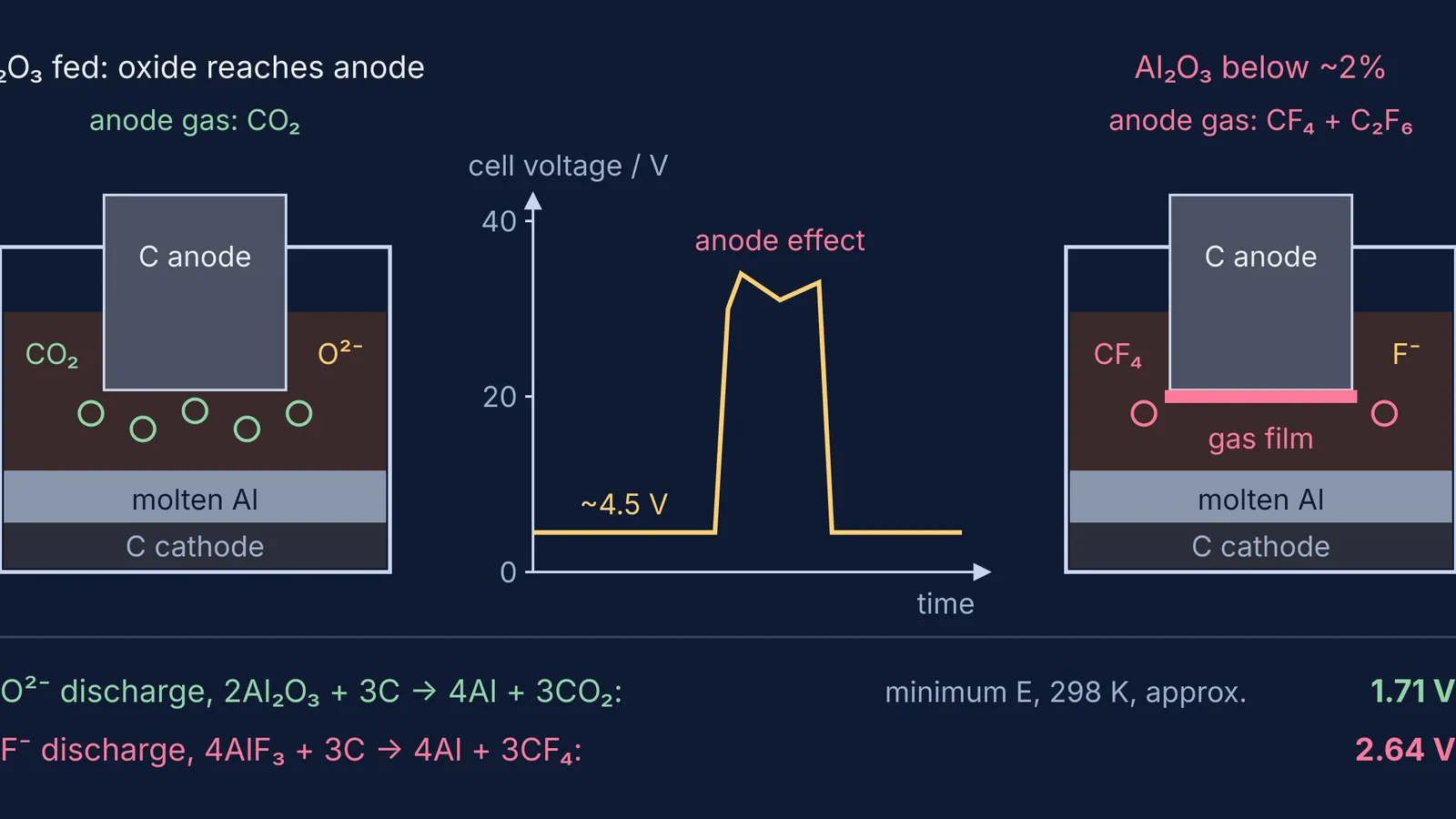
An aluminium smelter is supposed to give off one gas at its anode: carbon dioxide. Most of the time it does. But every so often a cell's voltage shoots from about 4.5 V to tens of volts, and for a minute or two the anode makes something else: carbon tetrafluoride, CF₄, with a little hexafluoroethane, C₂F₆. Smelter engineers call this the anode effect. It is a clean exam idea (which ion is discharged, and why) with a large climate cost attached.
What happens at the anode of a Hall–Héroult cell?
The cell holds alumina, Al₂O₃, dissolved in molten cryolite, Na₃AlF₆, at around 950 °C. Aluminium ions are reduced at the cathode and collect as liquid metal. At the carbon anode, oxide ions give up electrons and take carbon with them:
C + 2O²⁻ → CO₂ + 4e⁻
Overall, 2Al₂O₃ + 3C → 4Al + 3CO₂. We worked out the energy side of this reaction, including the 1.71 V minimum and the 0.334 kg of anode carbon burned per kilogram of metal, in how many kWh it takes to make 1 kg of aluminium.
Now notice what else is in the bath. Cryolite is a fluoride. So the anode is always surrounded by two kinds of anion, O²⁻ from the dissolved alumina and F⁻ from the solvent. Which one gets discharged is the same question you answer for brine, where Cl⁻ and water compete (see why chlorine, not oxygen, forms at the anode in brine). Here the answer depends on how much alumina is left.
Why is oxide discharged instead of fluoride?
Because it needs less voltage. Compare the two overall reactions with a carbon anode, using AlF₃ to stand for the fluoride in the bath:
Oxide route: 2Al₂O₃ + 3C → 4Al + 3CO₂
Fluoride route: 4AlF₃ + 3C → 4Al + 3CF₄
Both make 4 Al, so both move 12 electrons. Check the second one: 4 Al, 12 F and 3 C on each side. The anode half-reaction is C + 4F⁻ → CF₄ + 4e⁻, and three of those give 12 electrons.
The minimum voltage for each comes from E = ΔG°/nF, worked out below. As long as oxide ions are there, the anode discharges them, because that happens first as the potential rises.
Worked example: how much worse is the fluoride route?
Use 298 K data (NIST-JANAF values, rounded): ΔfG°(CO₂) = −394.4 kJ/mol, ΔfG°(Al₂O₃) = −1582.3 kJ/mol, ΔfG°(AlF₃) ≈ −1431 kJ/mol, ΔfG°(CF₄) ≈ −888 kJ/mol.
Part (a): the two minimum voltages.
Oxide route: ΔG° = 3(−394.4) − 2(−1582.3) = +1981 kJ.
E = 1 981 000 ÷ (12 × 96 485) = 1.71 V.
Fluoride route: ΔG° = 3(−888) − 4(−1431) = −2664 + 5724 = +3060 kJ.
E = 3 060 000 ÷ (12 × 96 485) = 2.64 V.
Gap: 2.64 − 1.71 ≈ 0.9 V in favour of oxide.
These are teaching estimates: the real cell runs near 950 °C with cryolite, not pure AlF₃, so the true gap differs. The conclusion holds: fluoride is discharged only when oxide cannot keep up.
Part (b): the normal CO₂ from the anode.
Carbon burned: at least 0.334 kg per kg of Al.
CO₂ per kg of C: 44.01 ÷ 12.01 = 3.66.
0.334 × 3.66 = 1.22 t CO₂ per tonne of aluminium (a theoretical floor).
Part (c): what anode effects add. Regulators estimate CF₄ with a "slope" factor. For centre-worked prebake cells, the default in the IPCC 2006 Guidelines and in the US EPA reporting rule, 40 CFR 98 Subpart F is 0.143 kg CF₄ per tonne of aluminium for every anode-effect minute per cell-day, with C₂F₆ at 0.121 times the CF₄ mass. Use the IPCC AR5 100-year global warming potentials: CF₄ 6,630 and C₂F₆ 11,100.
Well-run cell, 0.1 anode-effect minutes per cell-day: CF₄ = 0.143 × 0.1 = 0.0143 kg per t Al.
CO₂ equivalent: 0.0143 × 6,630 ≈ 95 kg. C₂F₆ adds 0.0017 kg × 11,100 ≈ 19 kg. Total about 0.11 t CO₂e per t Al, small beside 1.22 t.
Badly run cell, 2 minutes per cell-day: CF₄ = 0.286 kg, which is 0.286 × 6,630 ≈ 1.9 t CO₂e.
C₂F₆ adds 0.035 kg × 11,100 ≈ 0.38 t, so the total is about 2.3 t CO₂e per t Al.
At 2 minutes a day, a fraction of a kilogram of fluorocarbon outweighs all the CO₂ from burning the anode. With the newer AR6 values (CF₄ about 7,380, C₂F₆ about 12,400) the totals come out roughly 11% higher. Always say which set you used.
Why does the voltage jump during an anode effect?
When dissolved alumina falls below roughly 2%, oxide ions cannot diffuse to the anode as fast as the current demands. The anode potential rises until fluoride starts to be discharged. Once the carbon surface is fluorinated, the molten salt no longer wets it well, so the gas spreads into a film that blocks most of the anode instead of leaving as separate bubbles, so the current has to cross a layer of gas instead of molten salt. The resistance soars and the cell voltage jumps to tens of volts.
The cure is to put the missing reactant back. The control system adds alumina and disturbs the gas film, for example by moving the anode, and the cell returns to making CO₂.
Why are CF₄ and C₂F₆ such strong greenhouse gases?
Two reasons. C–F bonds absorb infrared light strongly at wavelengths where CO₂ and water vapour absorb little, so each molecule traps a lot of heat. And almost nothing in the air can break them. IPCC assessments give CF₄ an atmospheric lifetime of about 50,000 years and C₂F₆ about 10,000 years.
How do smelters keep anode effects down?
The chemistry tells you the fix: never let alumina run short. Modern cells use point feeders that drop small doses of alumina into the bath every minute or two, guided by the cell's resistance, instead of large doses at long intervals. Plants record anode-effect minutes per cell-day because that number feeds their emission estimates. Side-worked prebake and Søderberg cells have their own, different slope factors.
There is one more catch. The IPCC's 2019 Refinement recognises that some CF₄ forms even without a classic voltage spike, at ordinary cell voltages, so a cell that never shows an anode effect is not automatically PFC-free.
India's primary aluminium comes from smelters run by NALCO, Hindalco and Vedanta; any plant's anode-effect rate should come from its own disclosures.
If the voltage and ΔG steps still feel shaky, the Fermi Problem Library has electrochemistry problems with a step-by-step solver that explains the reasoning at each stage. For why carbon cannot simply reduce alumina in the first place, read why aluminium is extracted by electrolysis.
Quick checklist
The anode sees both O²⁻ (from alumina) and F⁻ (from cryolite).
Minimum E (298 K): 1.71 V for oxide, about 2.64 V for fluoride.
Anode effect: alumina below roughly 2%, gas film, voltage from about 4.5 V to tens of volts, CF₄ and C₂F₆ given off.
Anode CO₂: at least 1.22 t per t Al.
Slope method: 0.143 kg CF₄ per t Al per anode-effect minute per cell-day (IPCC and EPA default, centre-worked prebake). Multiply by the GWP and name the set (AR5: 6,630 for CF₄).
Fix: feed alumina little and often.


